
Naked as Trans (2023) '45
9th Festival of Naked Forms (FNAF)
Philemon Mukarno is a renowned performance artist who explores the themes of identity, culture, and spirituality. He was invited to participate in the 9th Festival of Naked Forms (FNAF) in Prague, a monothematic and naked-genre festival that focuses on how human nakedness and nudity are perceived. The festival took place on the 1st of September – 3rd of September 2023 at cultural boat Altenburg 1964, a former cargo ship that is now a cultural club. The festival consisted of two days of art performances, lectures, workshops, and spatial events.
Participants:
Philemon Mukarno, Fausto Grossi Terenzio, Jolanda Jansen, Kača Olivová ,Alois Stratil, Pascale Ciapp, Olha Skliarska, Darina Alster, Alexandra Holownia, Remi Voché, Ewa Rybska, Wladyslaw Kazmierczak, Anastasiia Prozora, Julia Kurek, Emilie Franceschin, Barbara Le Beguec, Dariusz Fodczuk, Eliza Mamardashvili, Saadat Aitalieva, Vlodko Kaufman, Martin Zet, Tina Hrevušová and Natalia Sara Skorupa.

The concept
The concept of the festival was Nudity as trans, which aimed to support all beings who have gone through any transition. The curator of the festival, Lenka Klodová, explained that the moment of transition is a moment of pure nudity in the sense of the requirement of absolute honesty with oneself. Nudity is also a transition since the biblical interpretation, where the recognition of one’s own nakedness is the moment of departure from the heavenly state to the human destiny. Nudity as a reference to an extraordinary personal relationship with God is also part of the religious trance, whether in the Eastern tradition of the Jurodivis or the Czech tradition of the Hussite Adamites. Trance also means a state where the state of consciousness changes, which is close to the definition of performance art.
The performance location
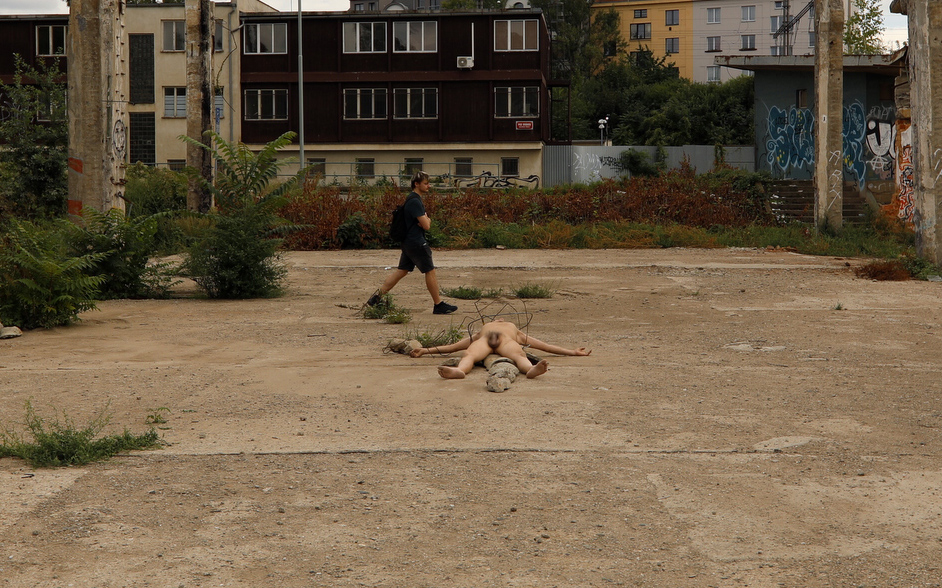
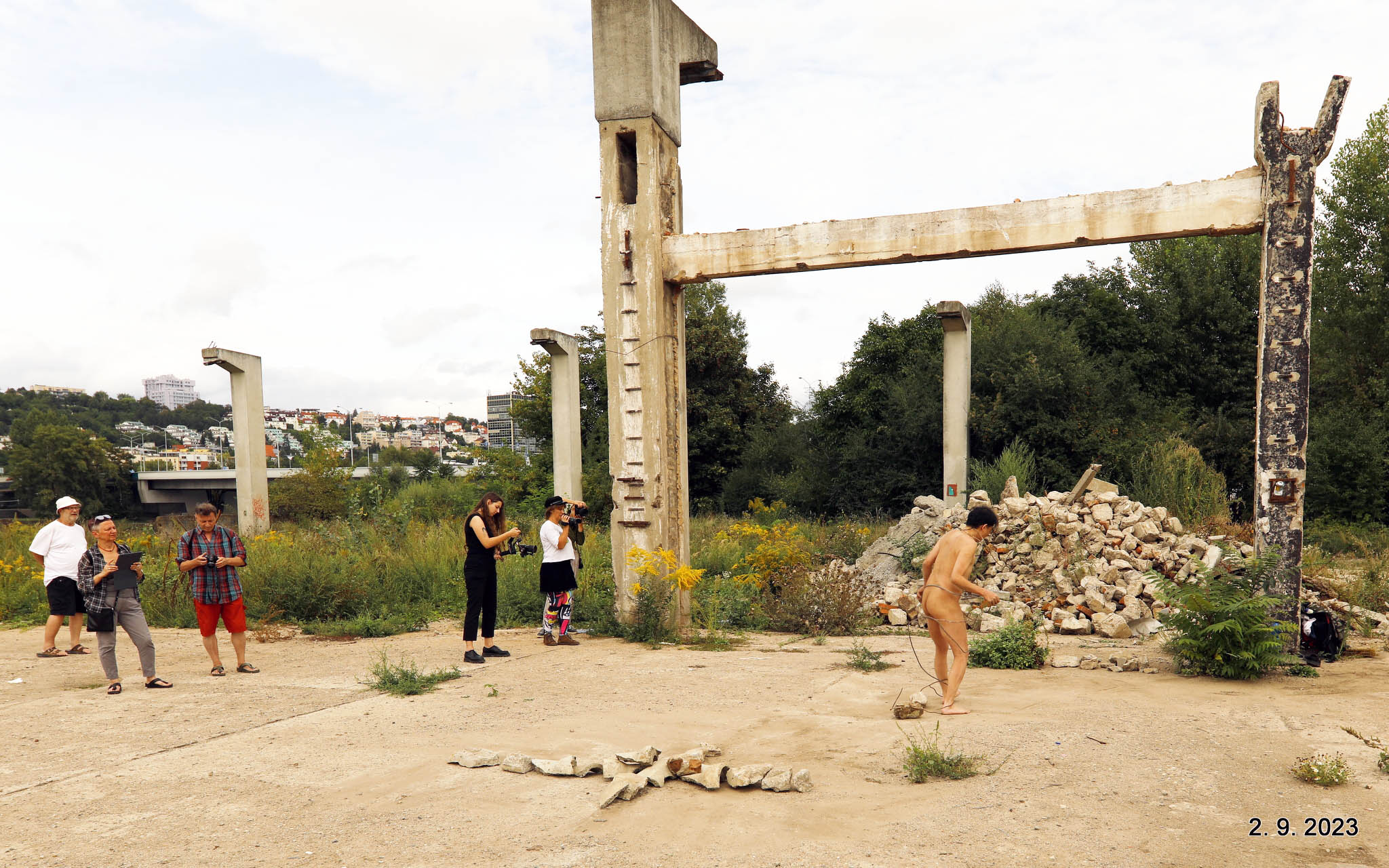
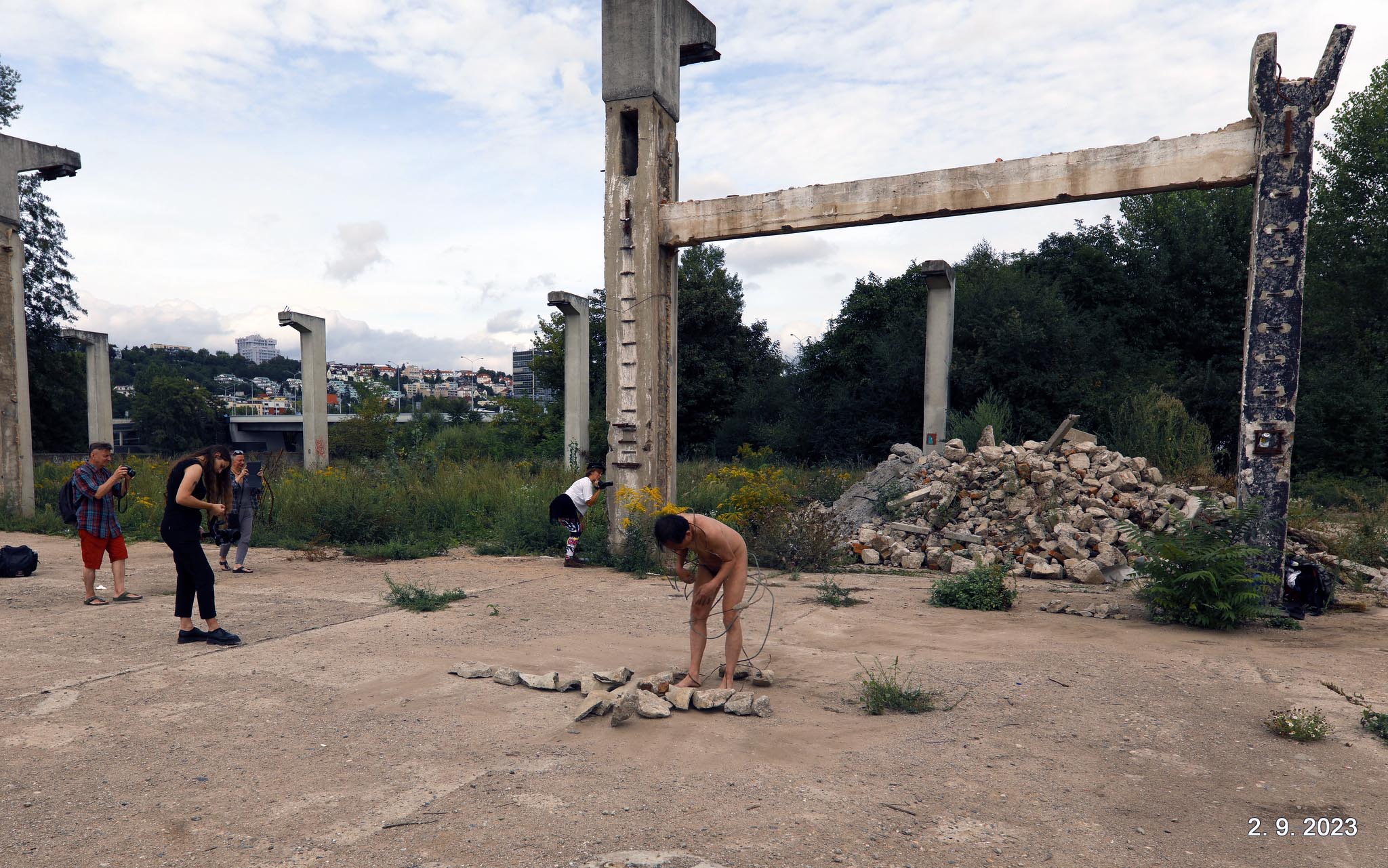
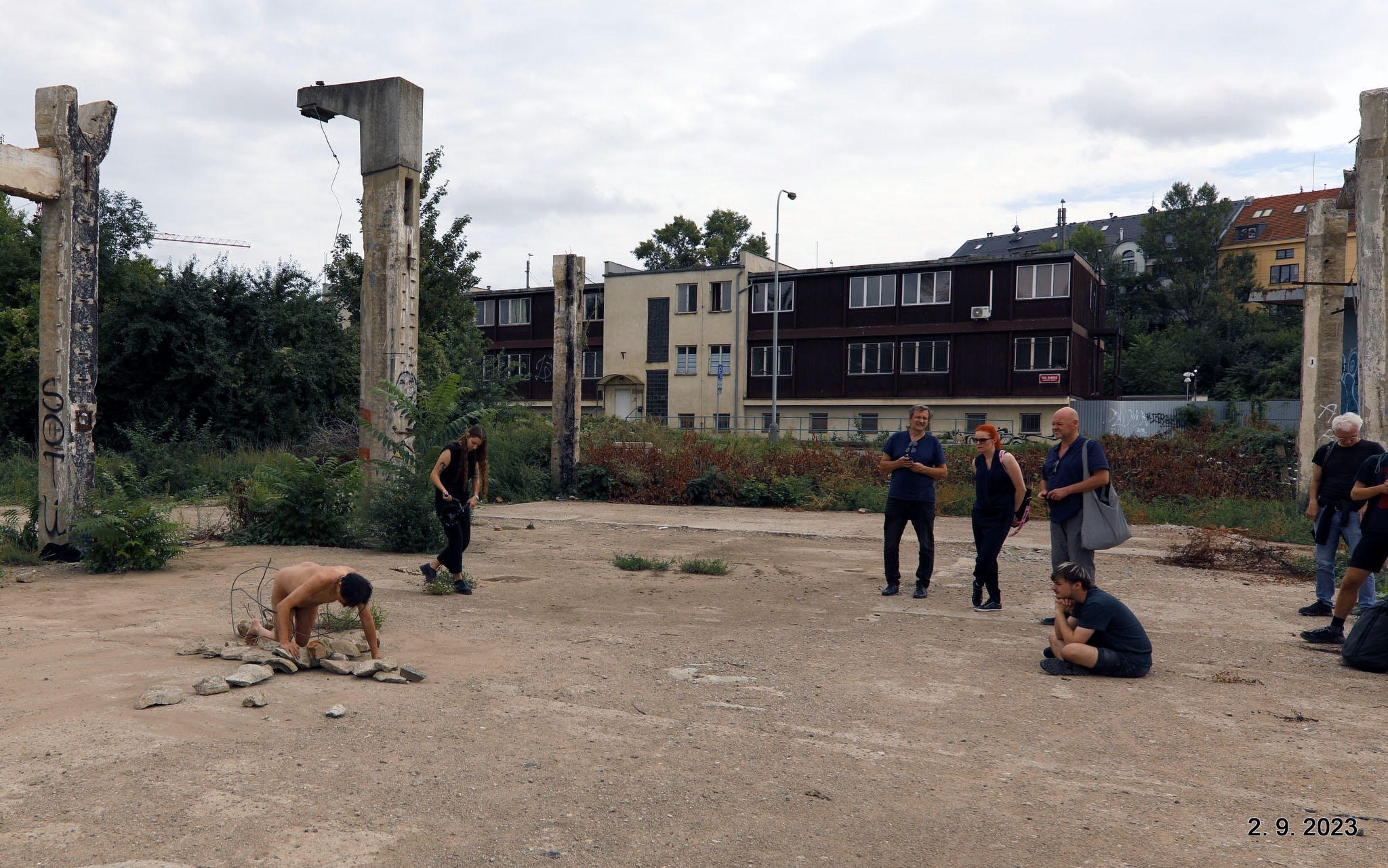
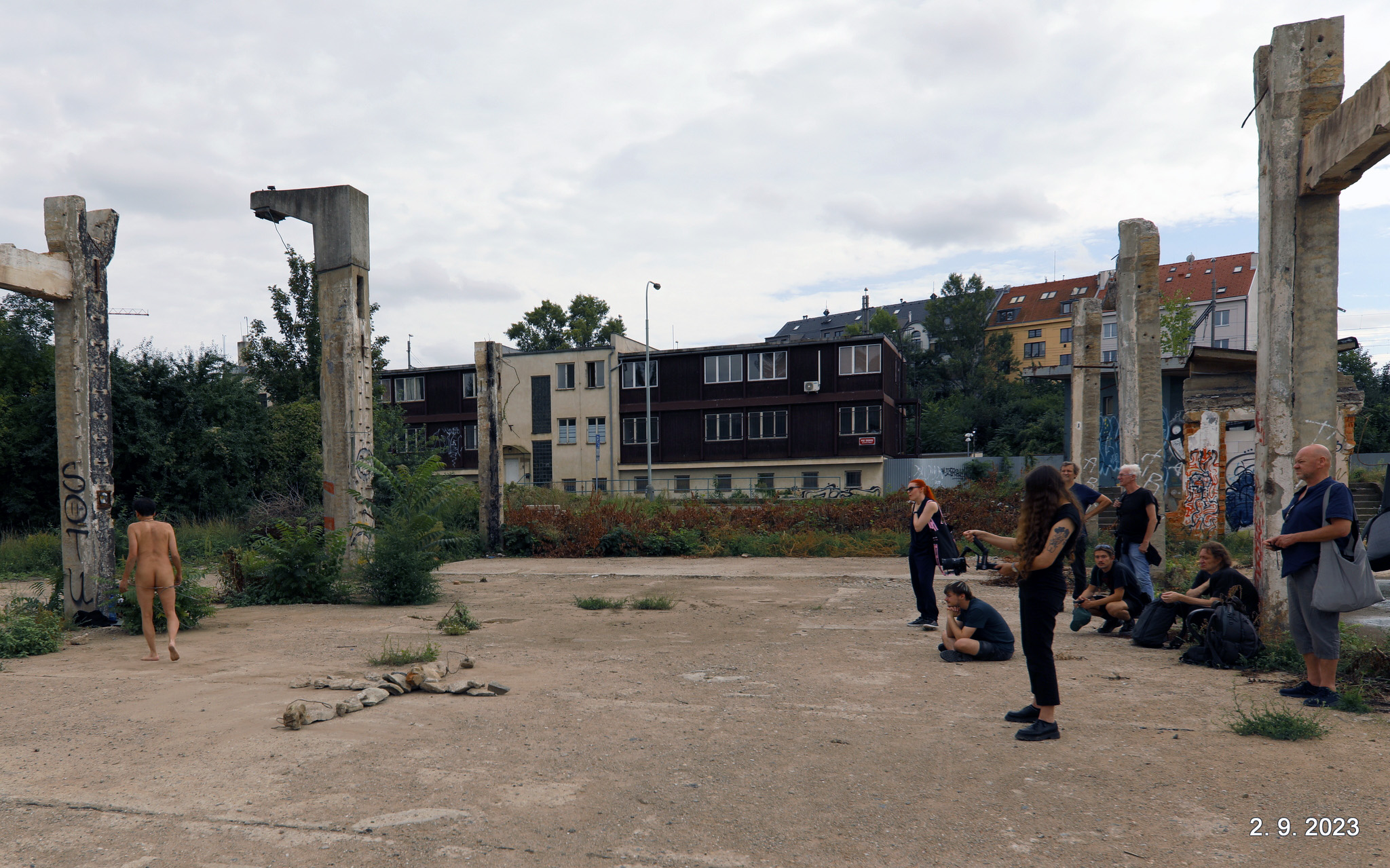
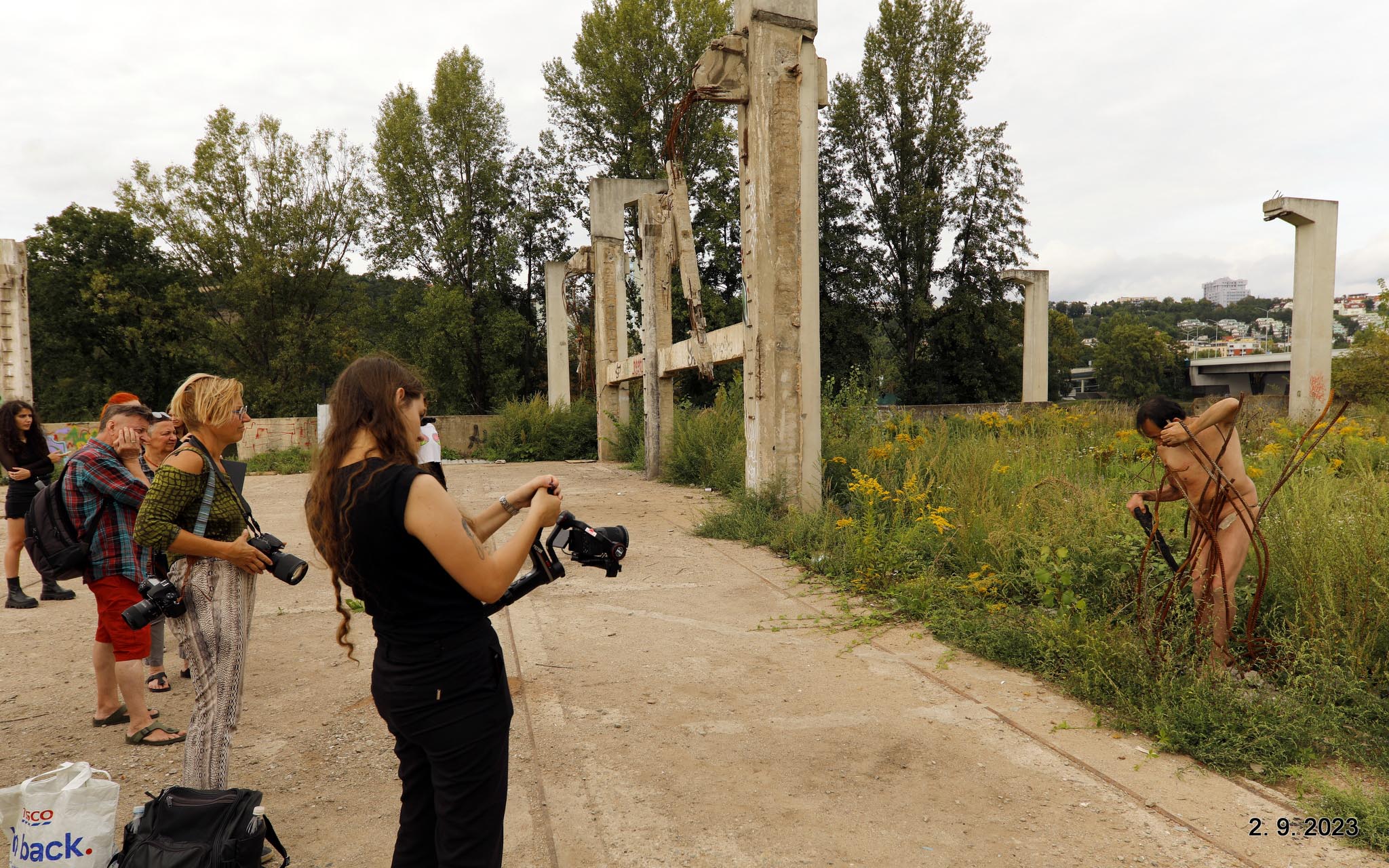
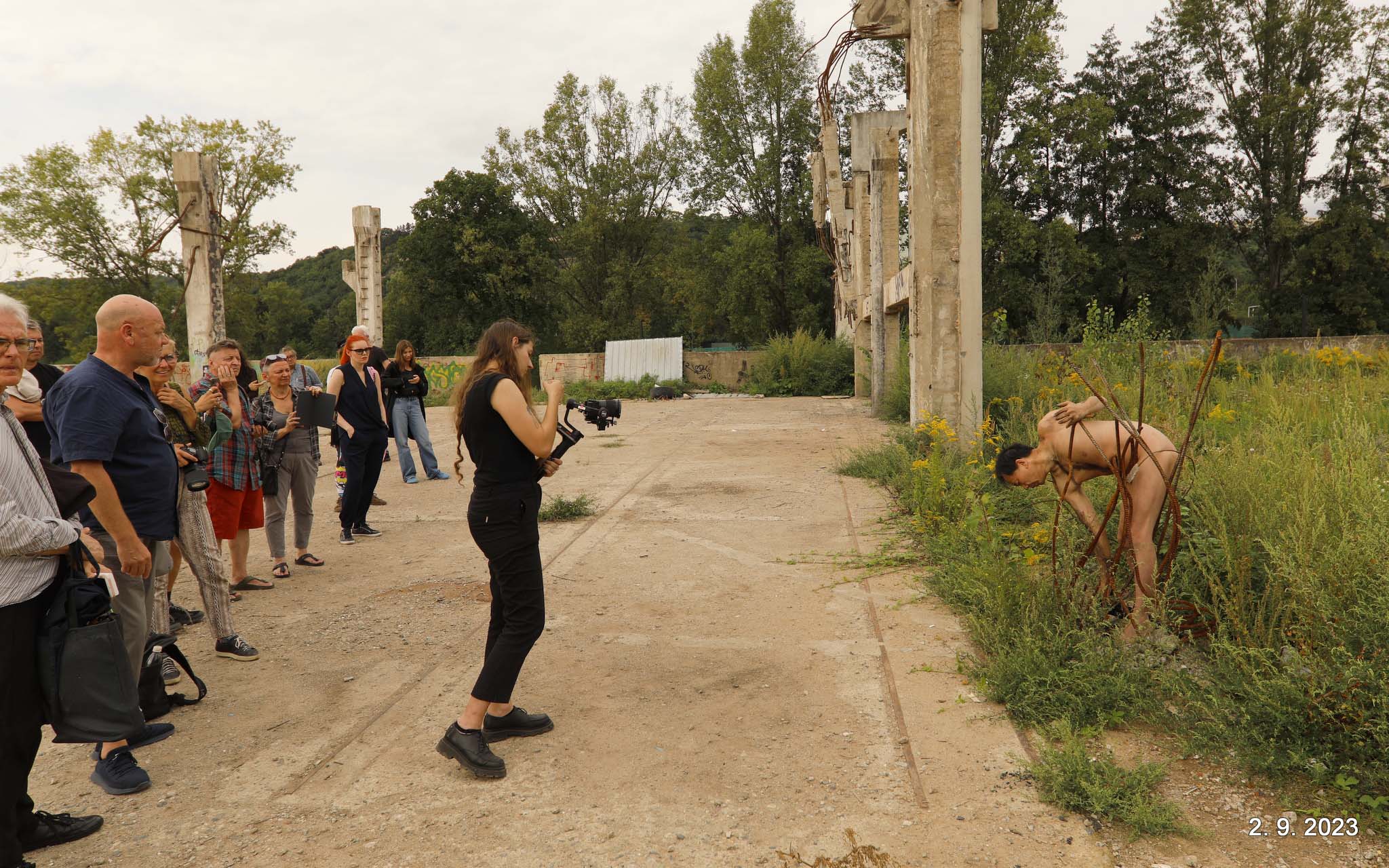
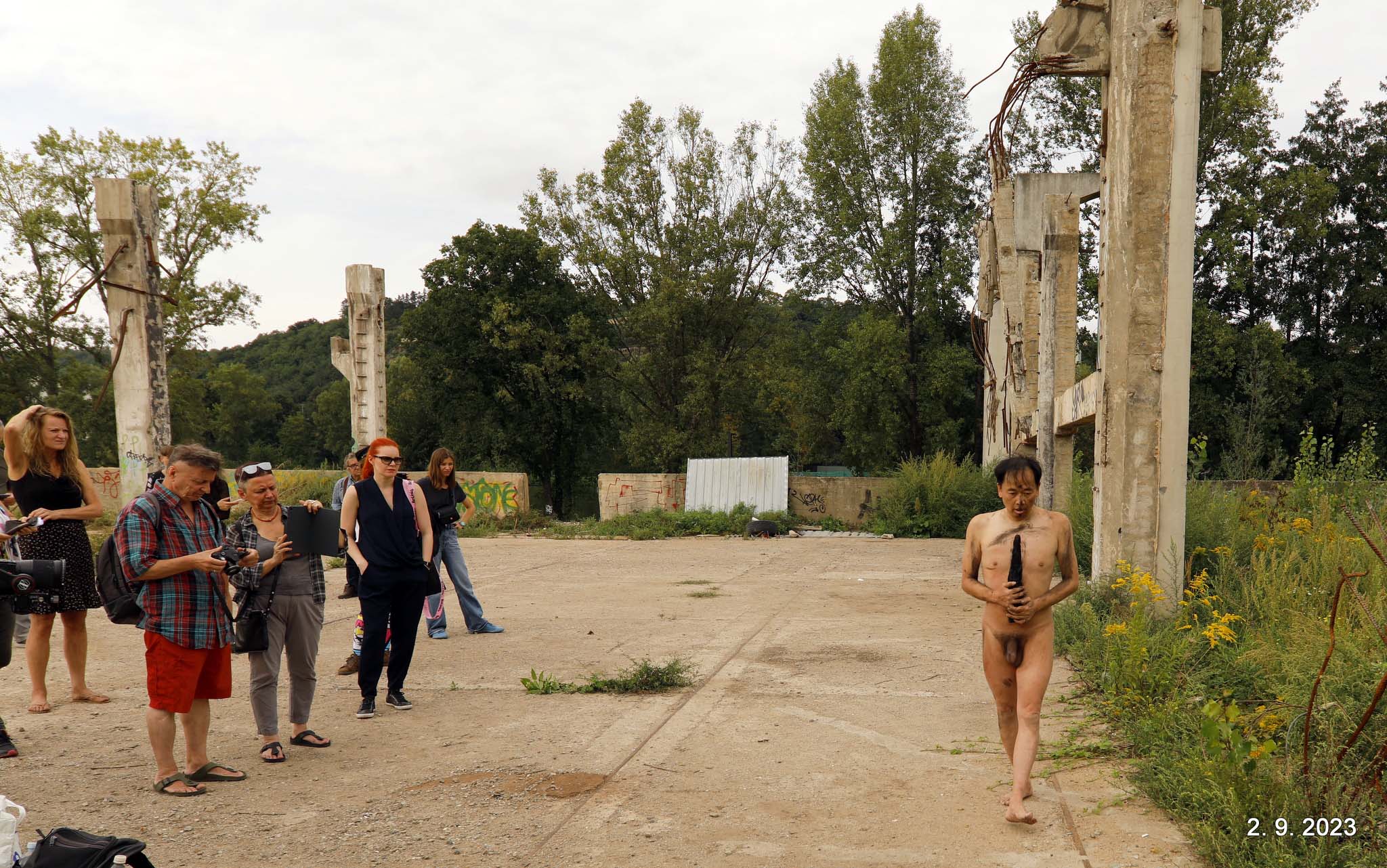
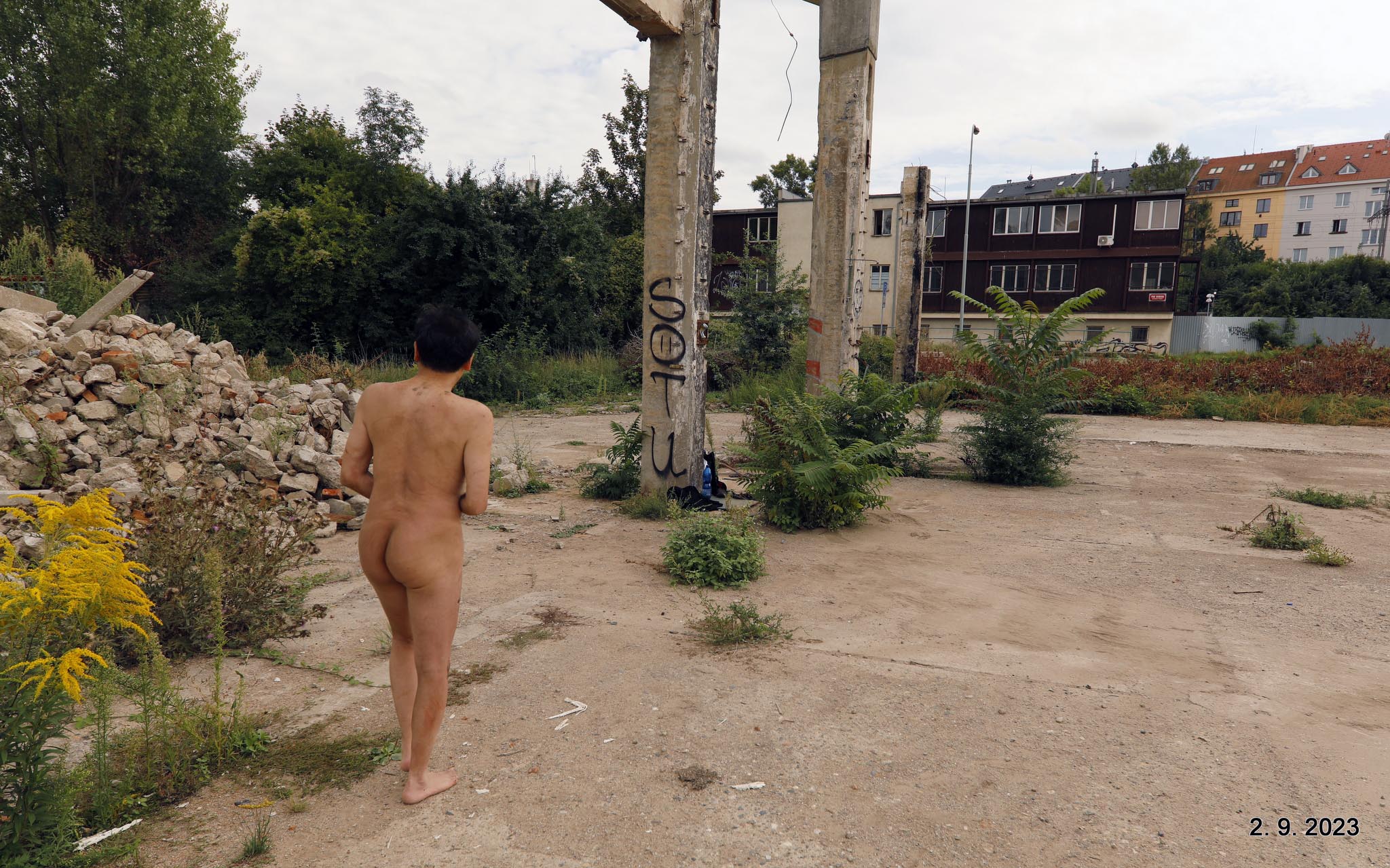
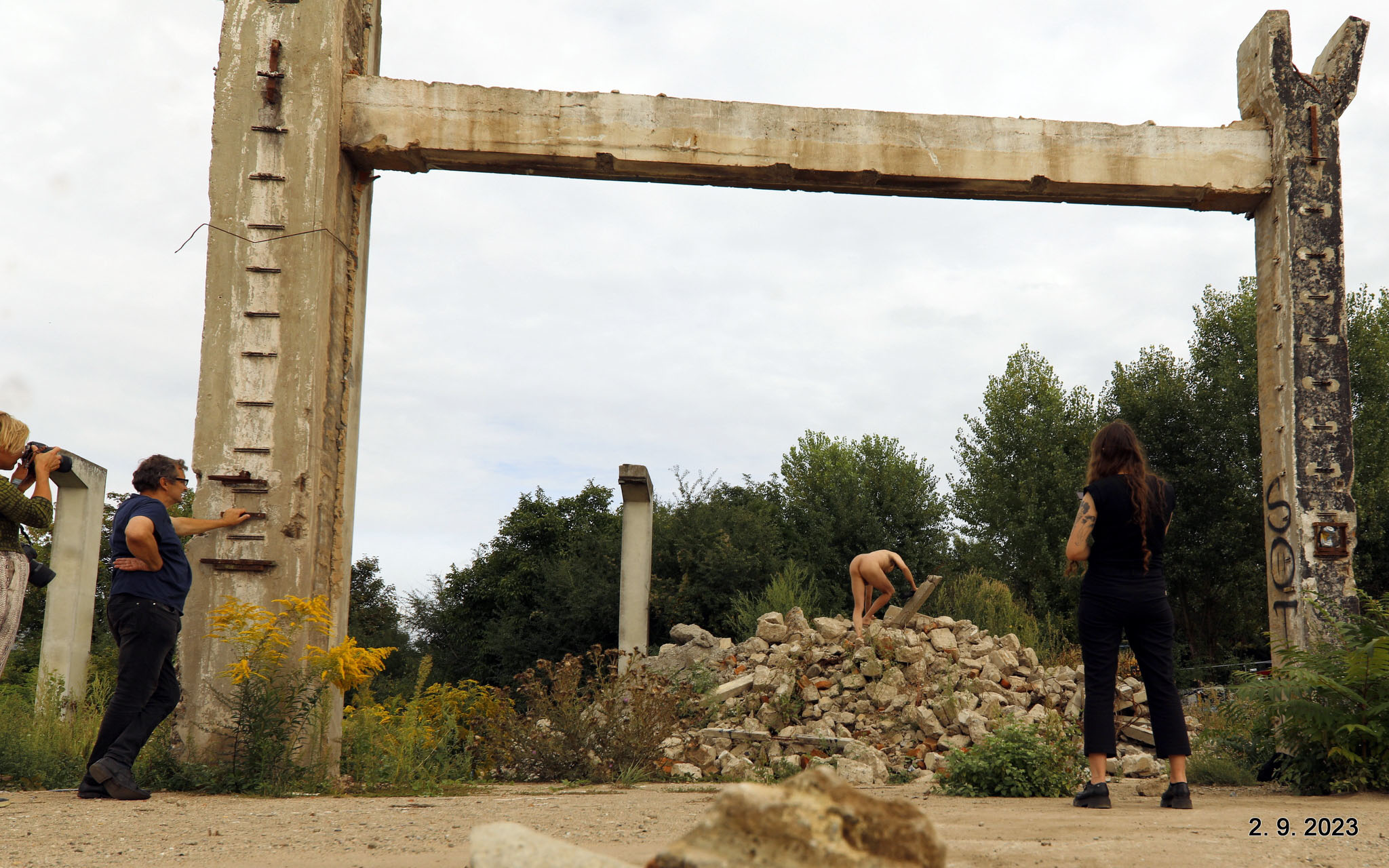
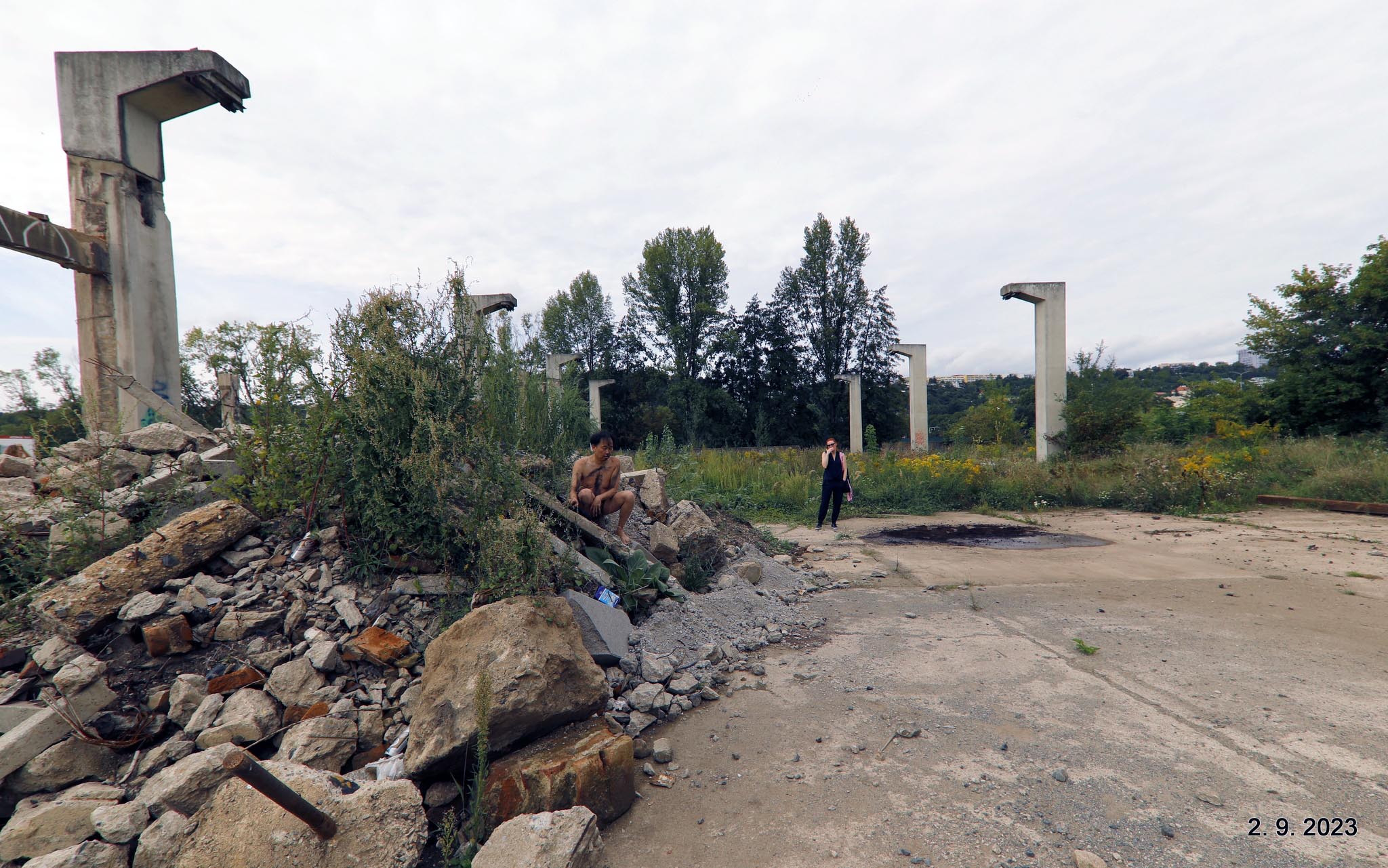
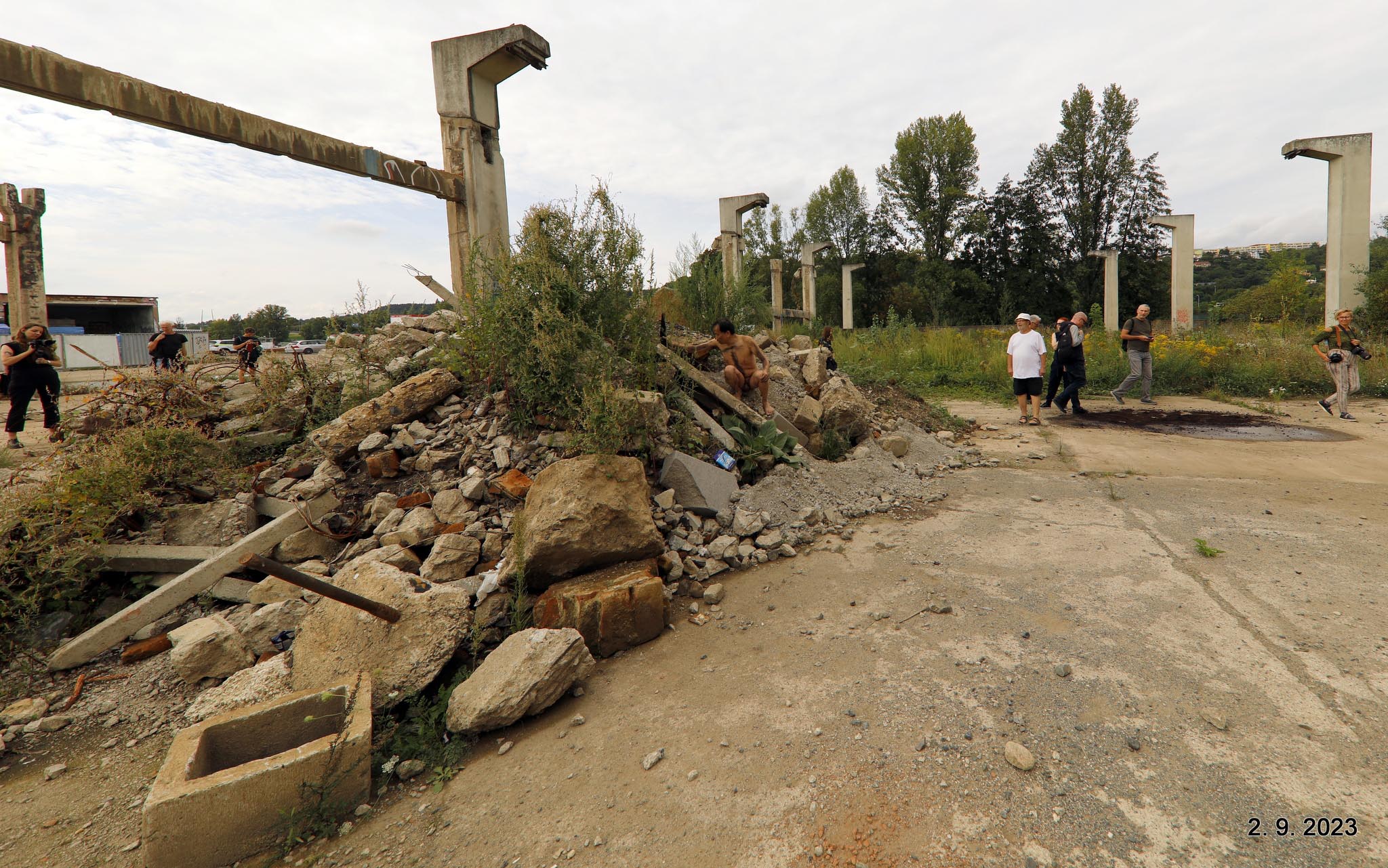
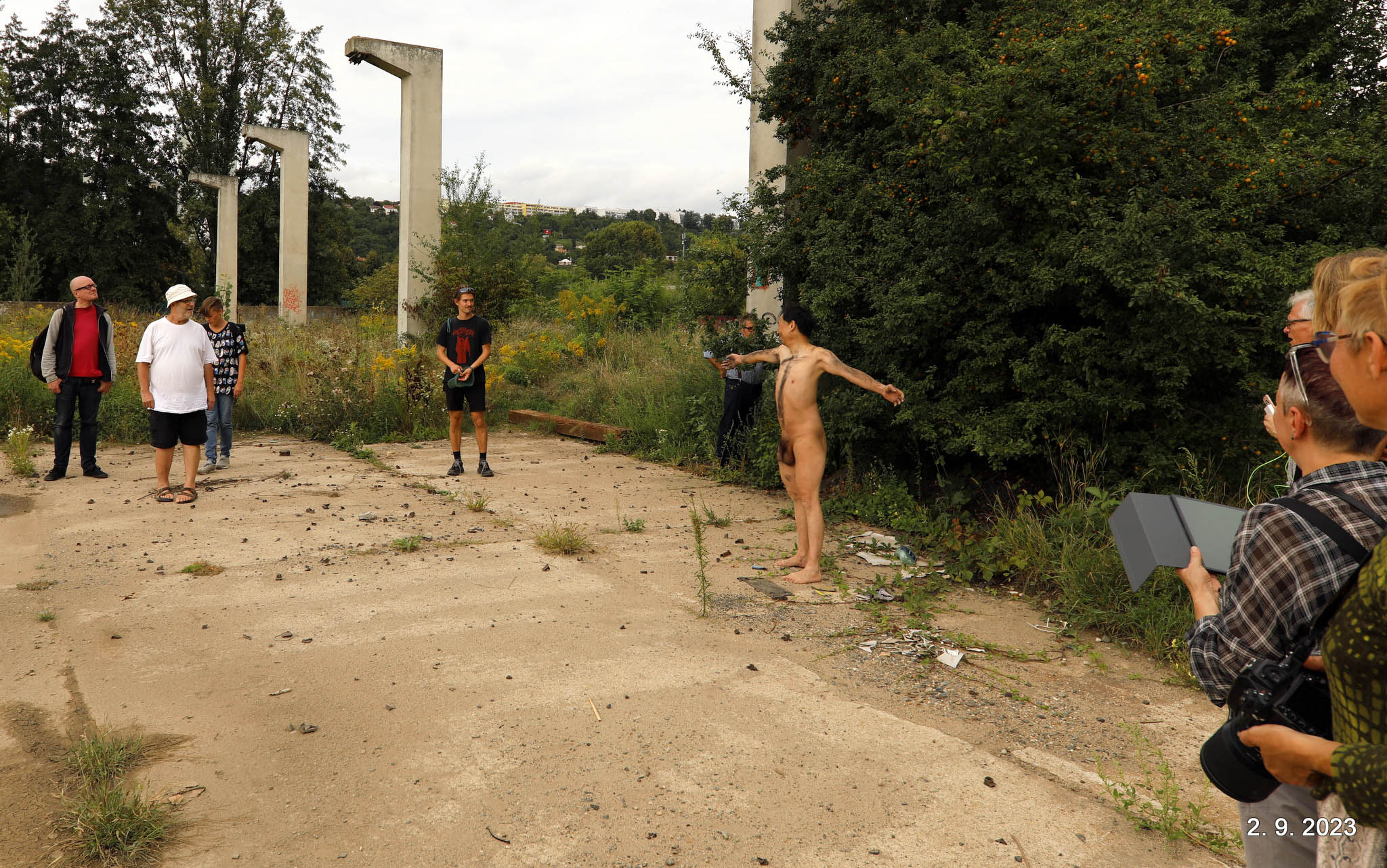
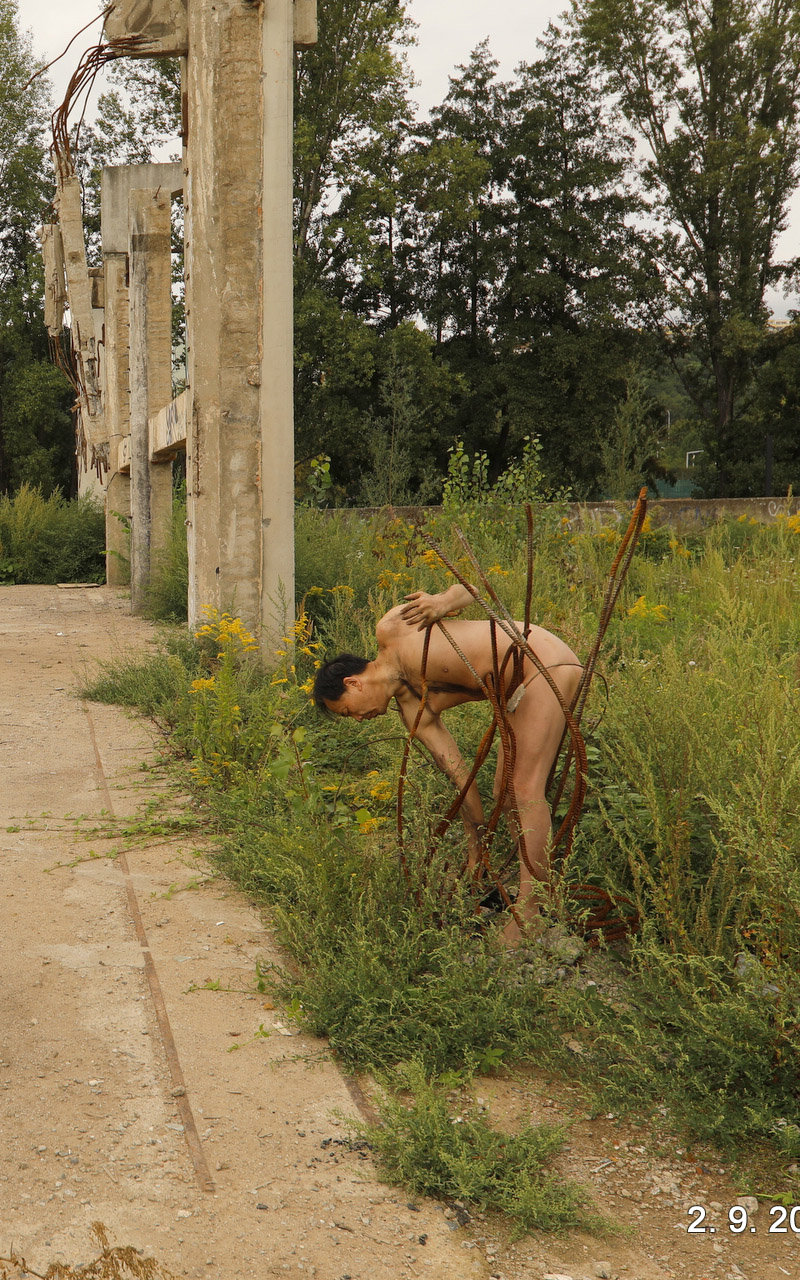
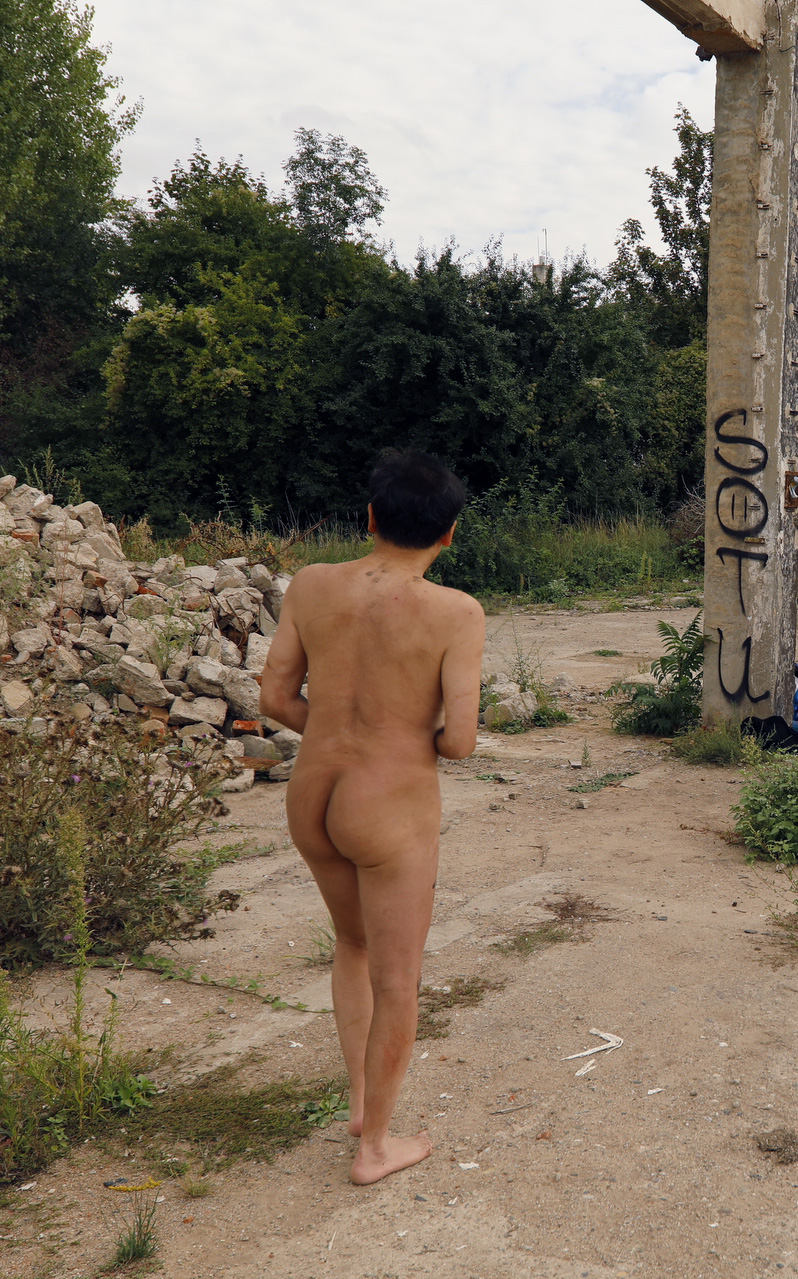
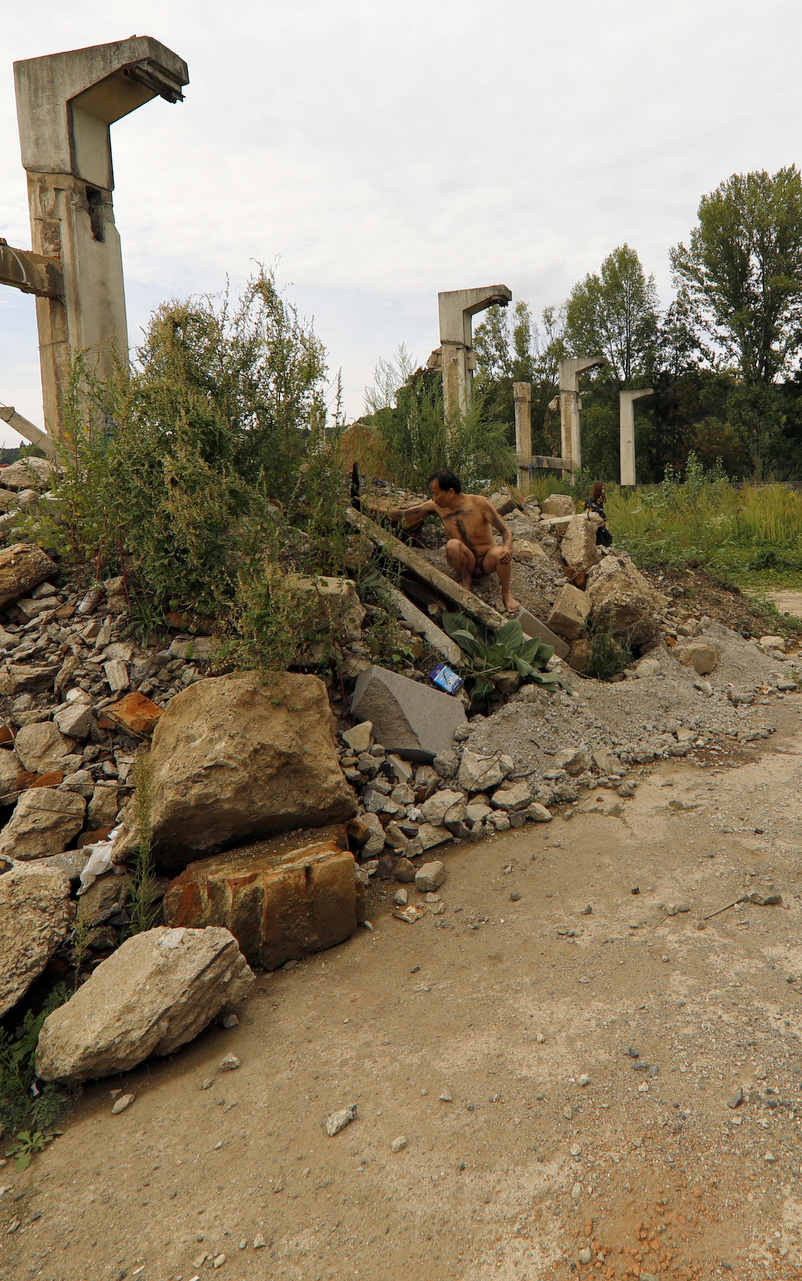
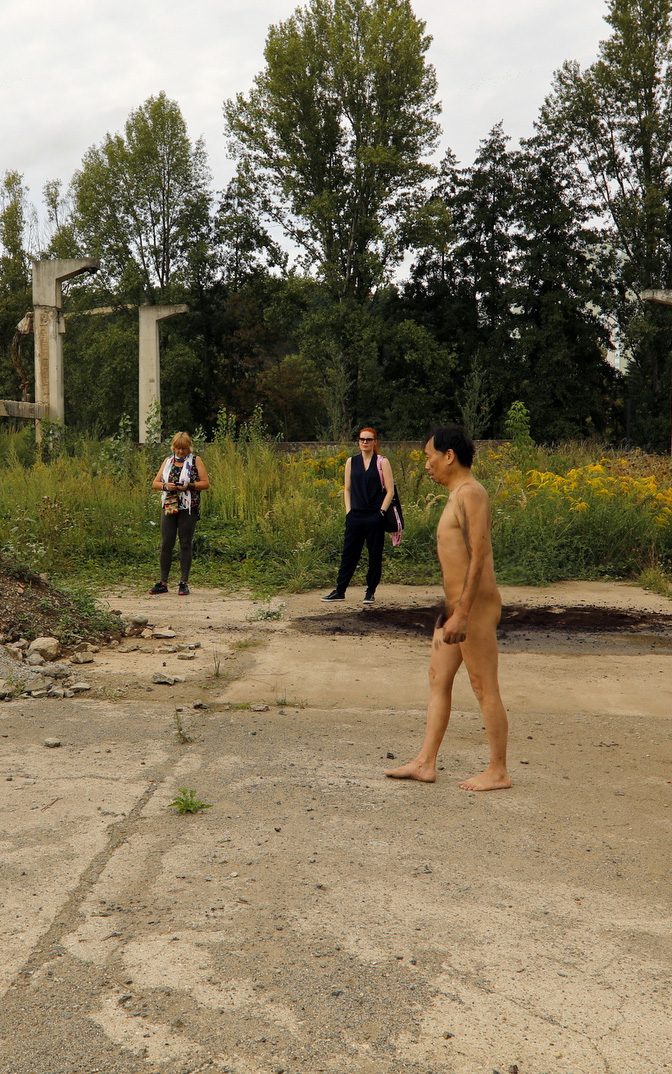
The performance location was on an abandoned industrial site near the boat Altenburg 1964. The site offered a contrast between nature and industry, as well as a variety of materials and objects that could be used for the performances. The site also provided a sense of isolation and intimacy, as well as a challenge for the performers and the audience.
The performance ‘Nudity as trans’
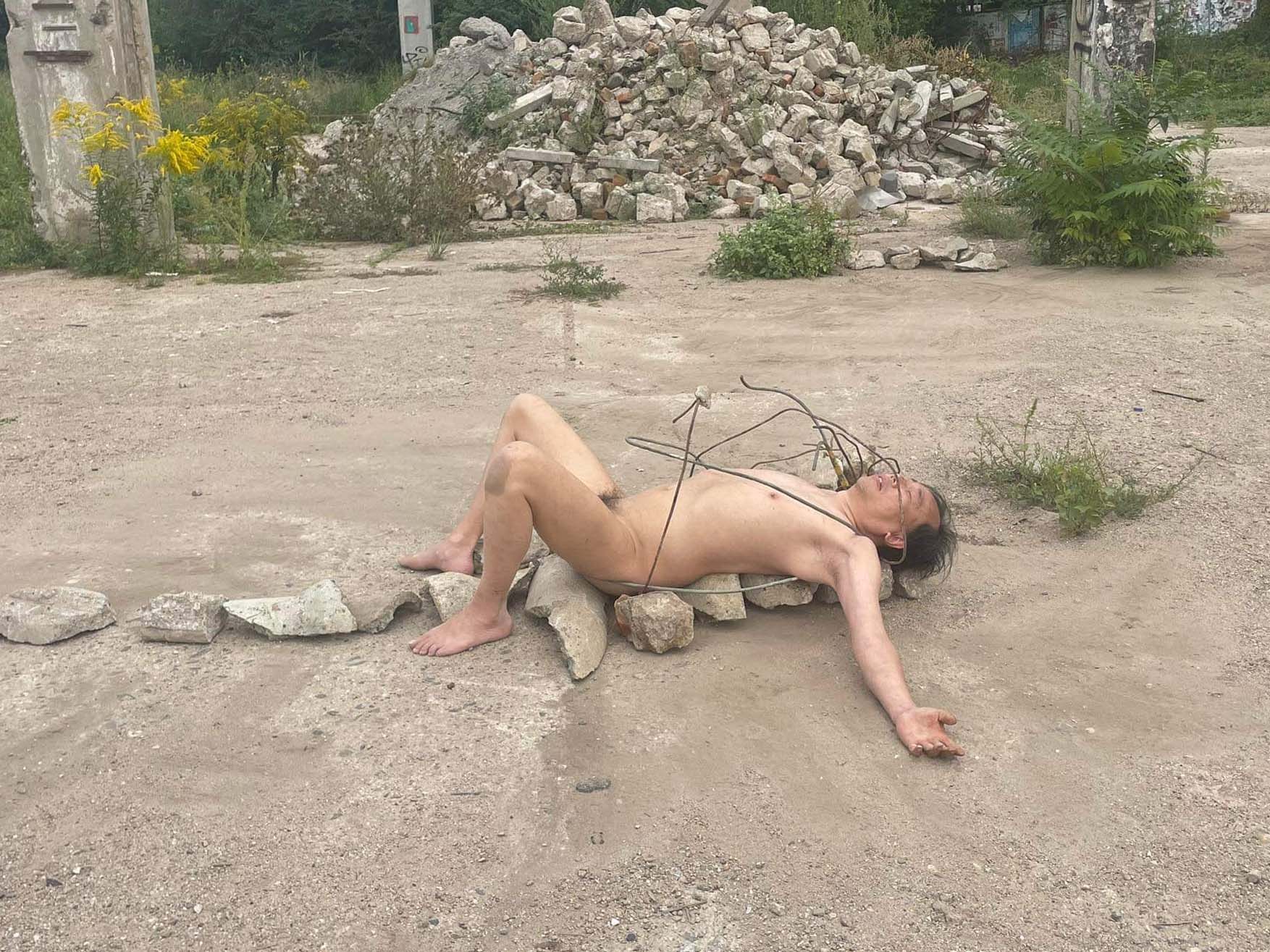
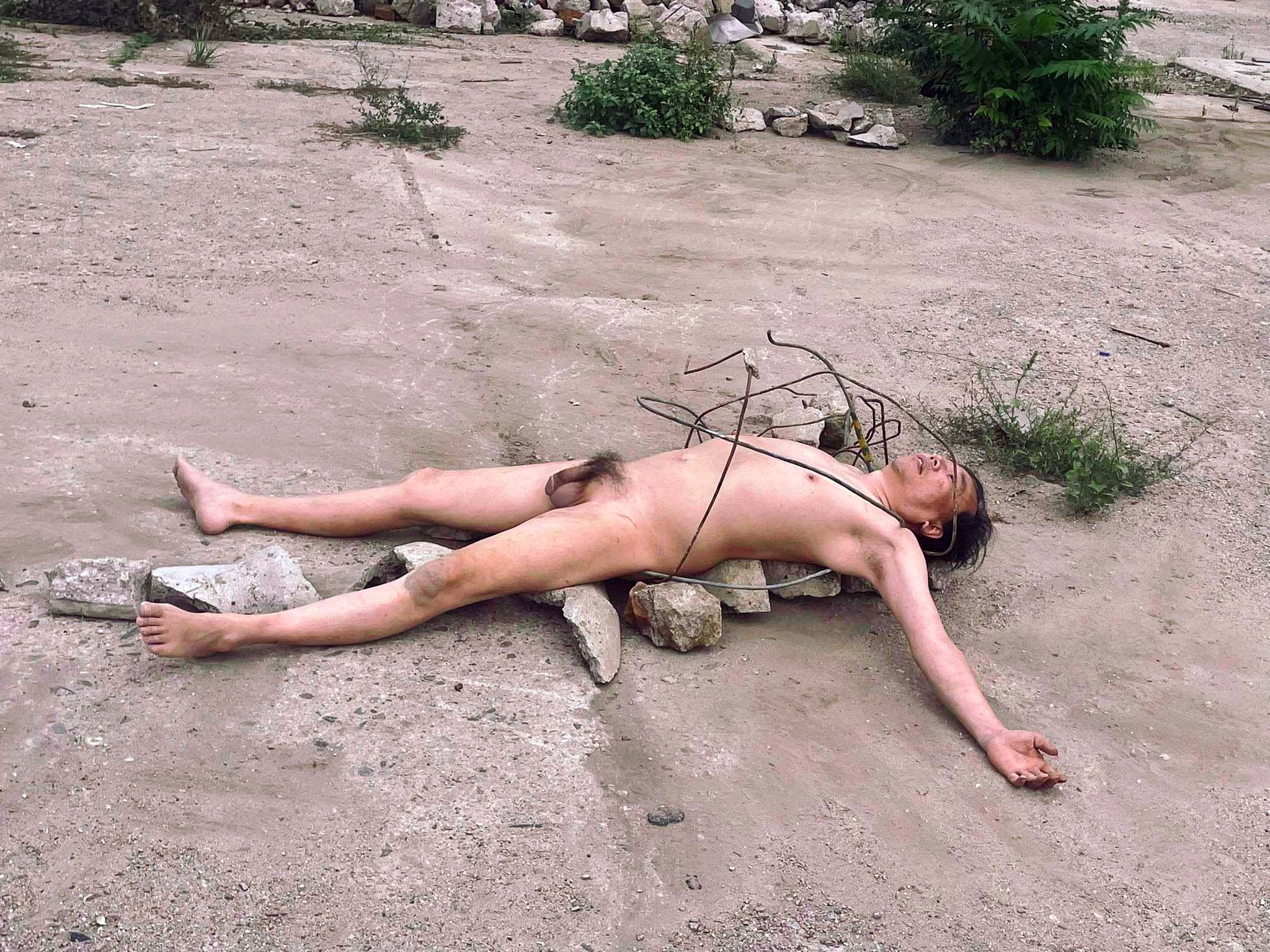
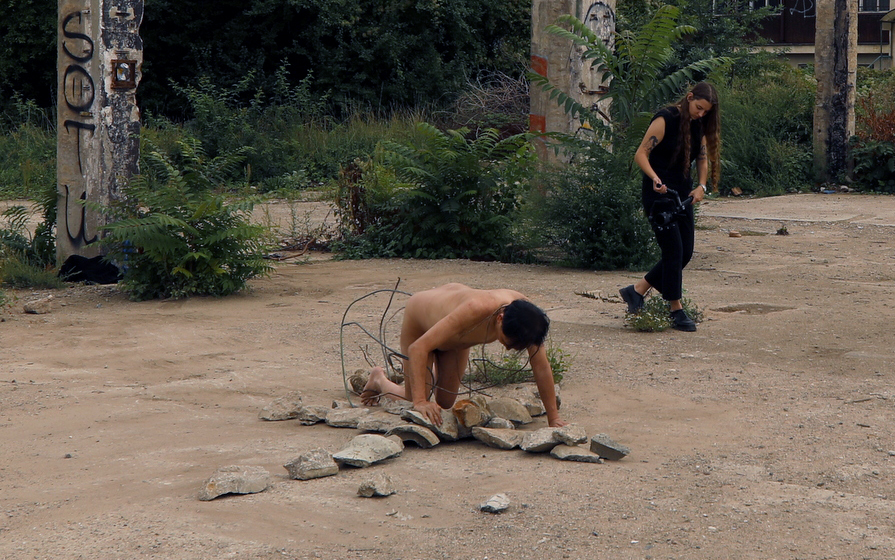
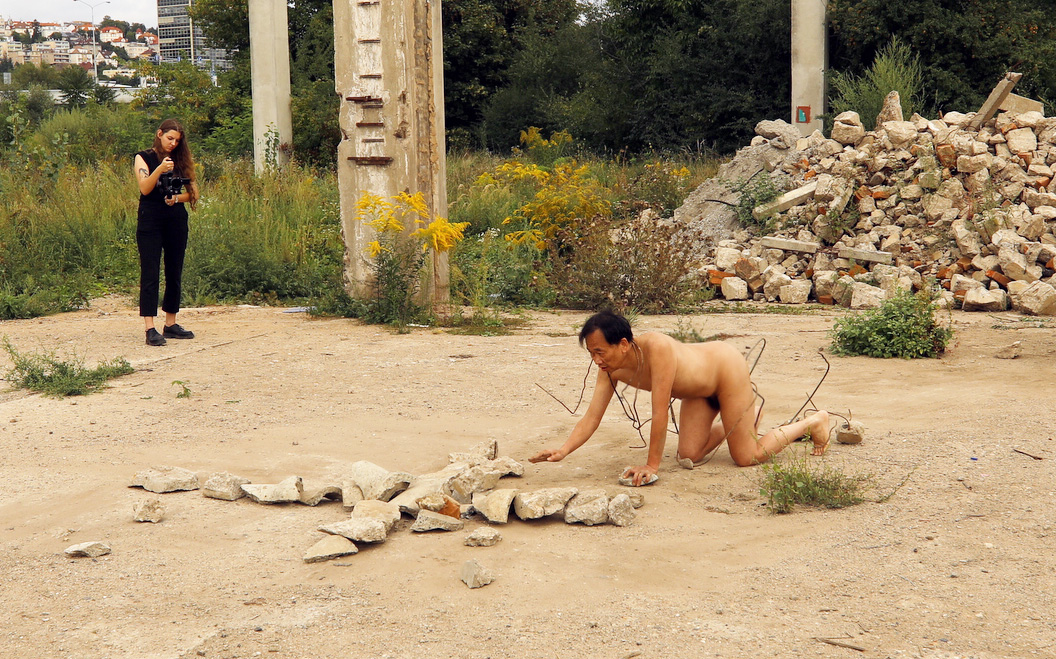
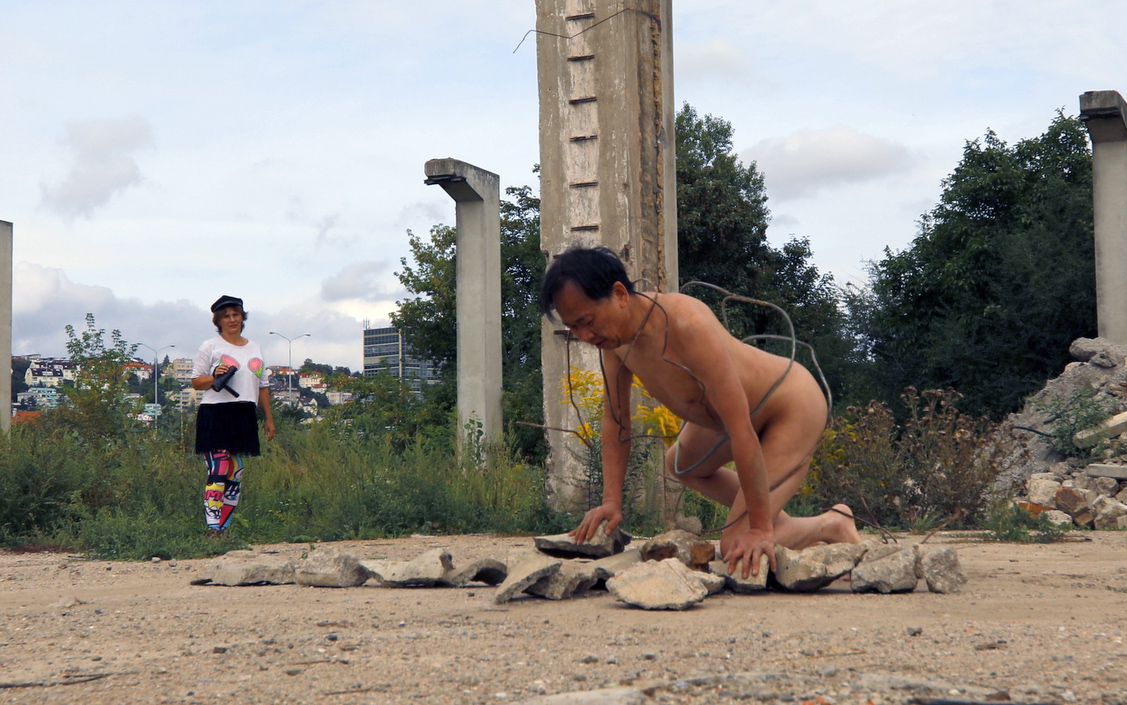
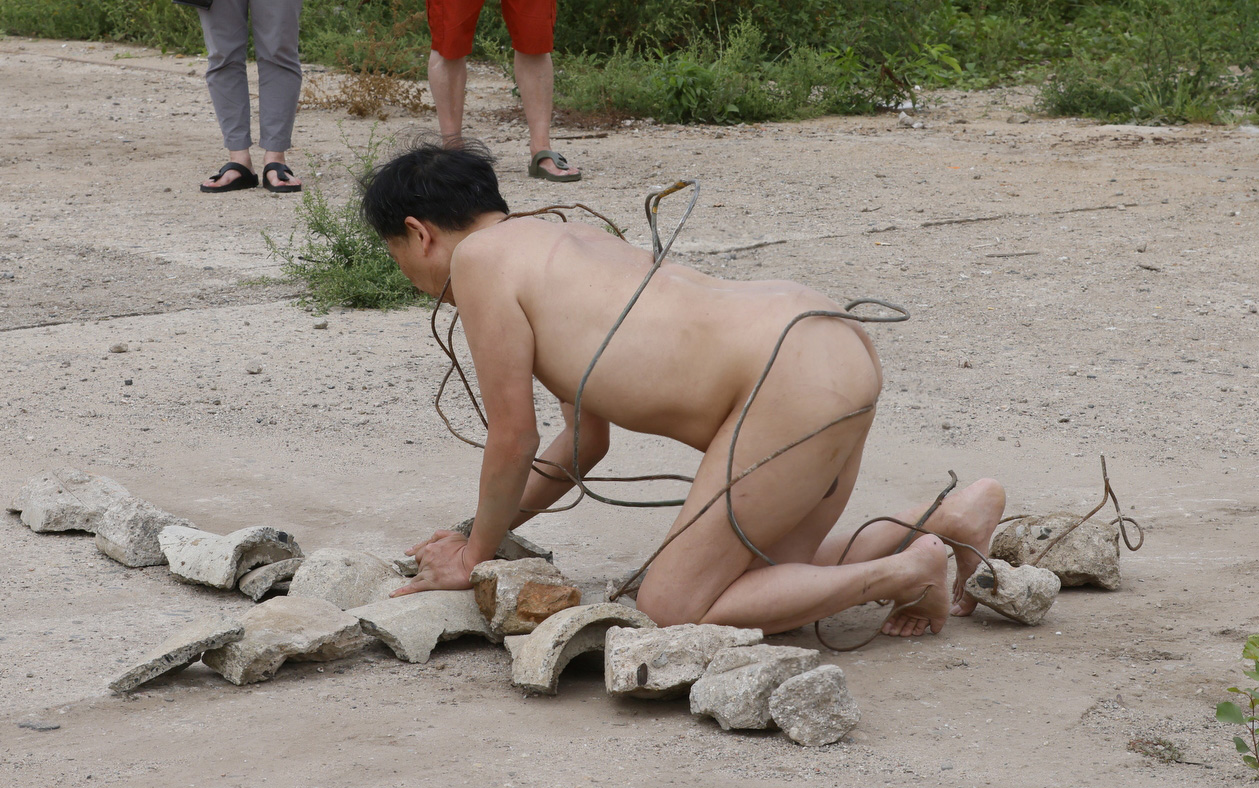
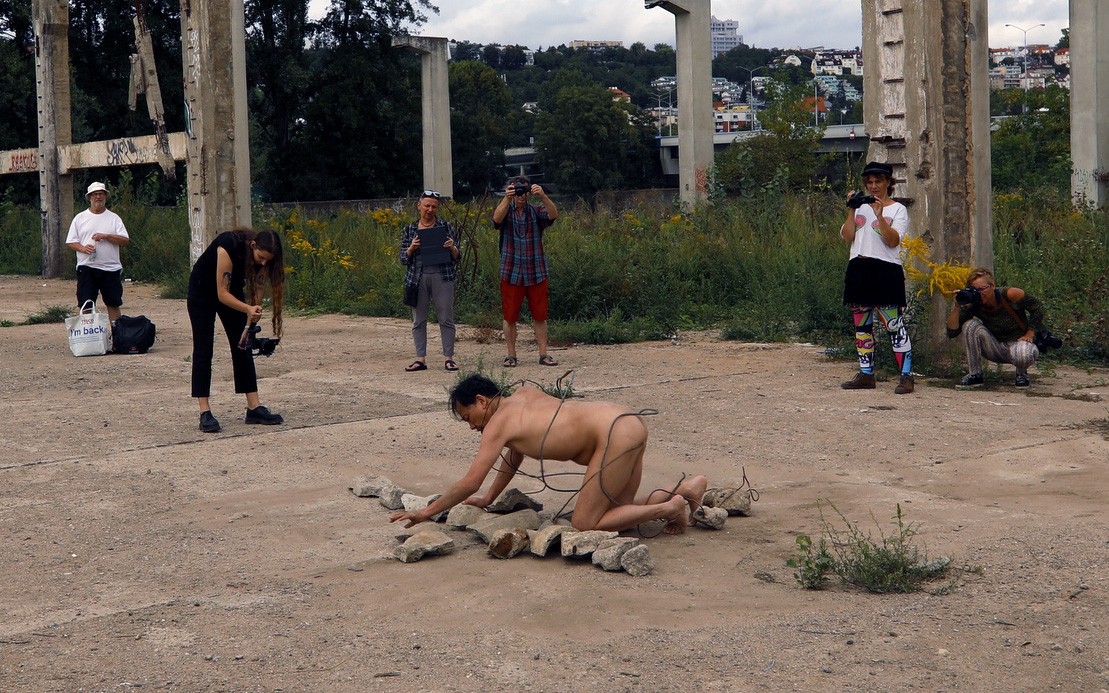
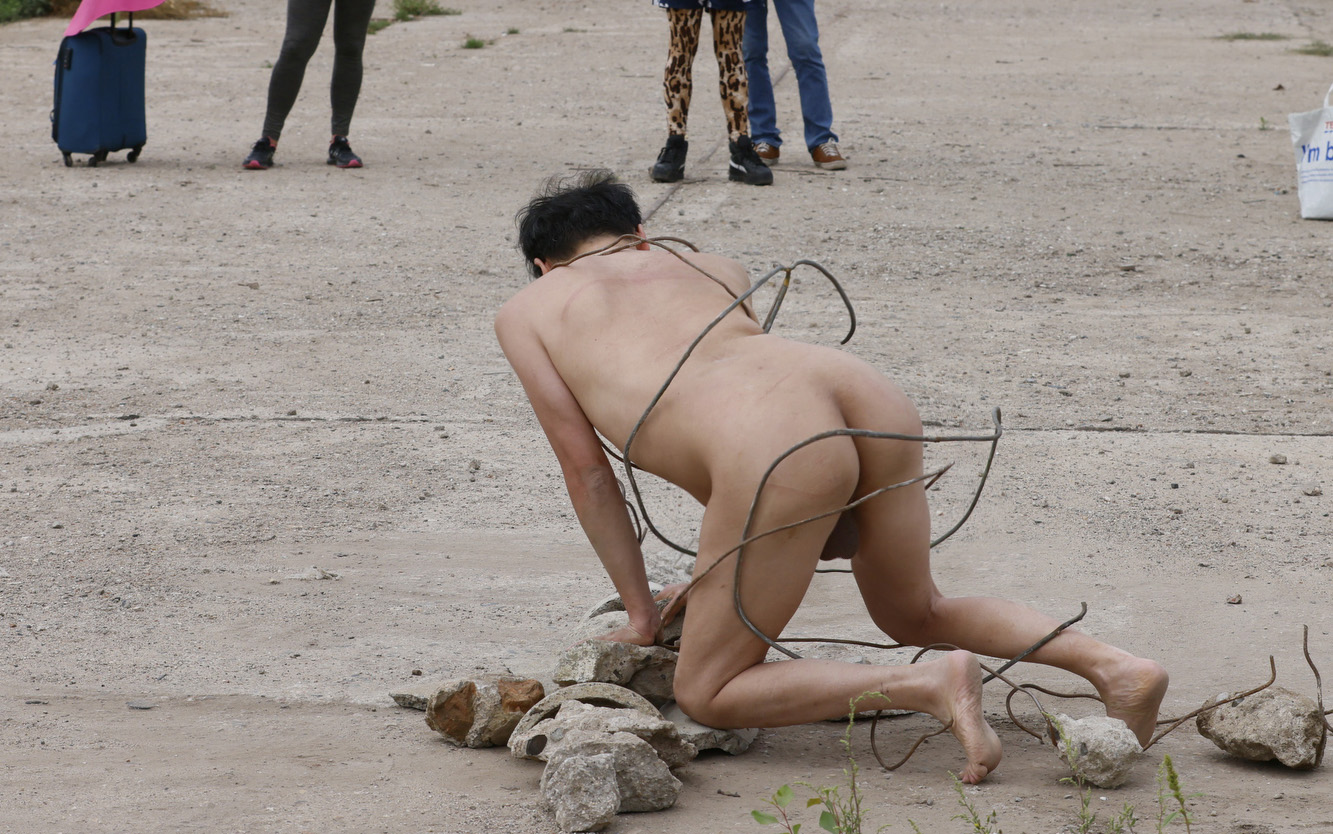
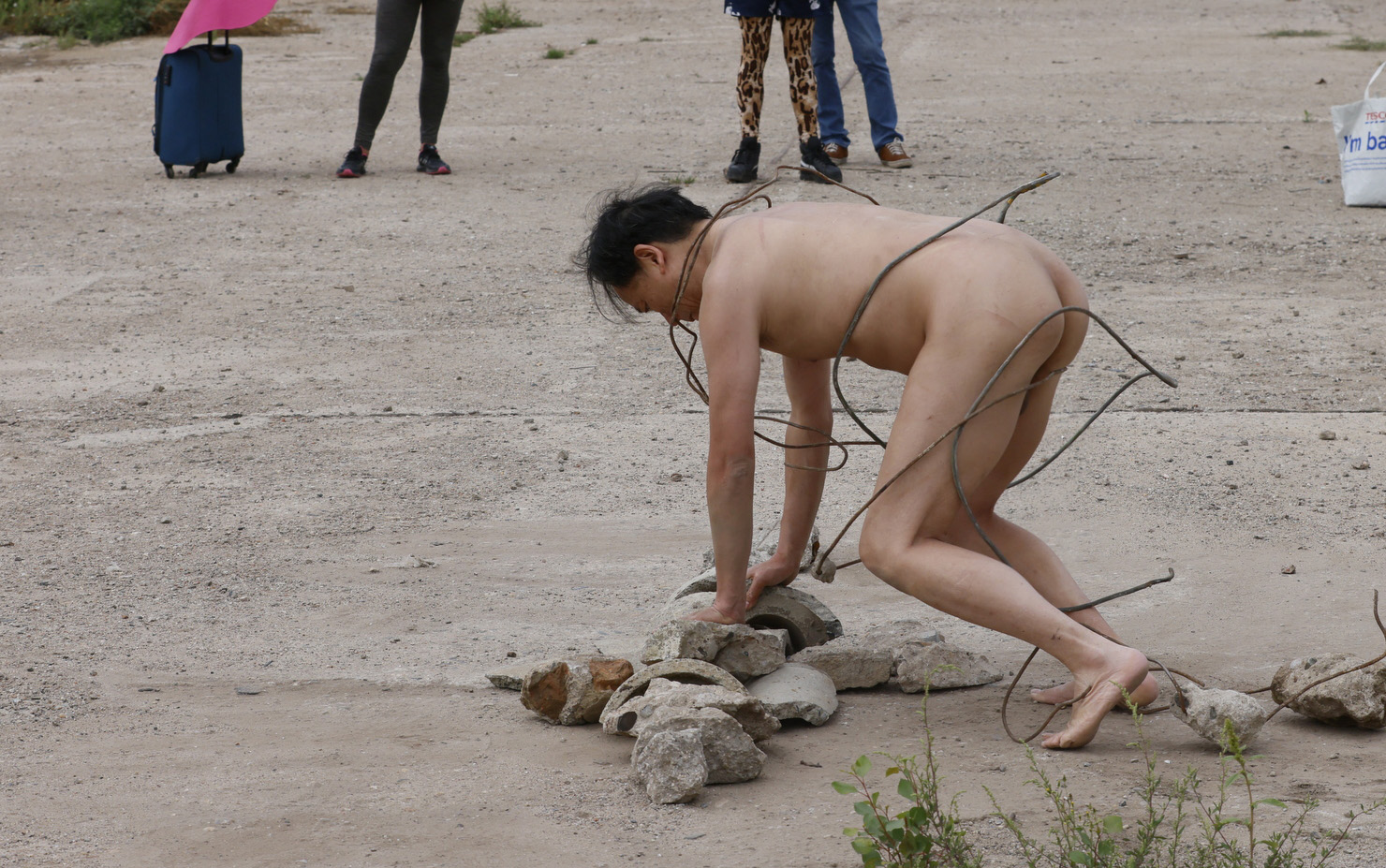
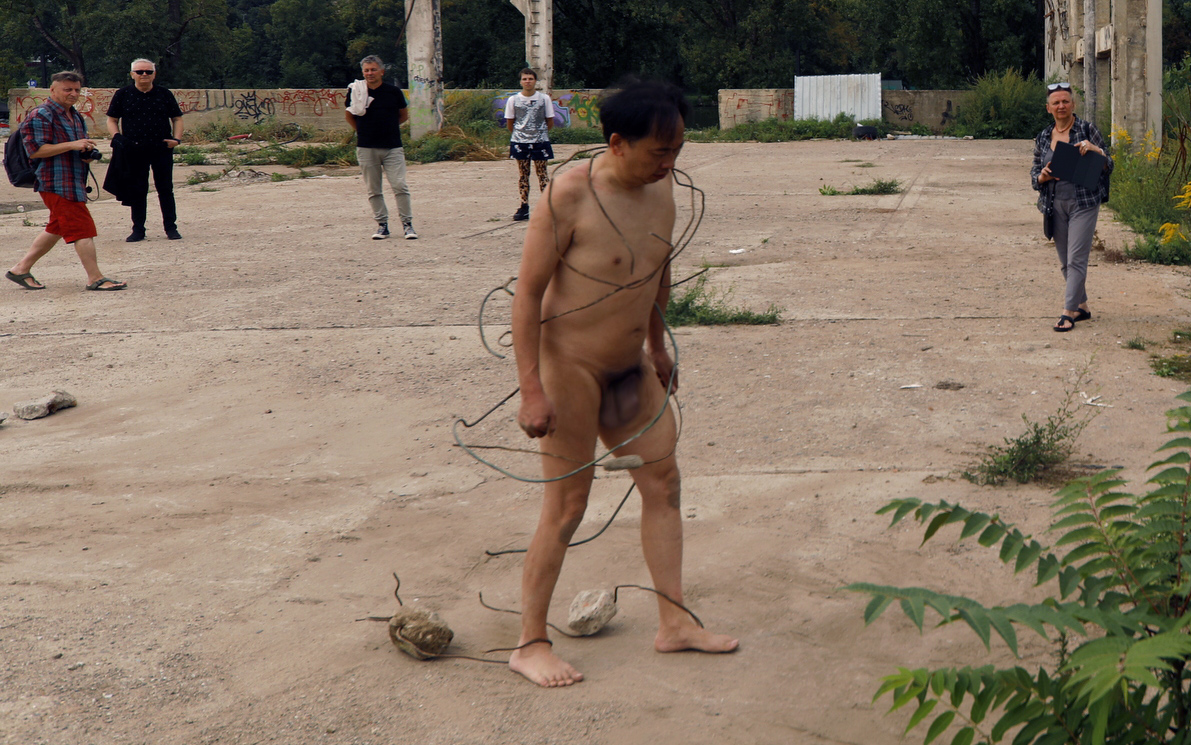
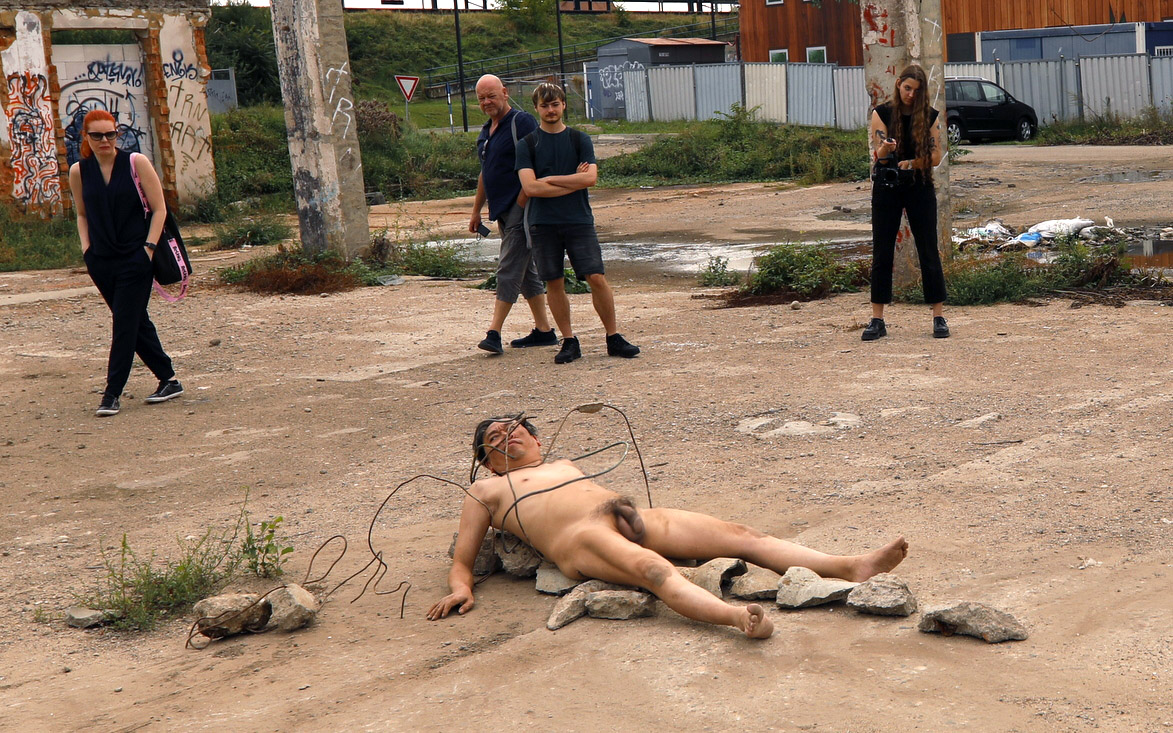
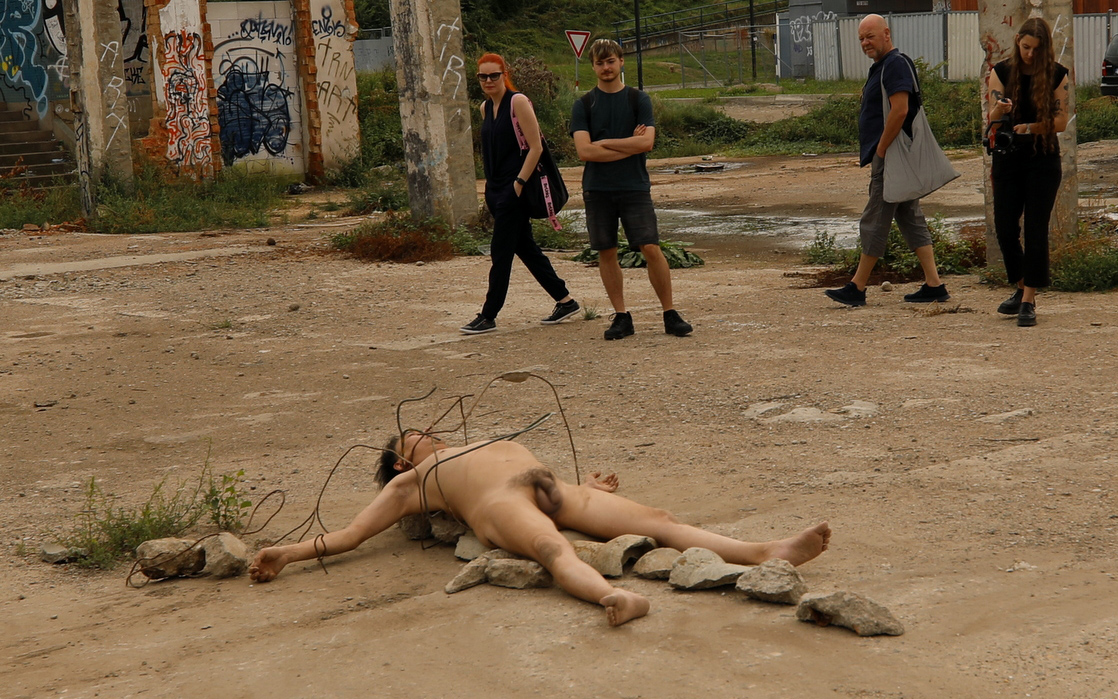
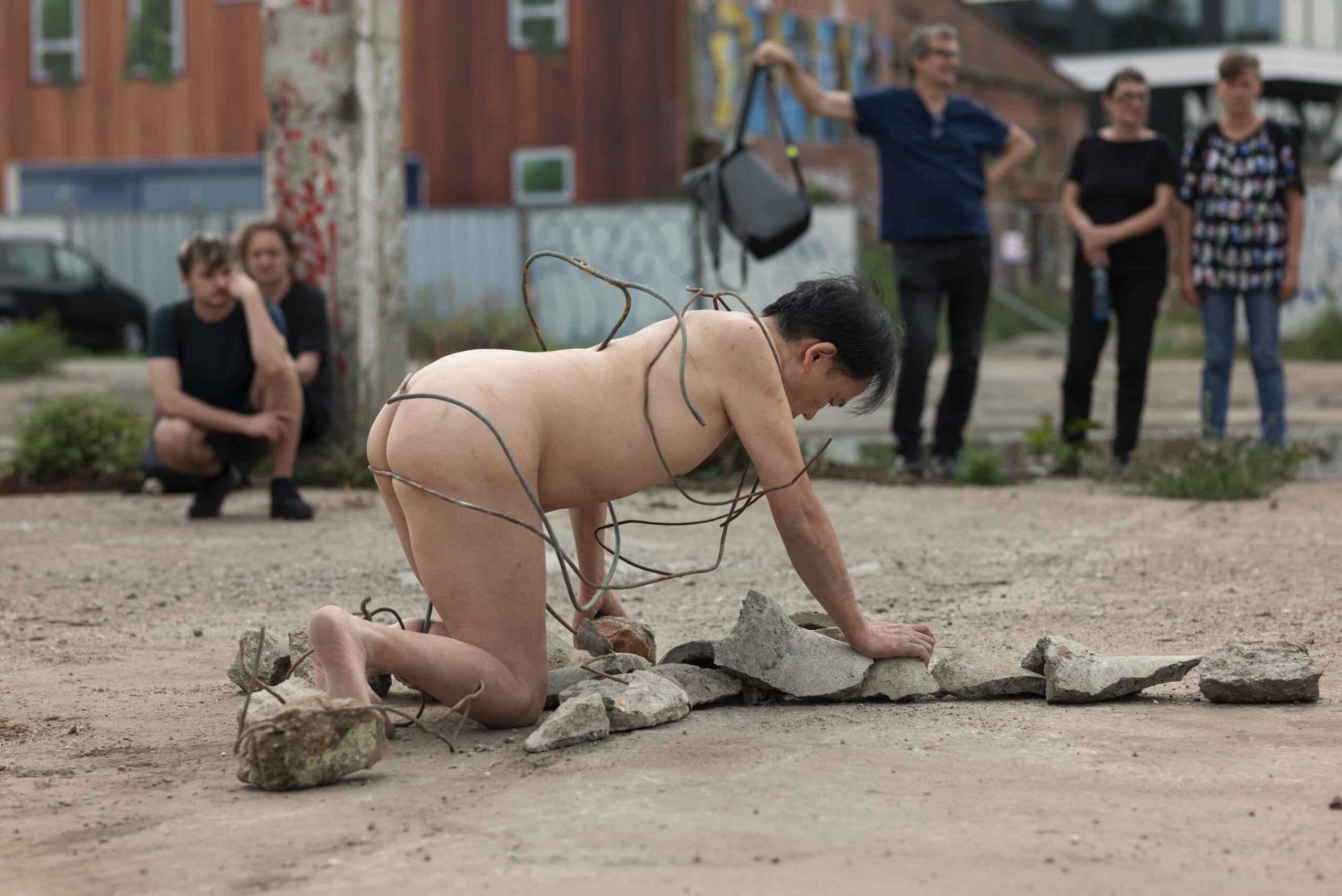
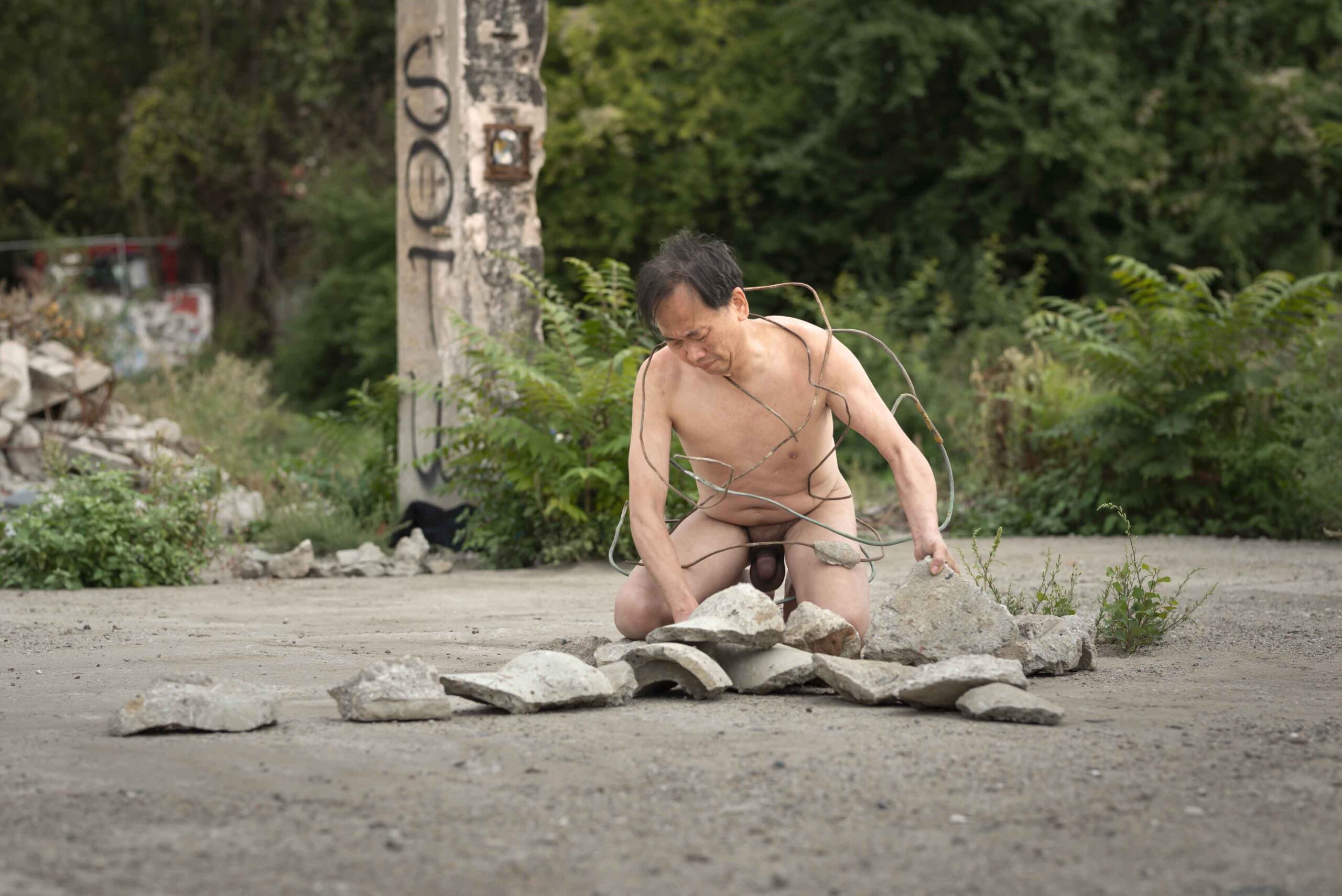
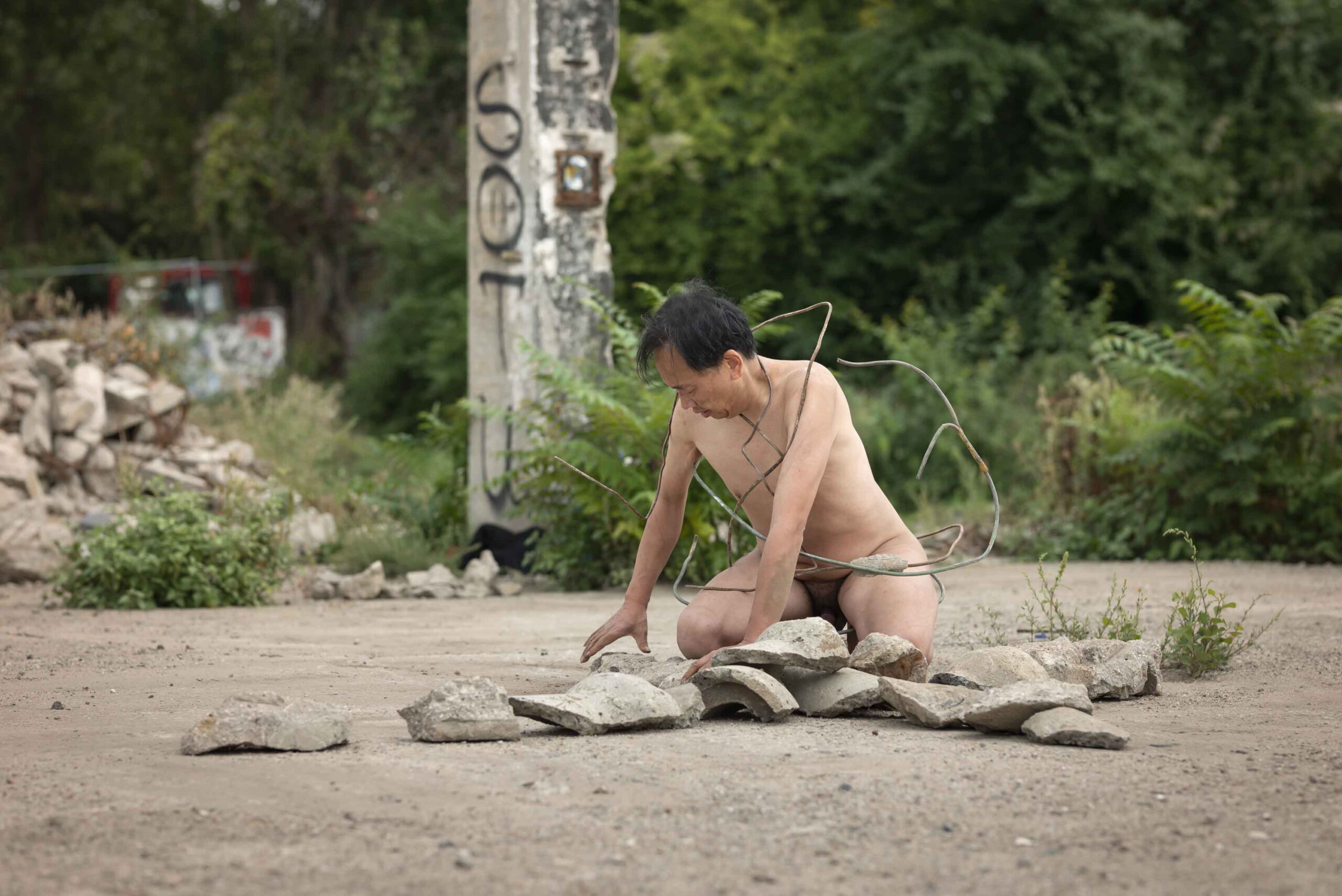
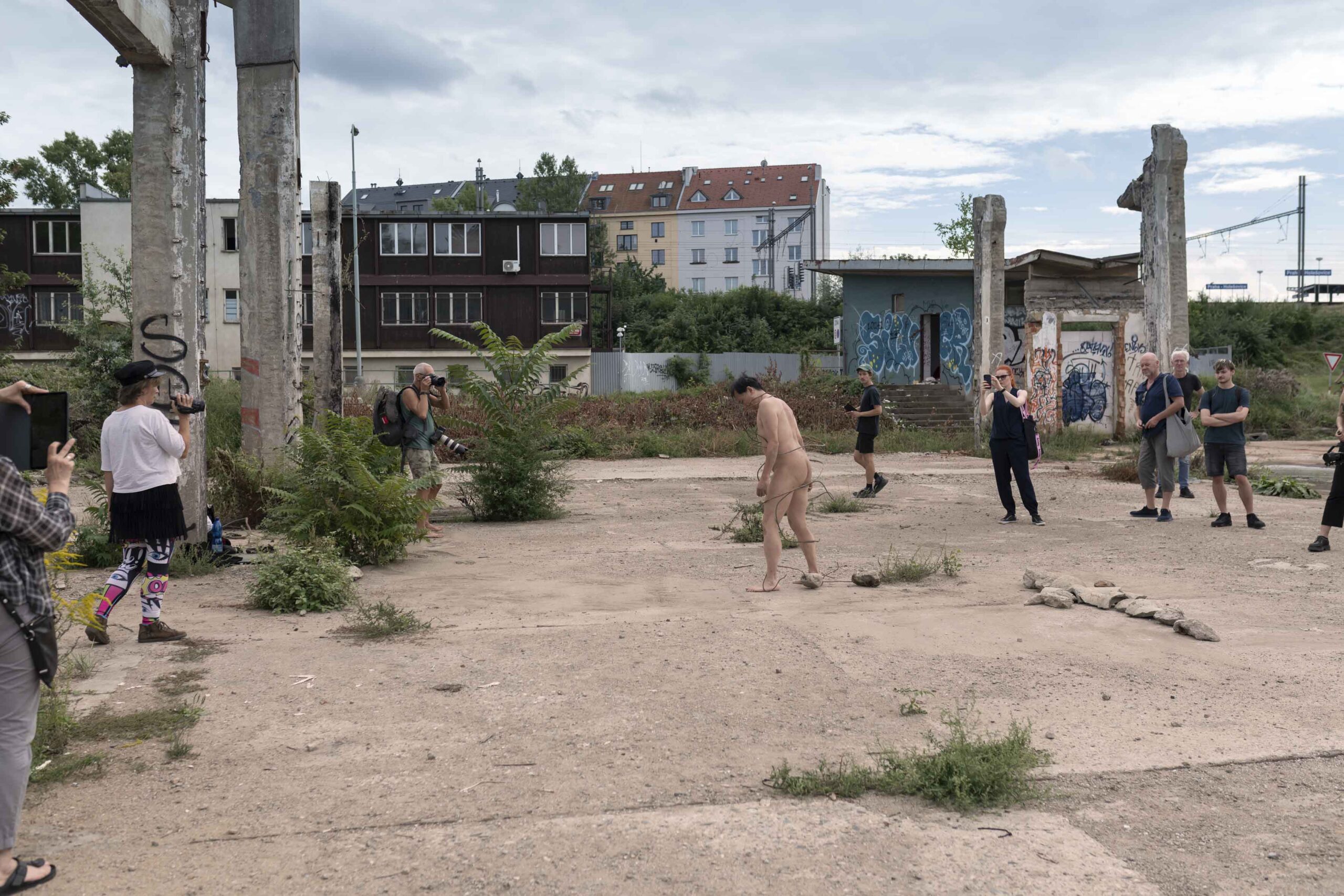
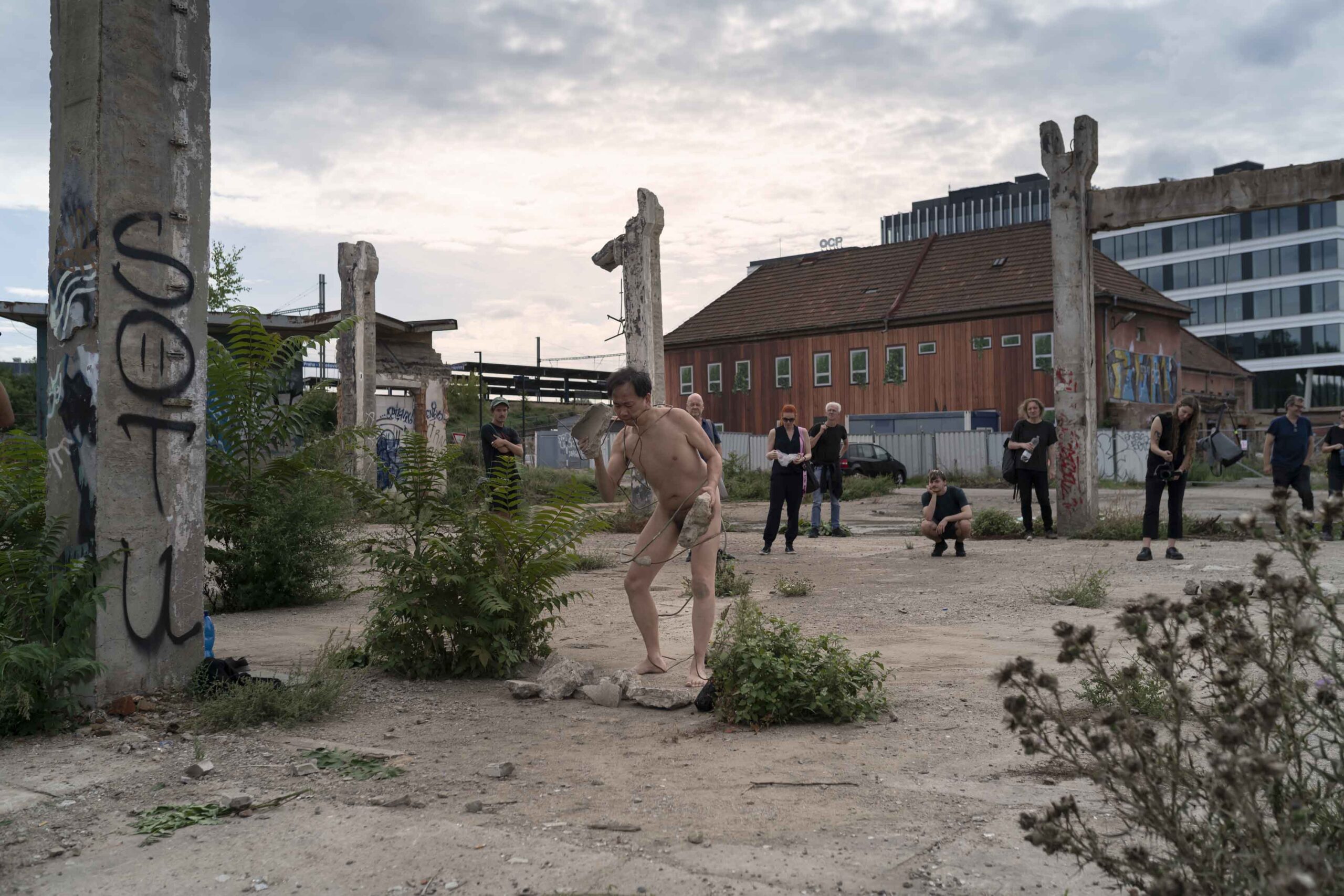
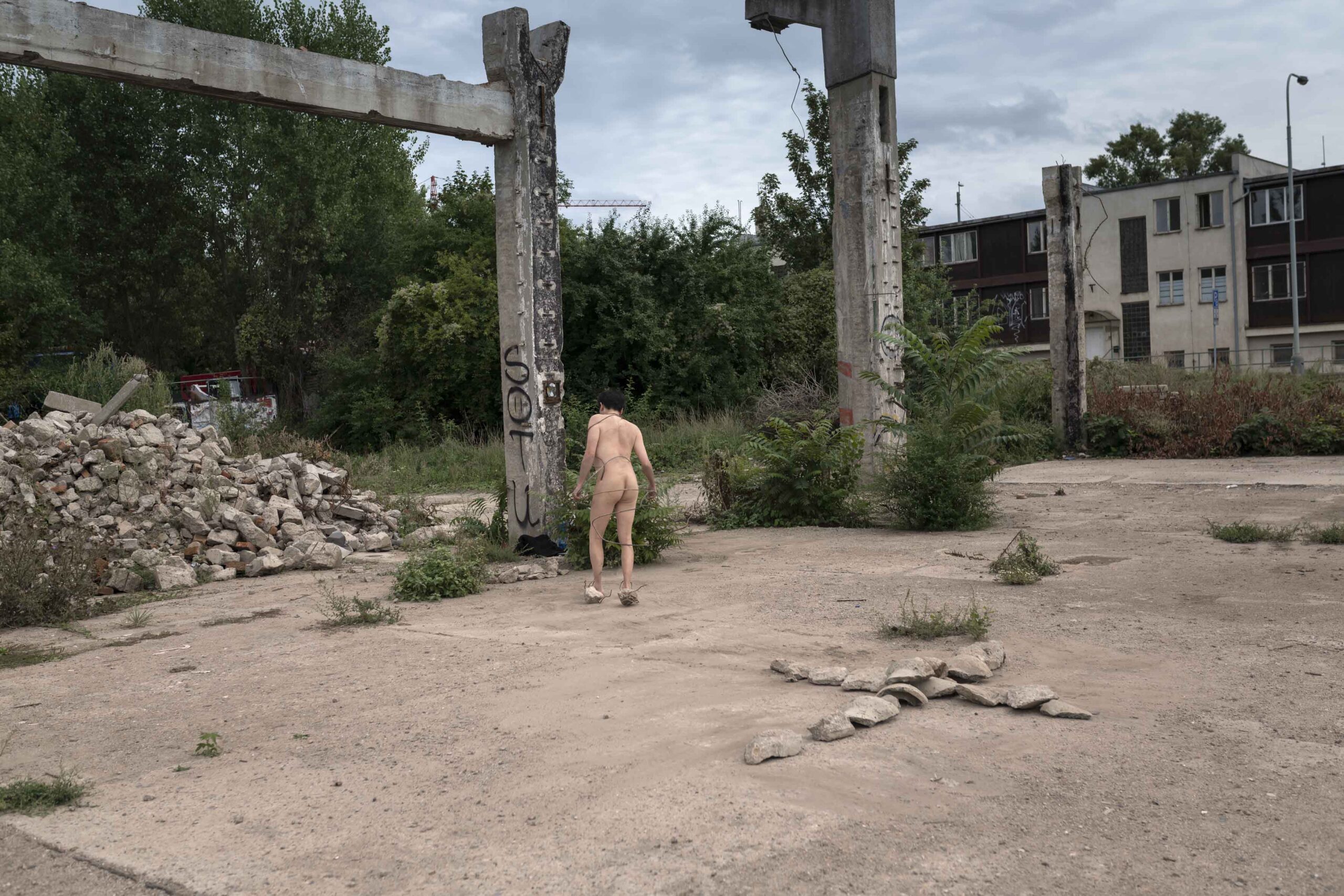
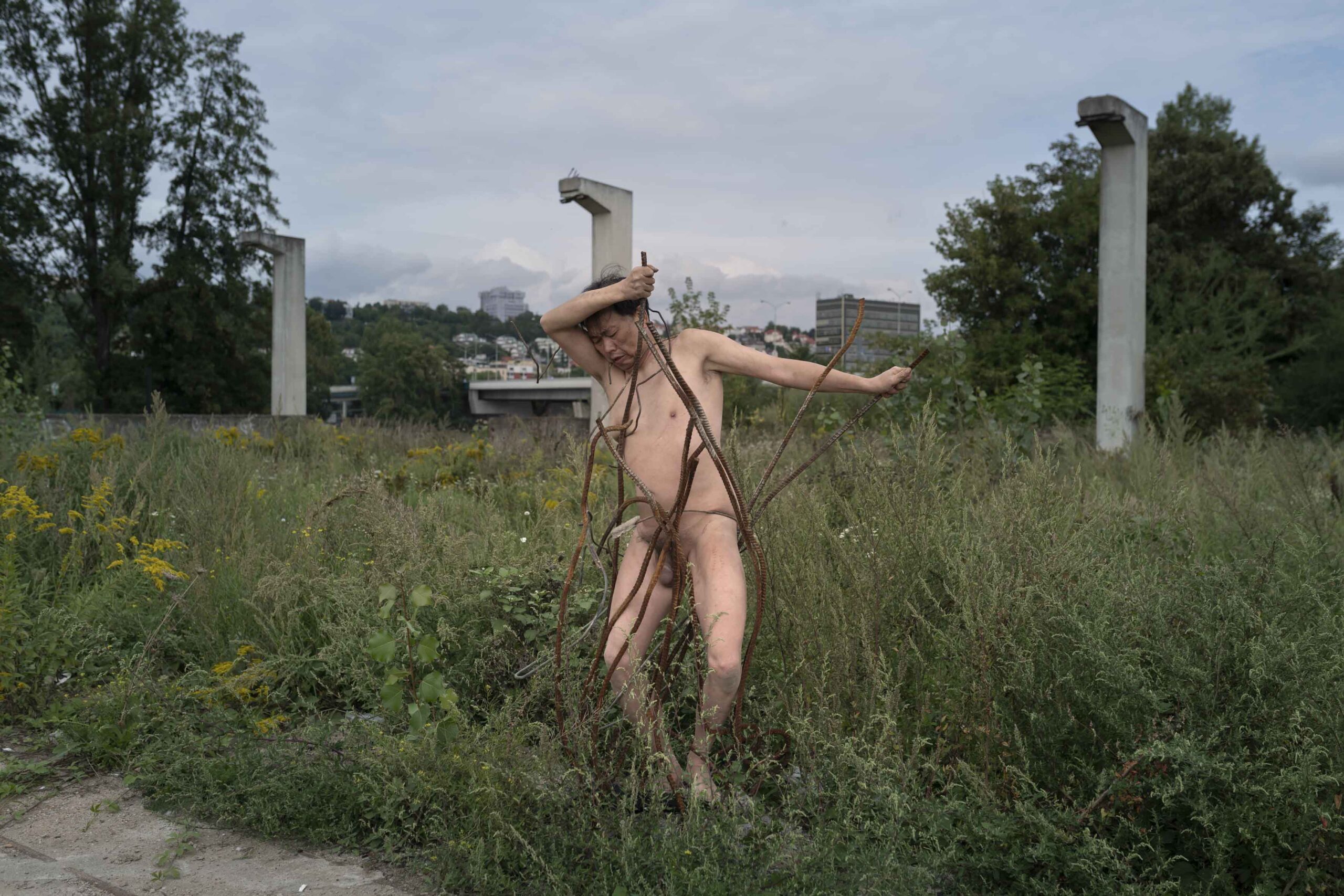
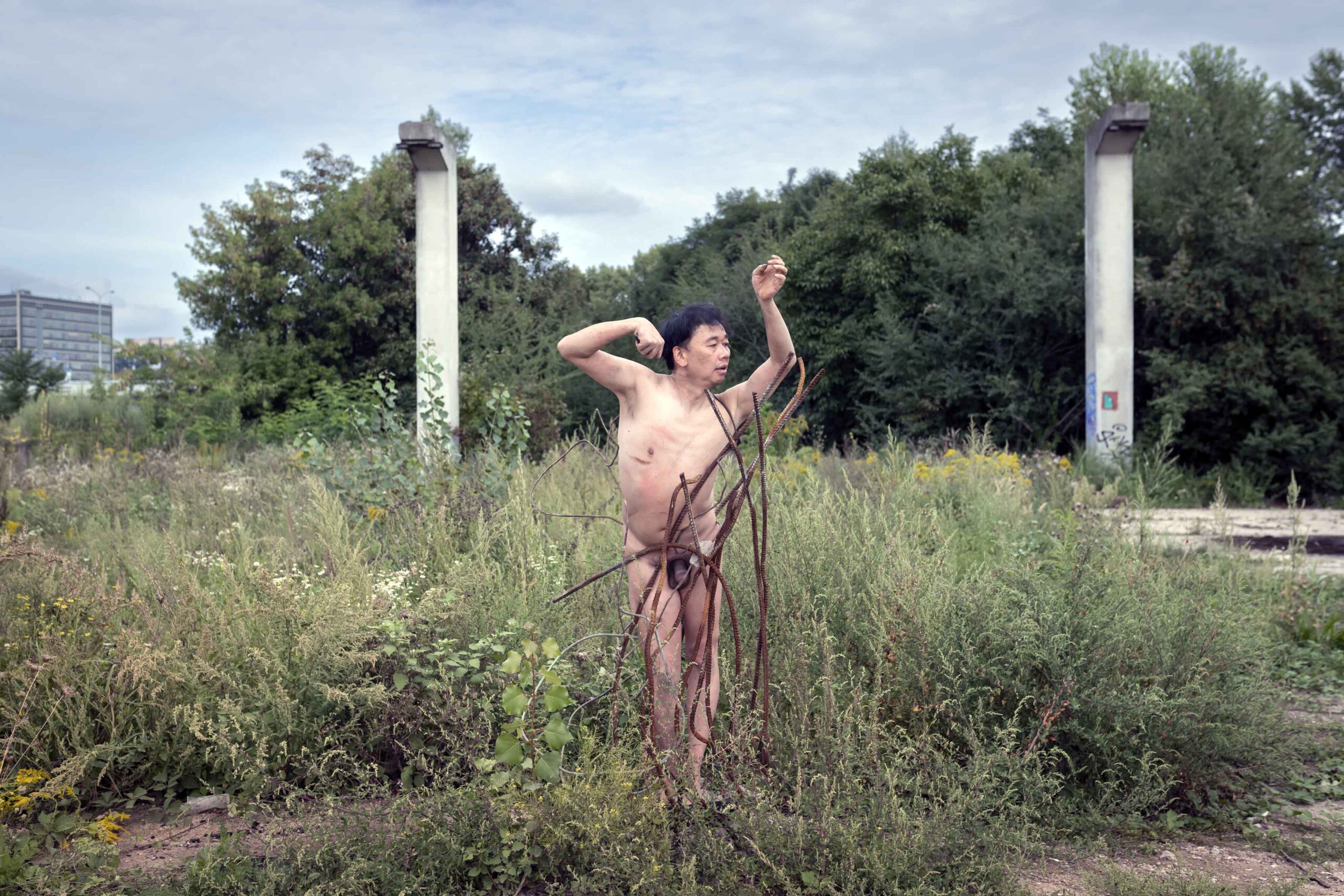
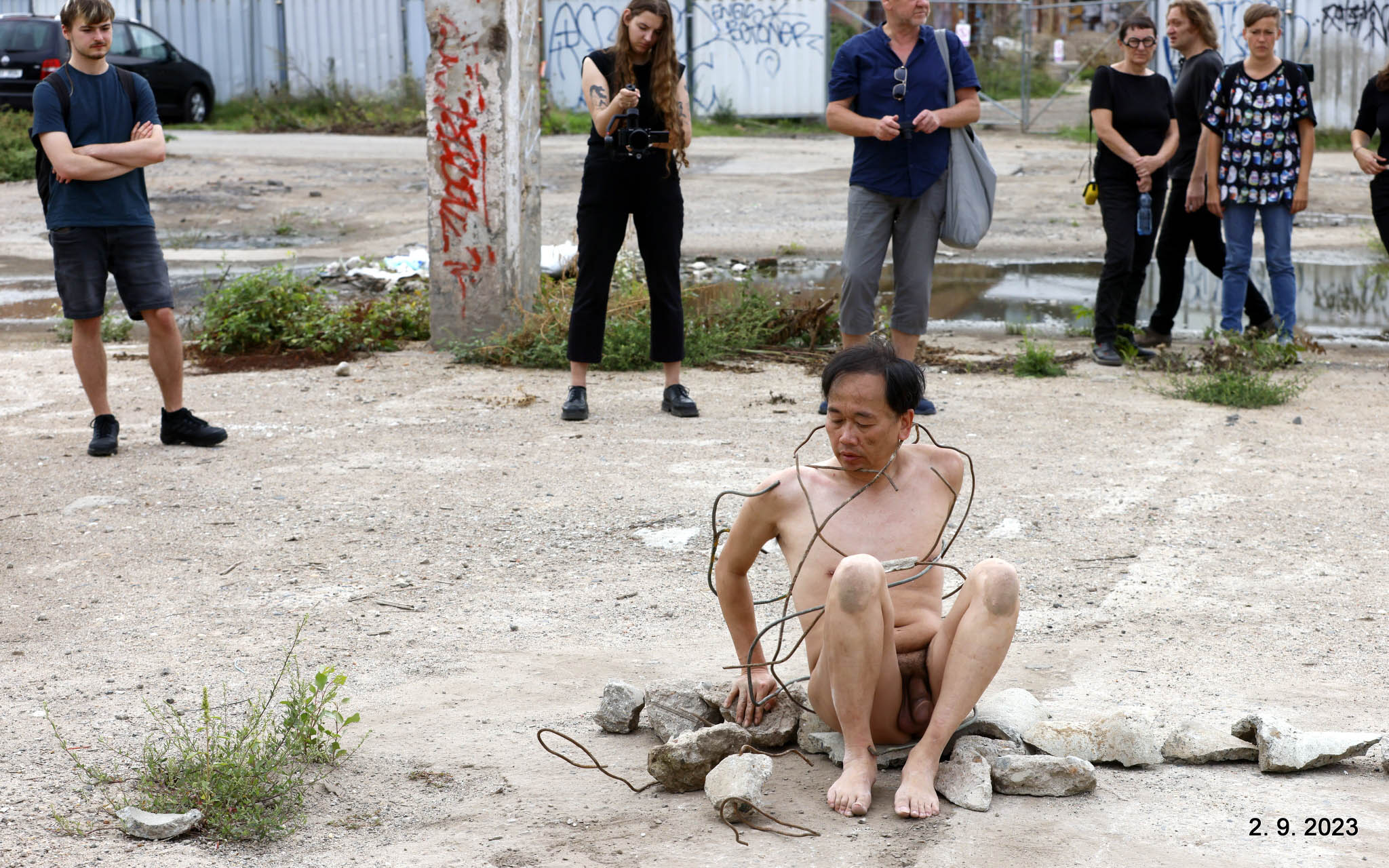
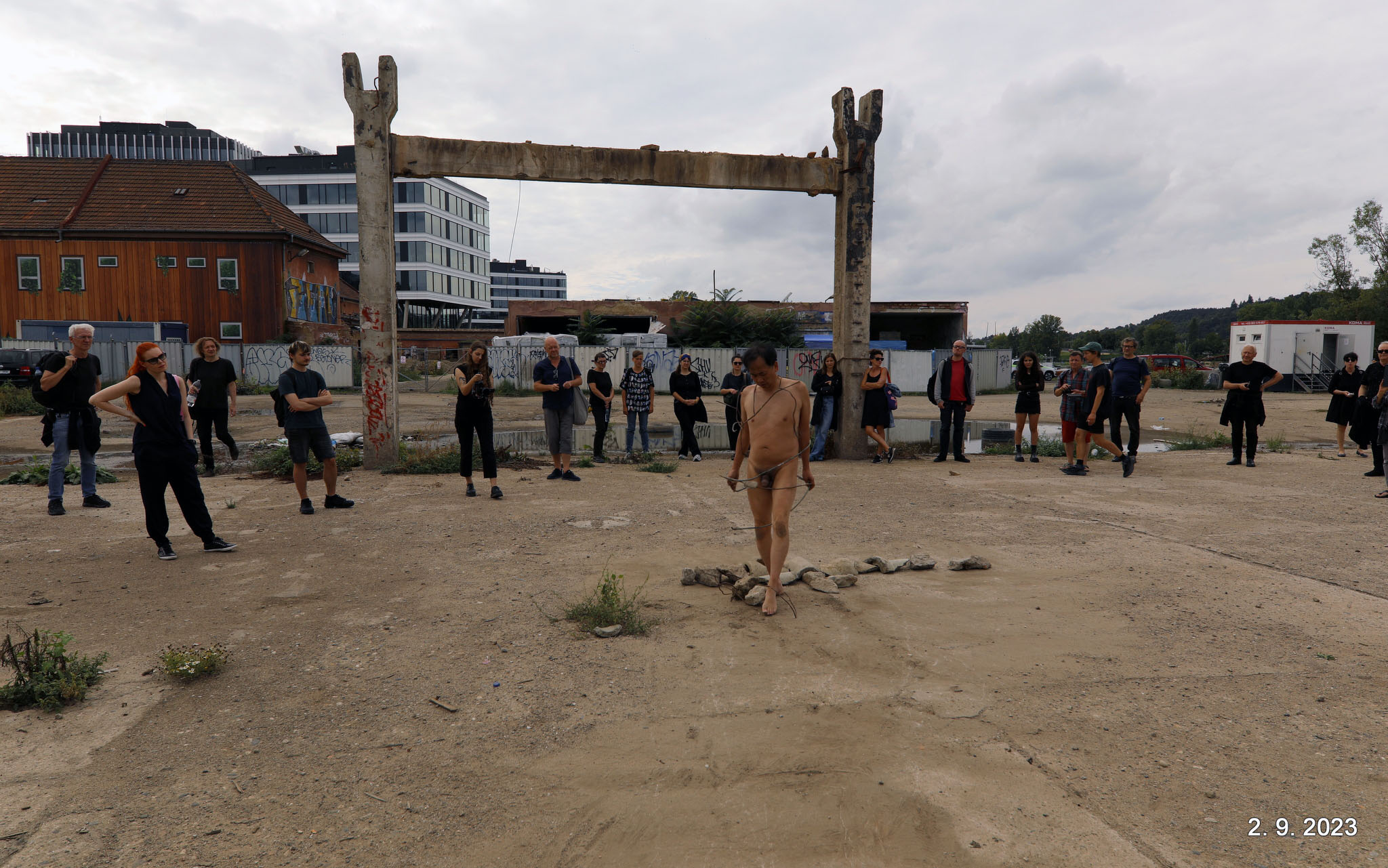
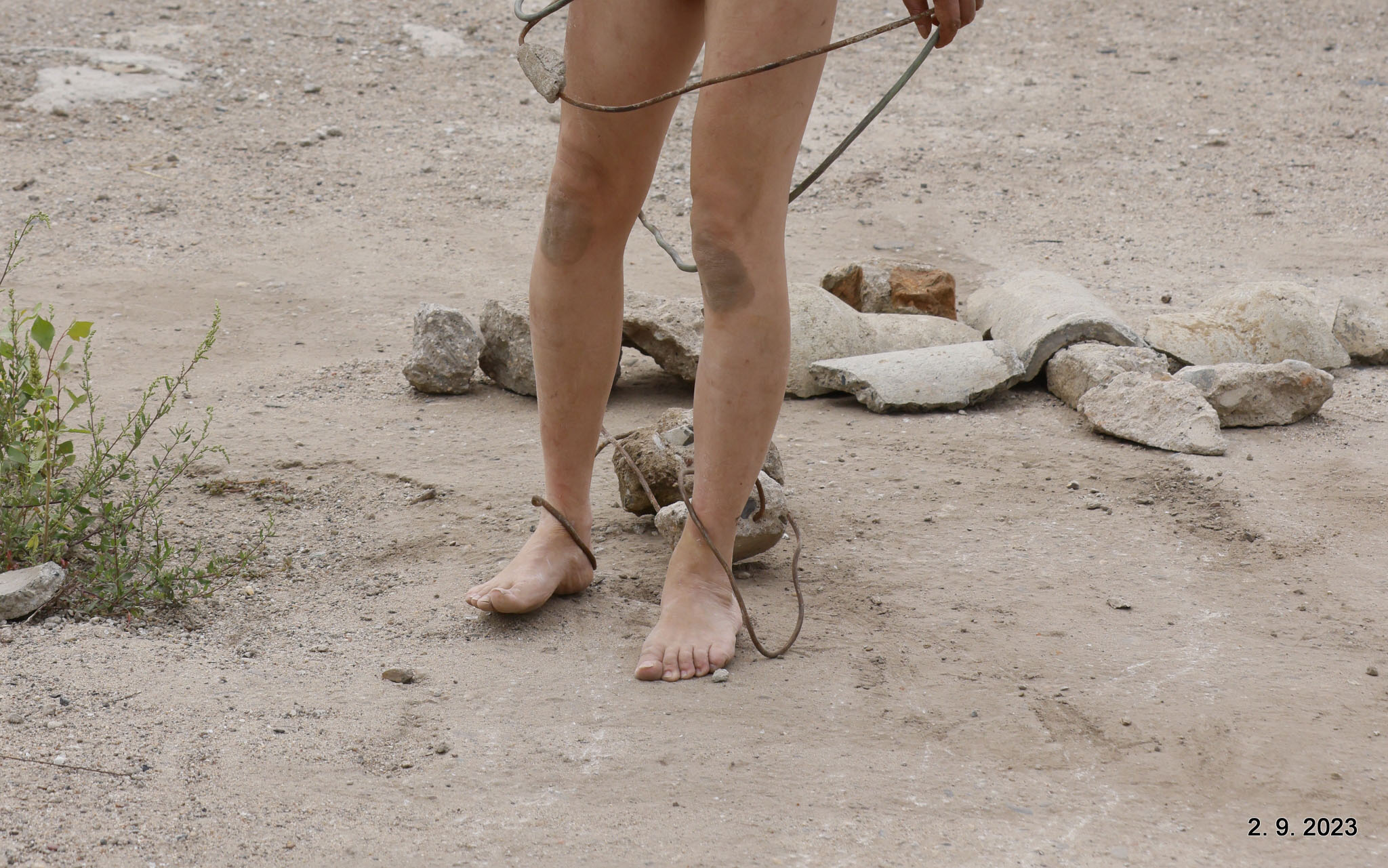
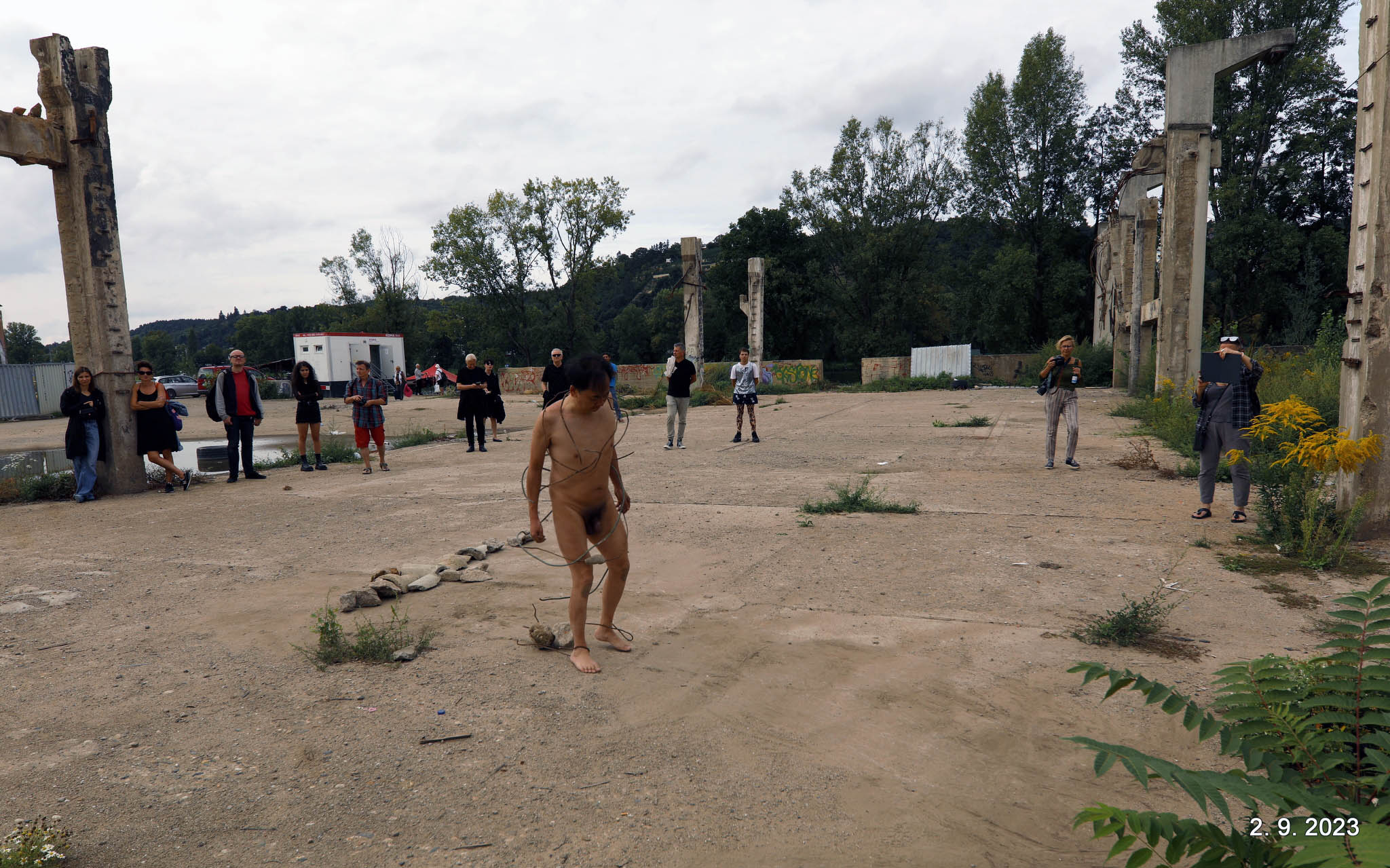
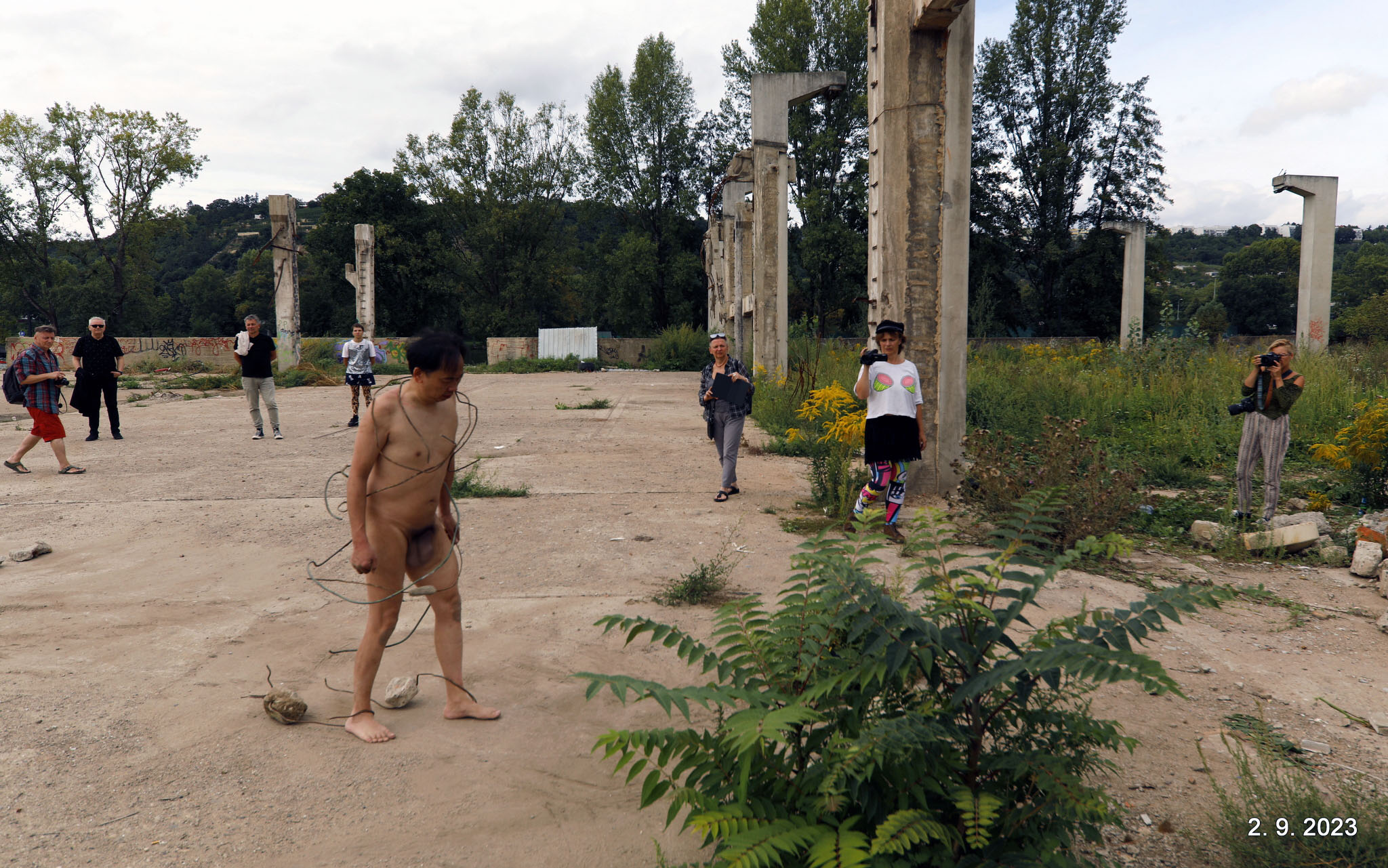
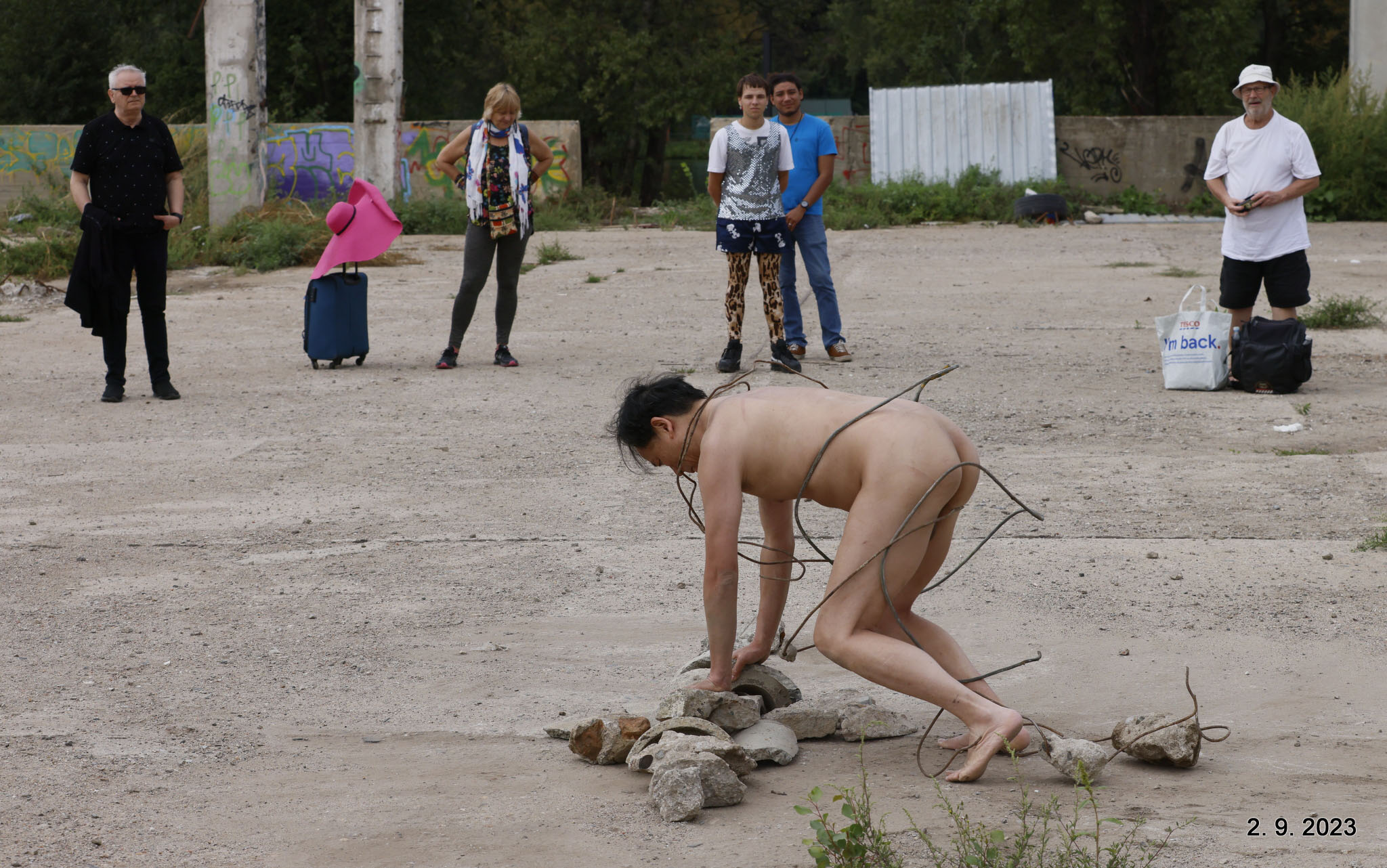
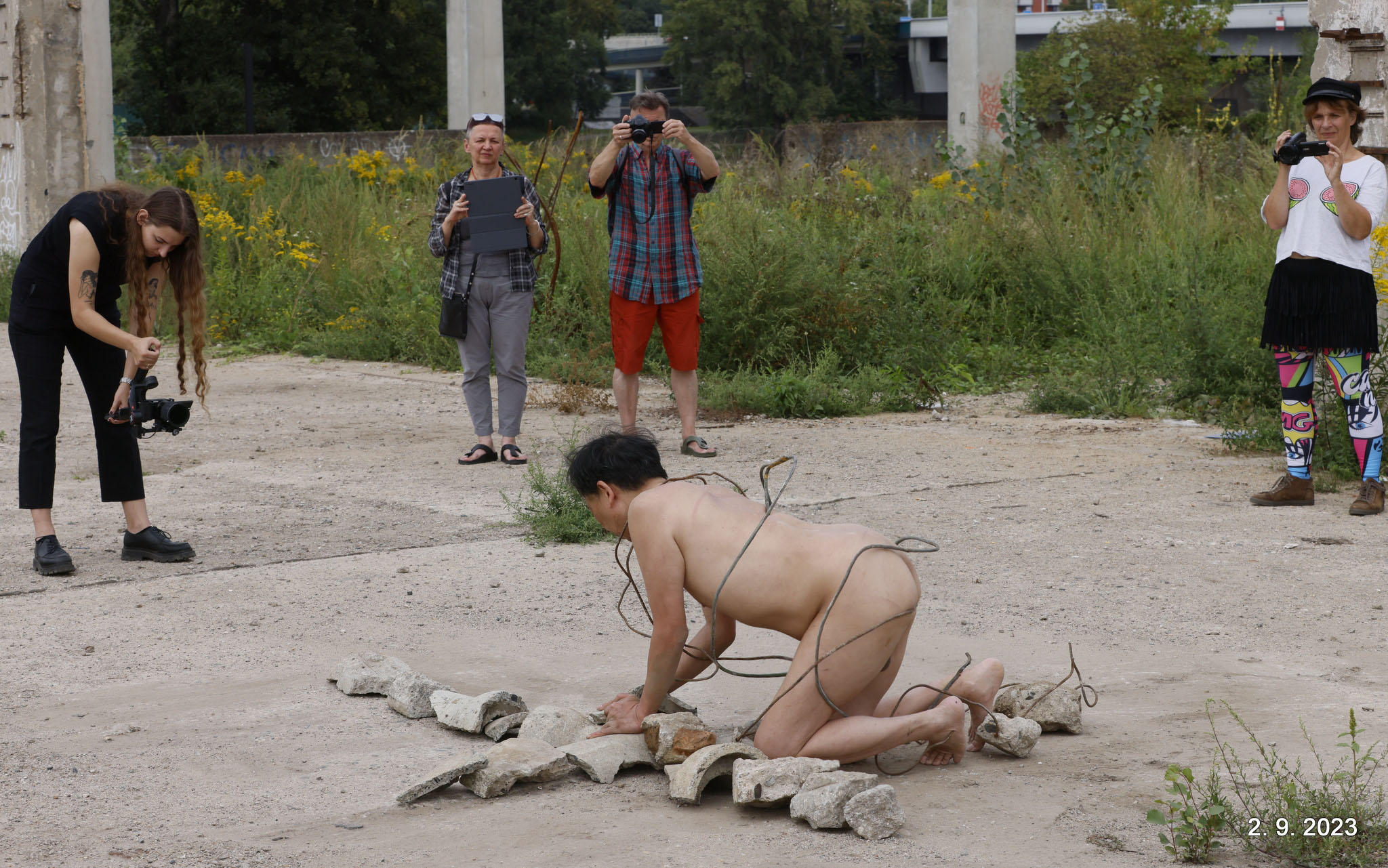
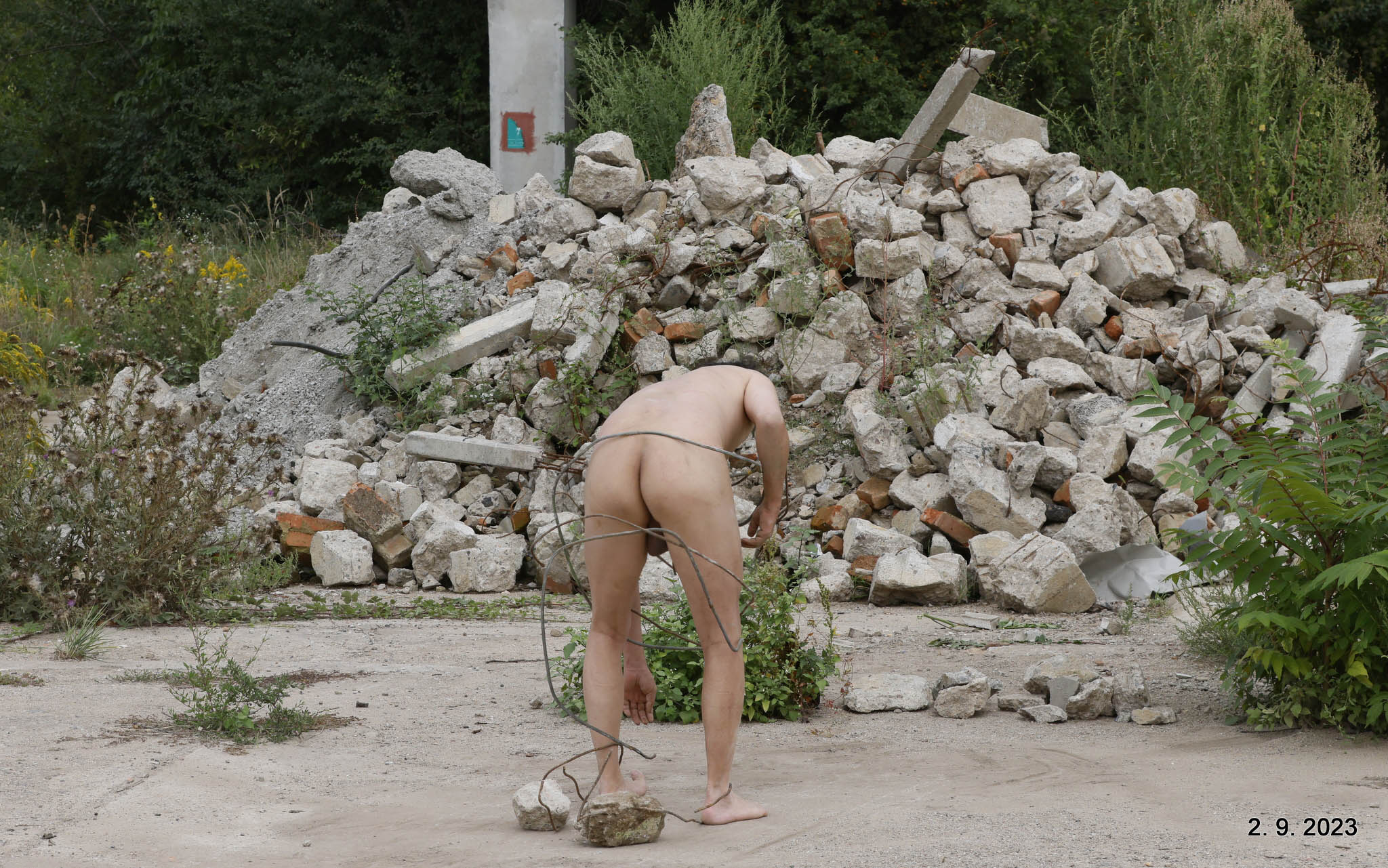
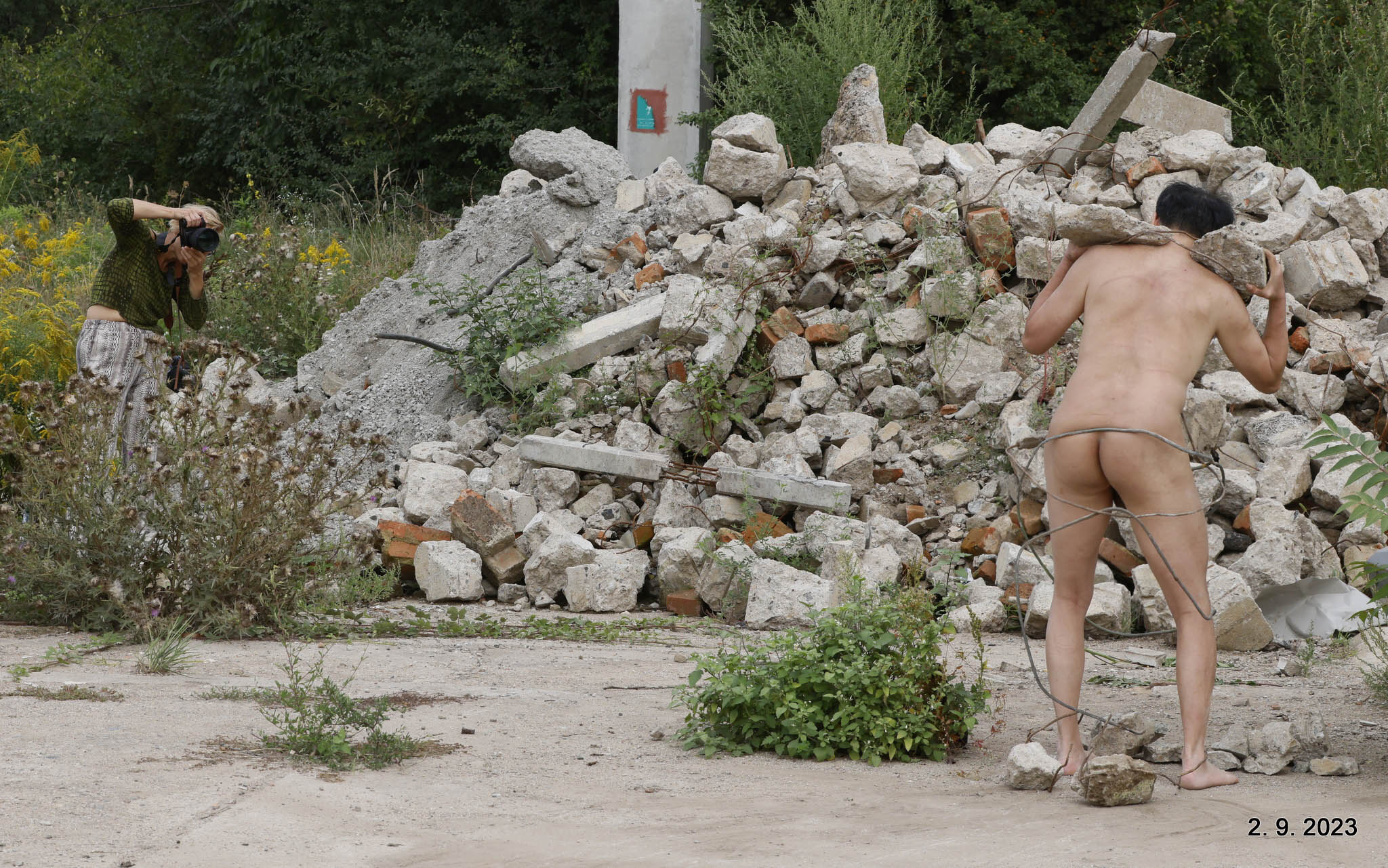
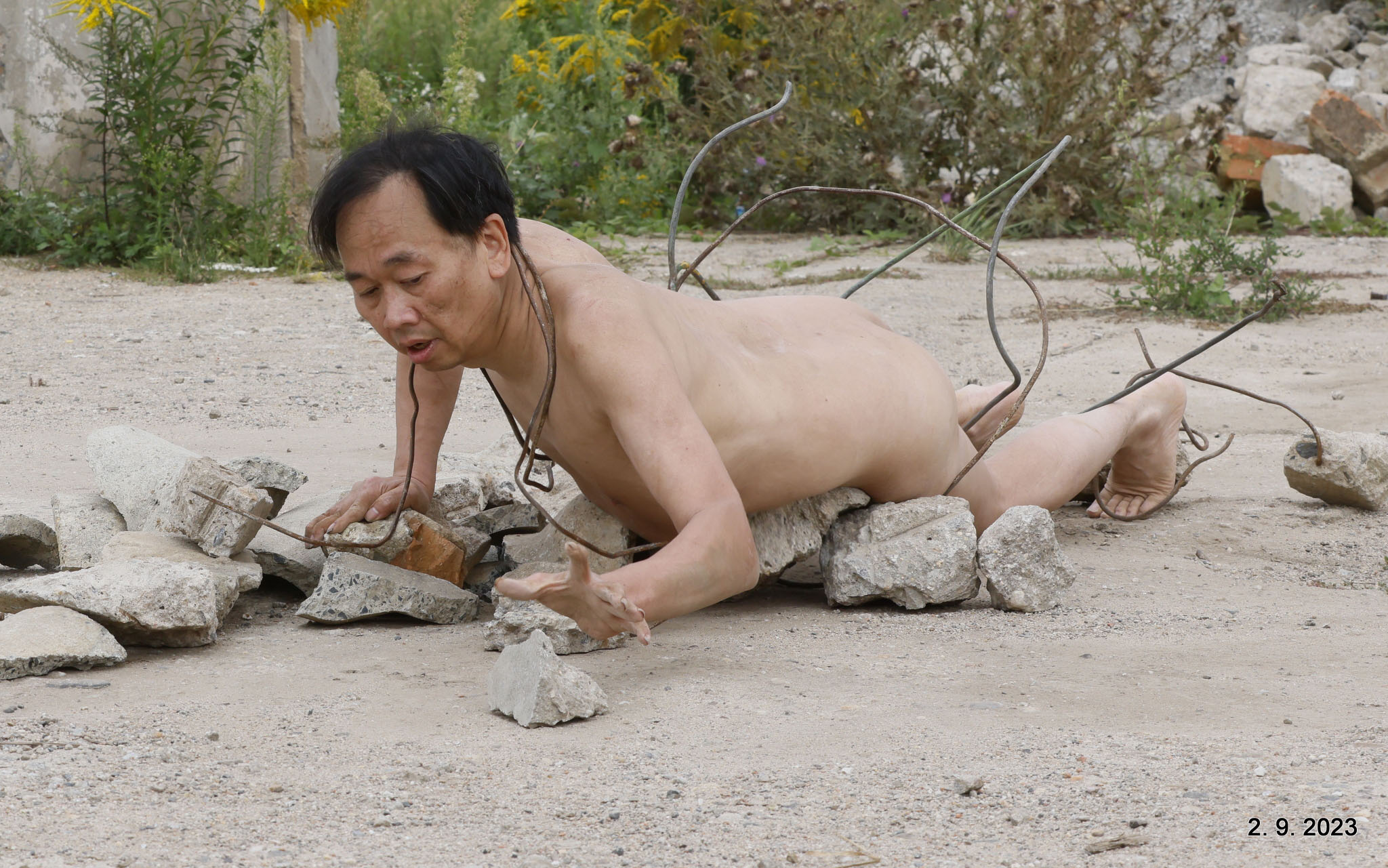
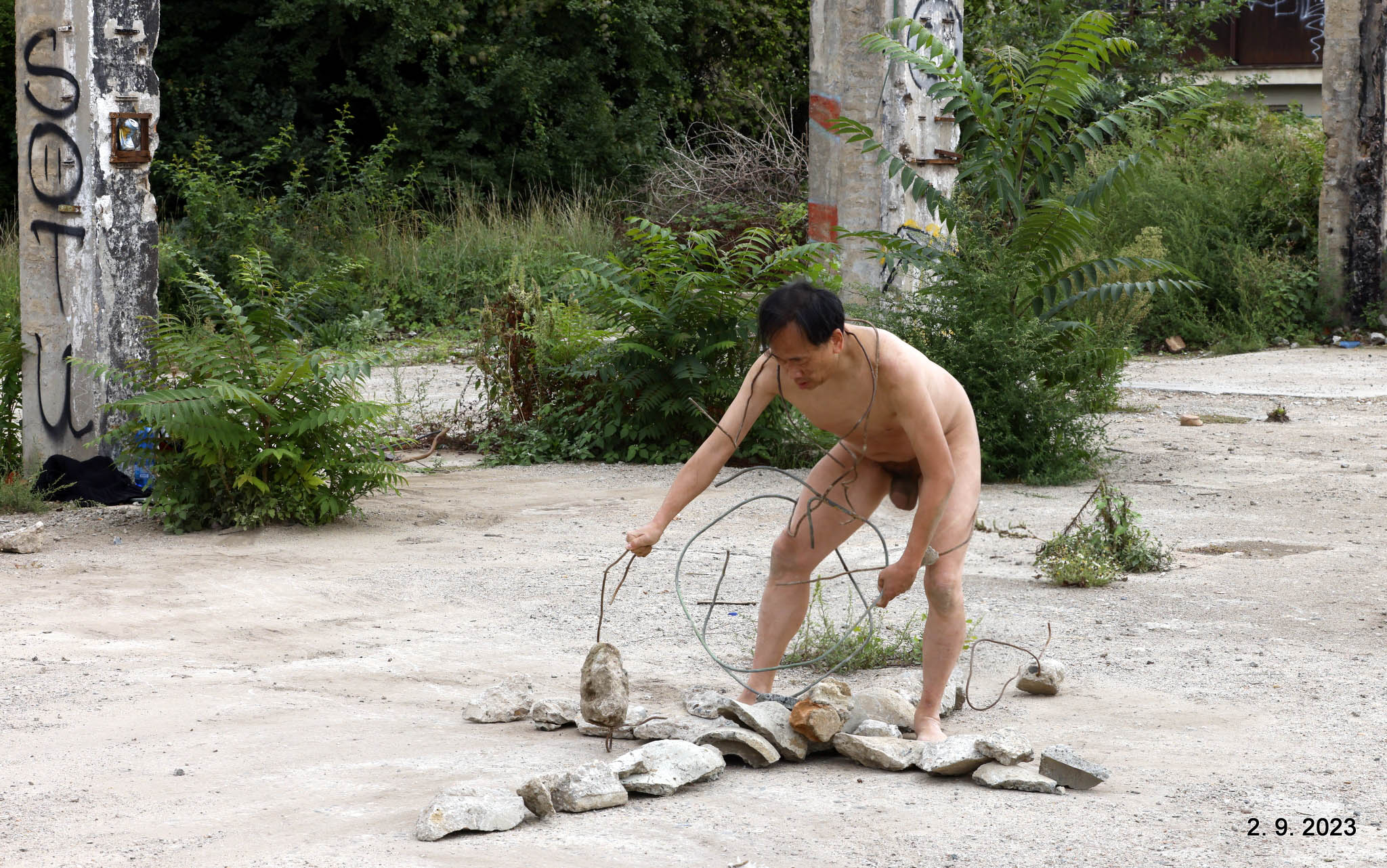
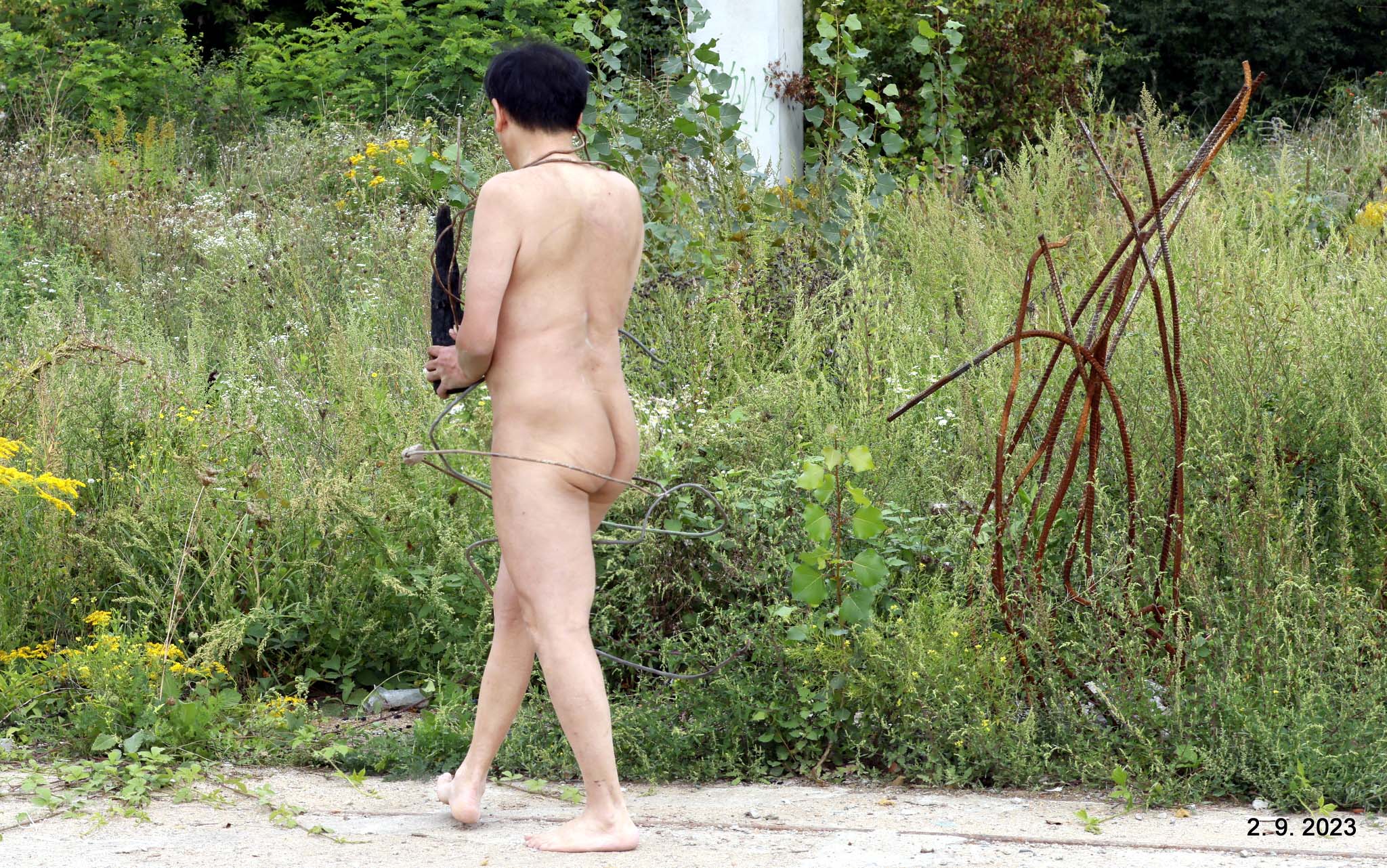
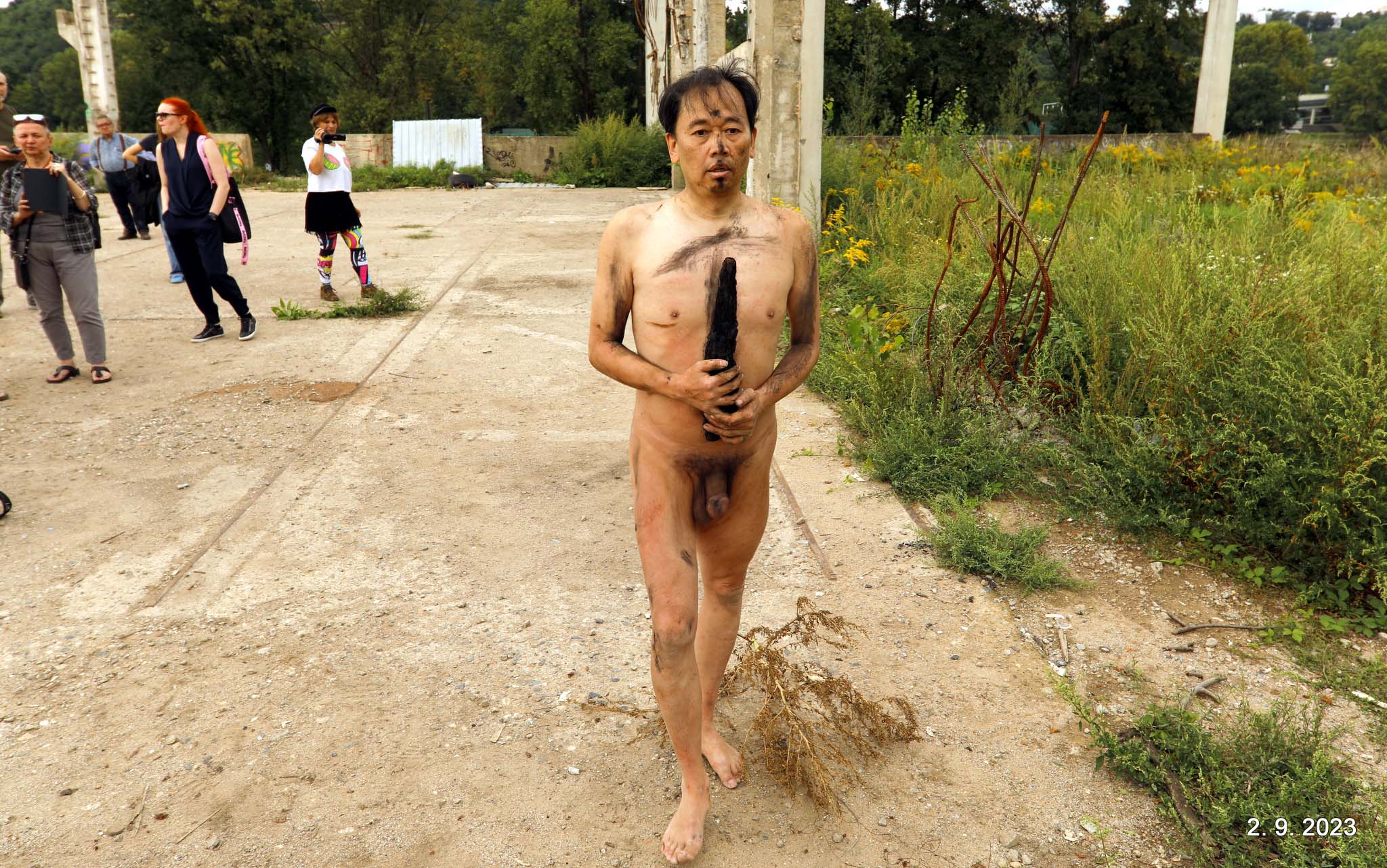
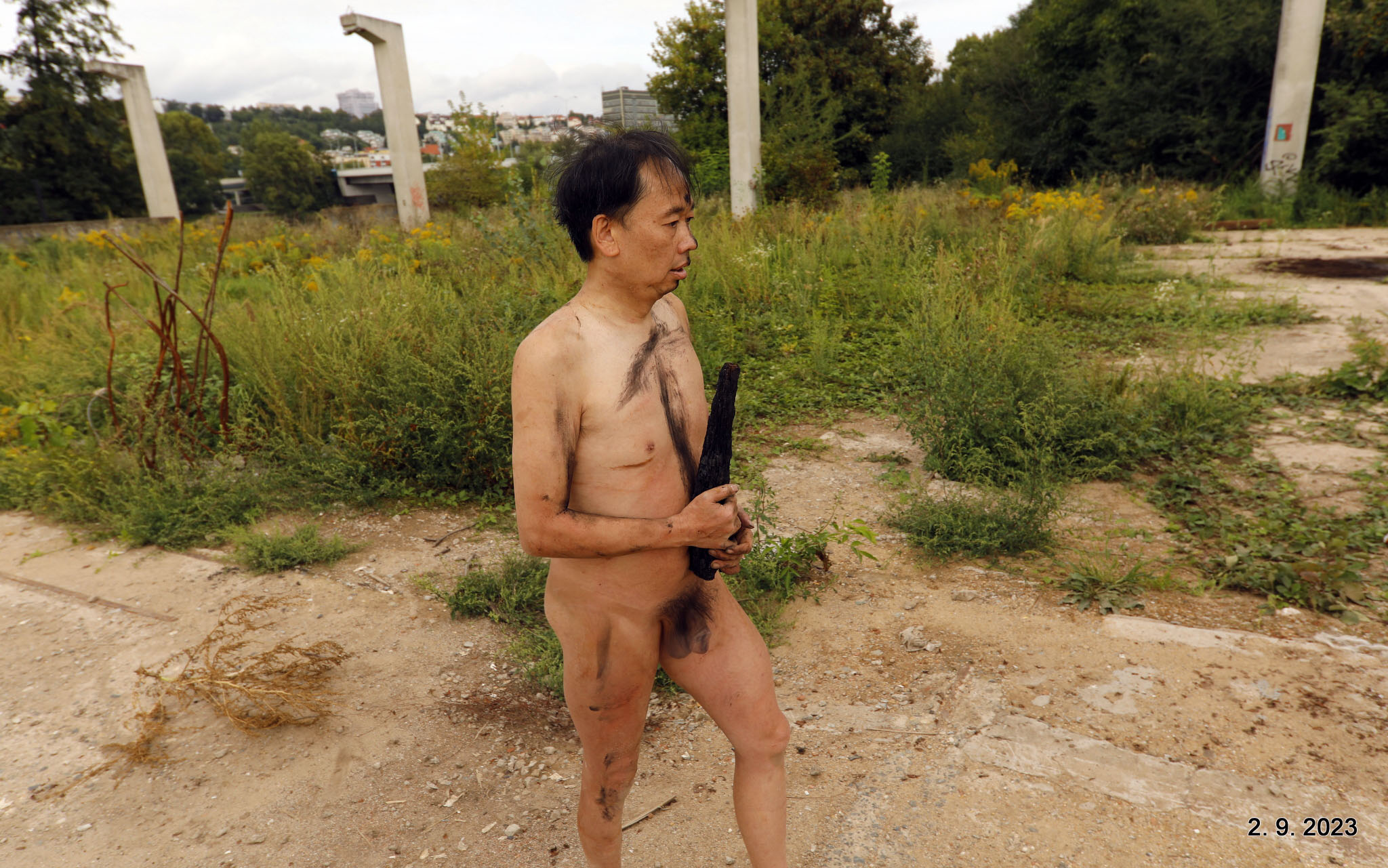
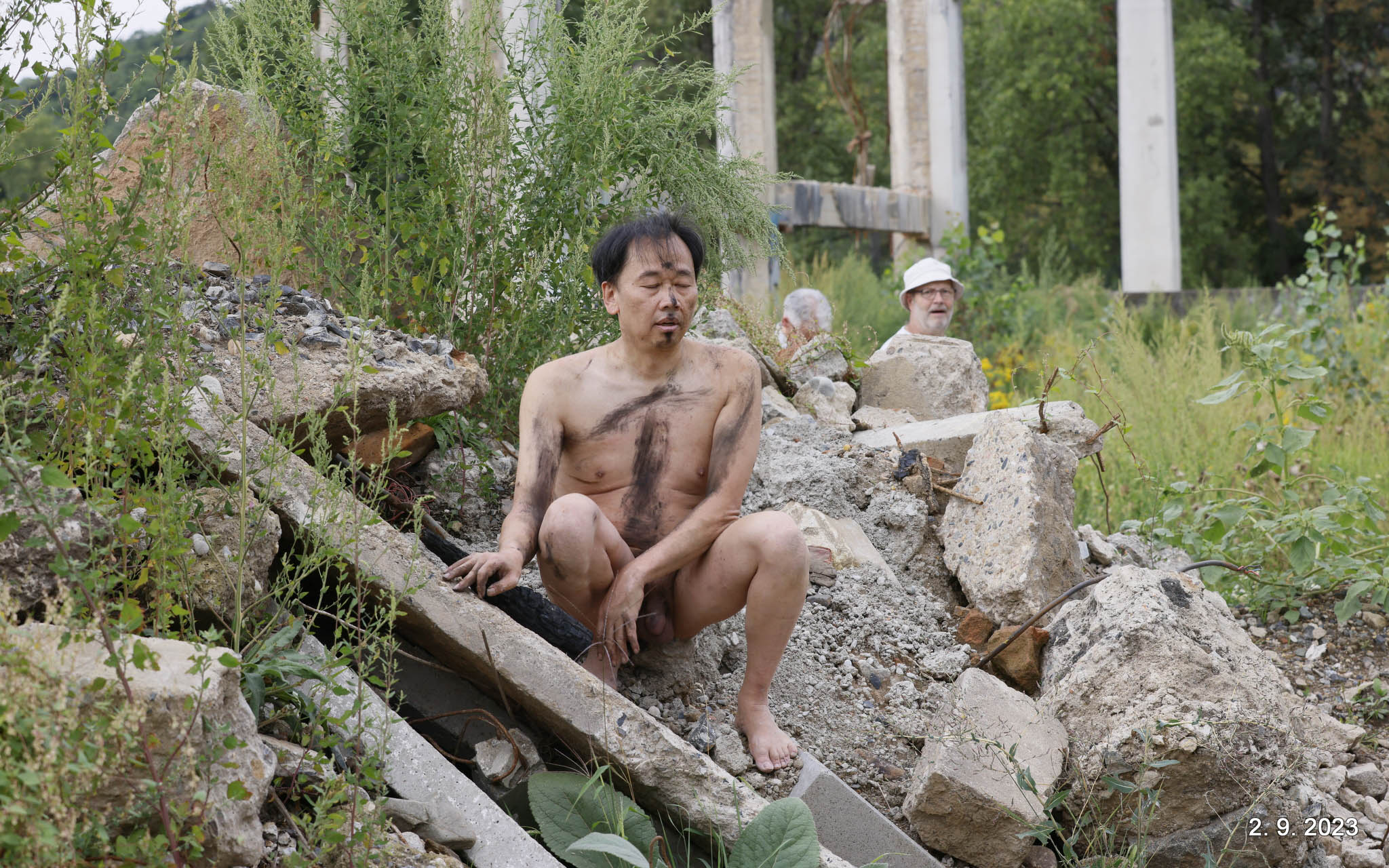
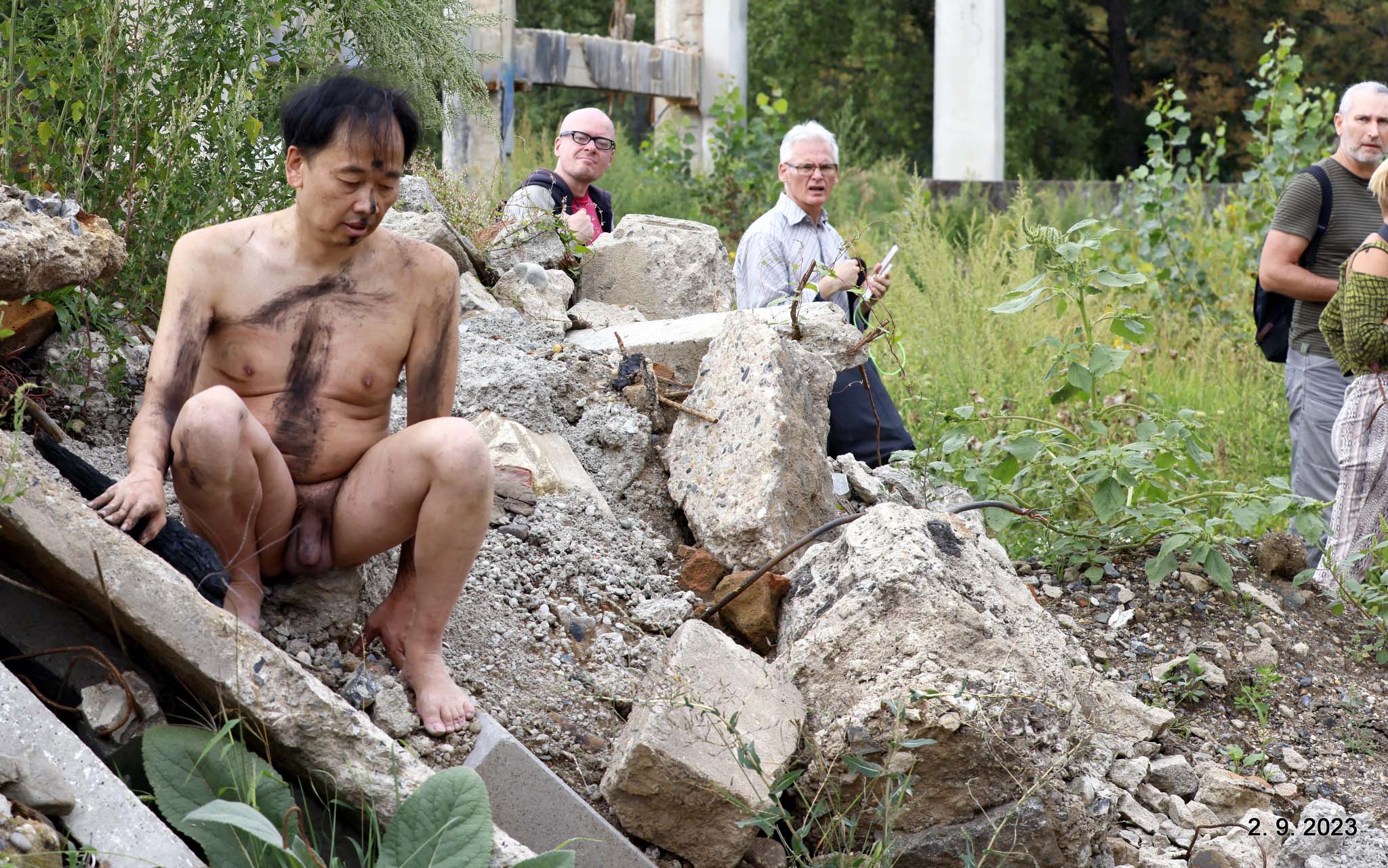
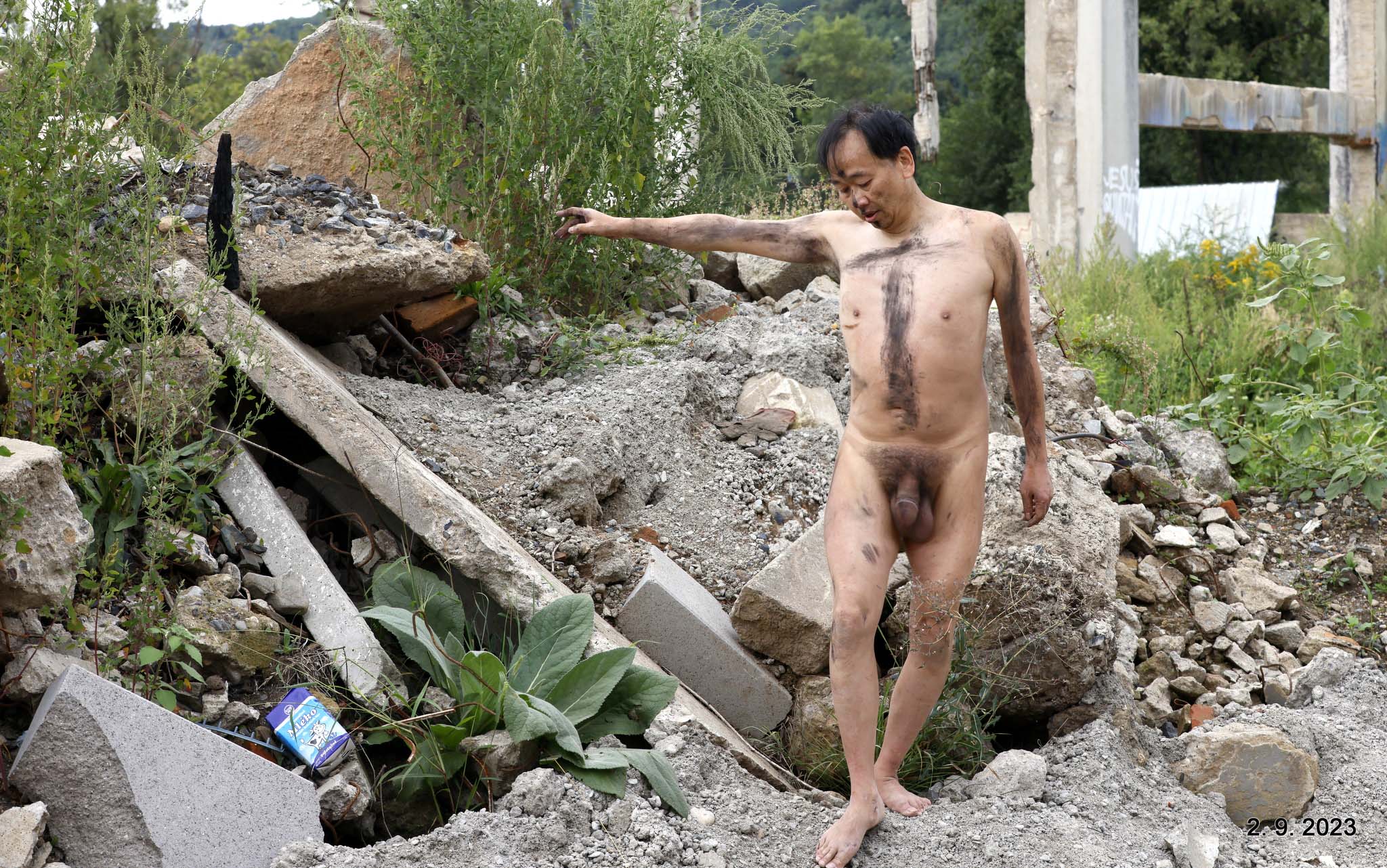
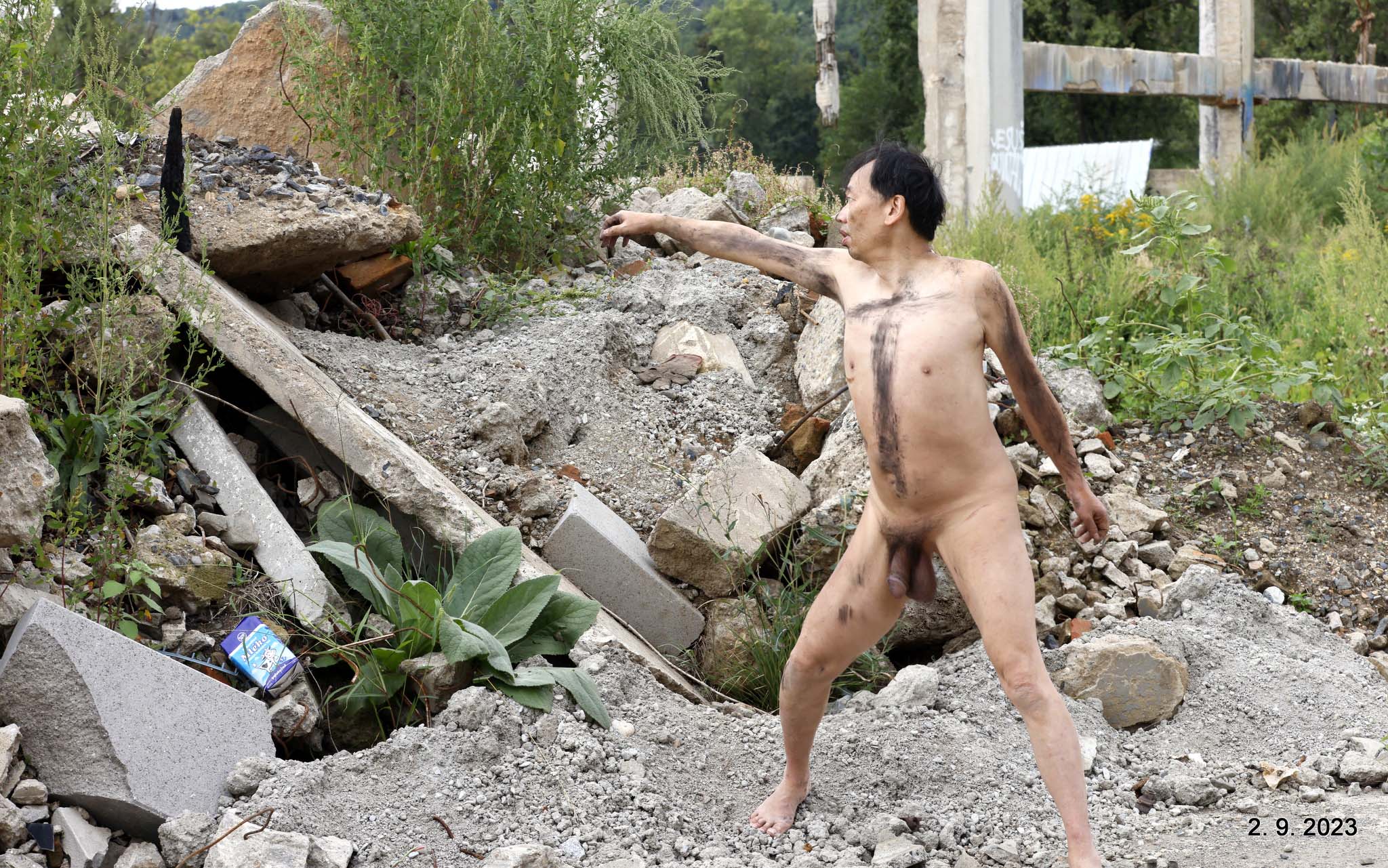
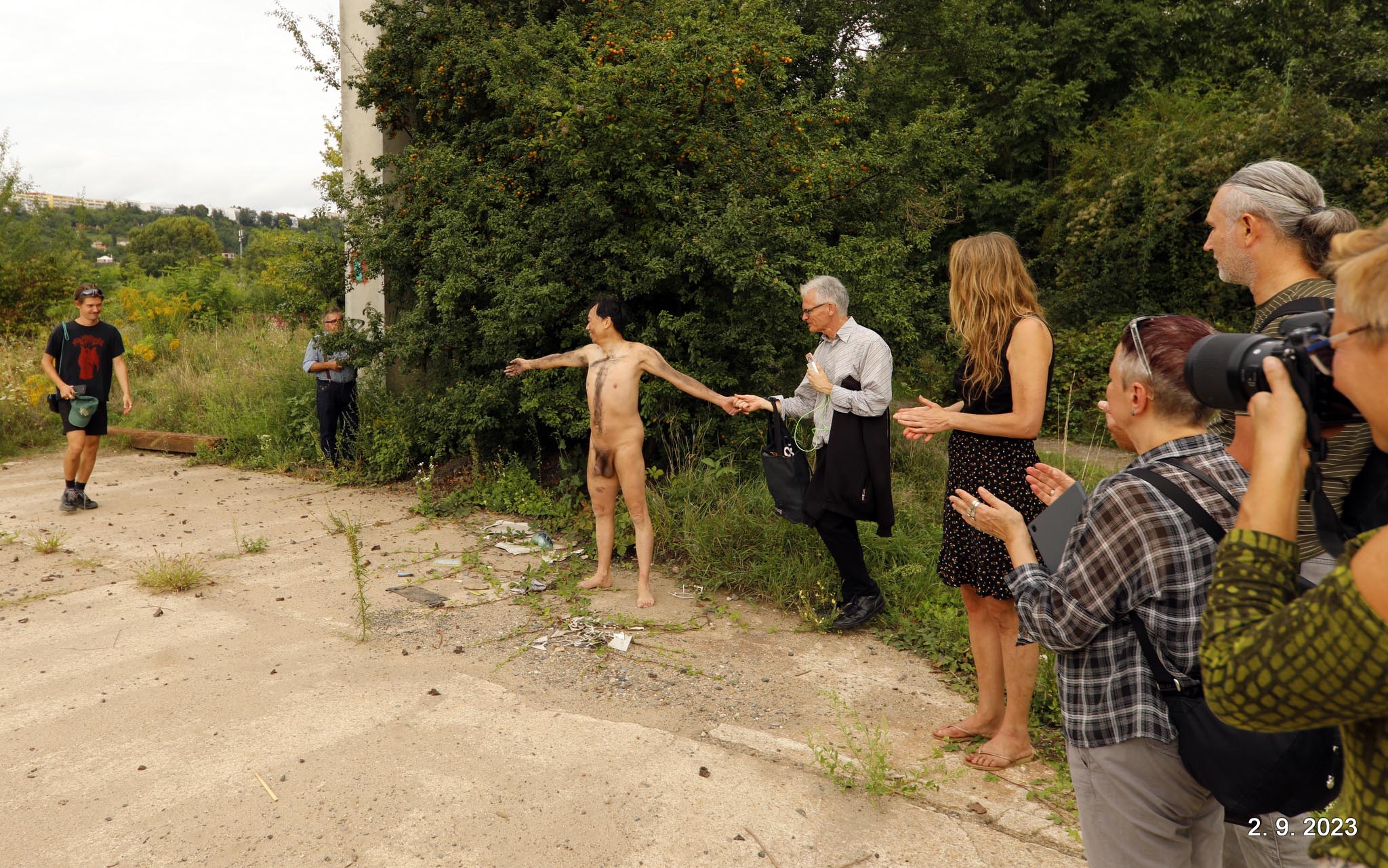
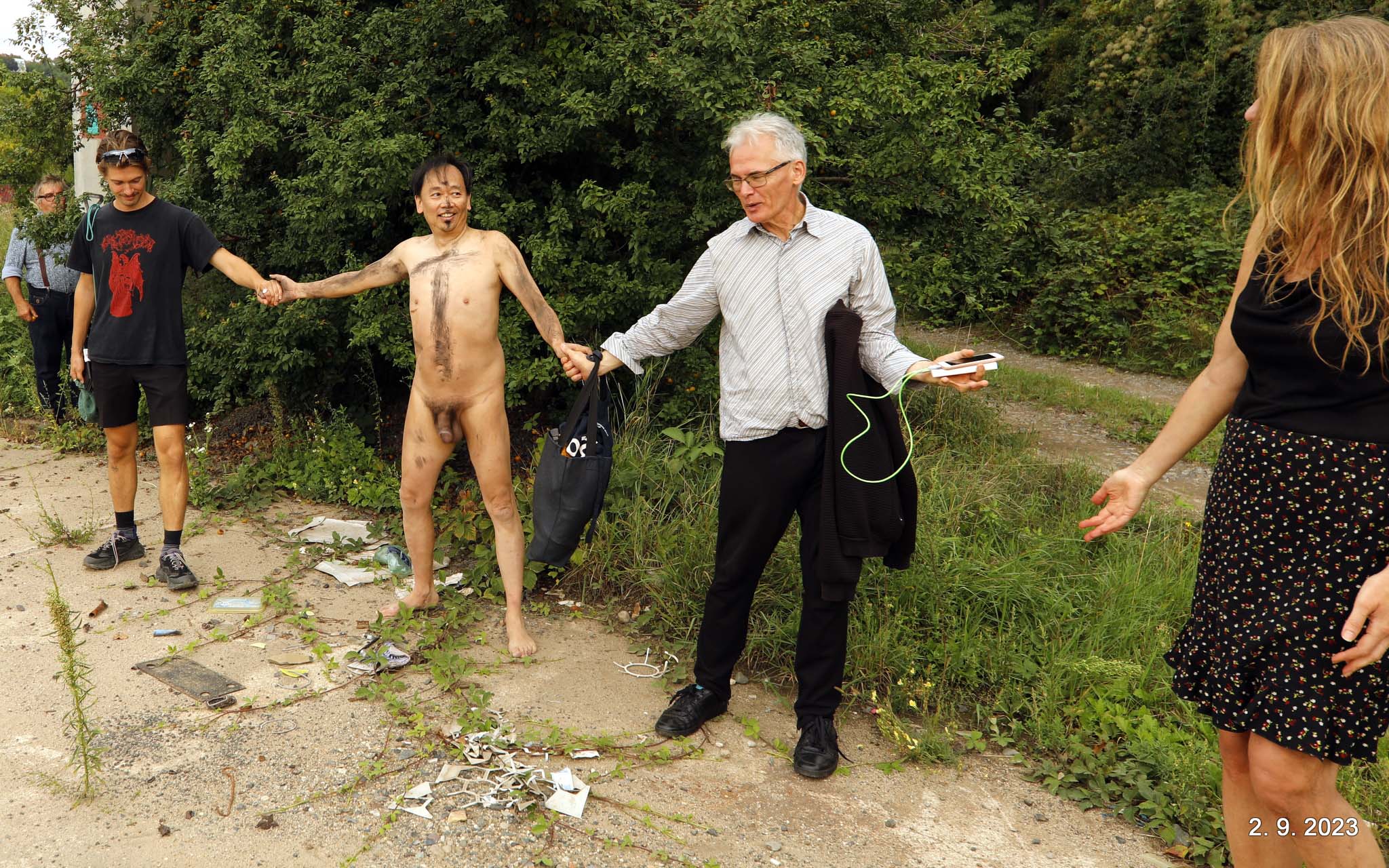
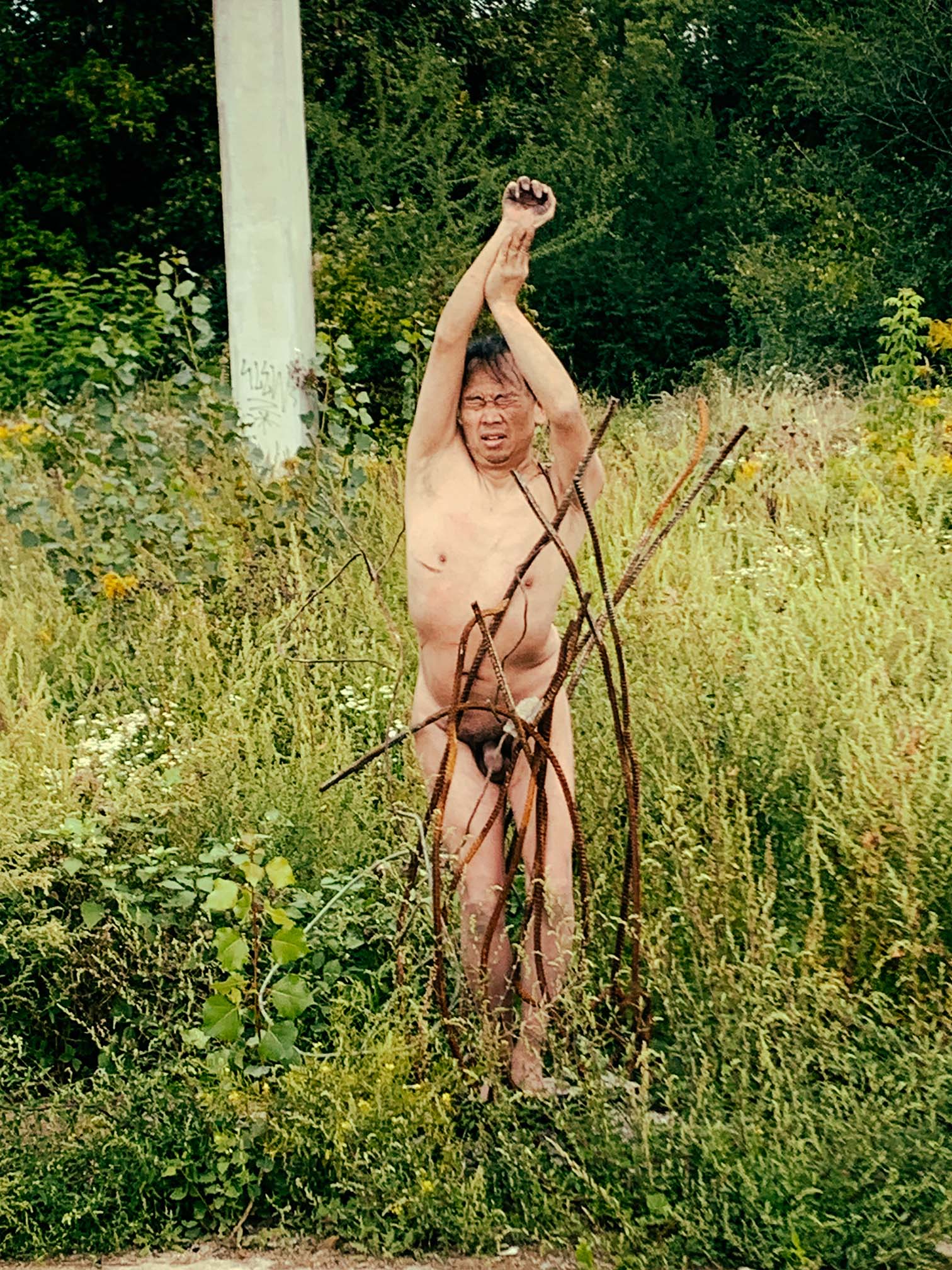
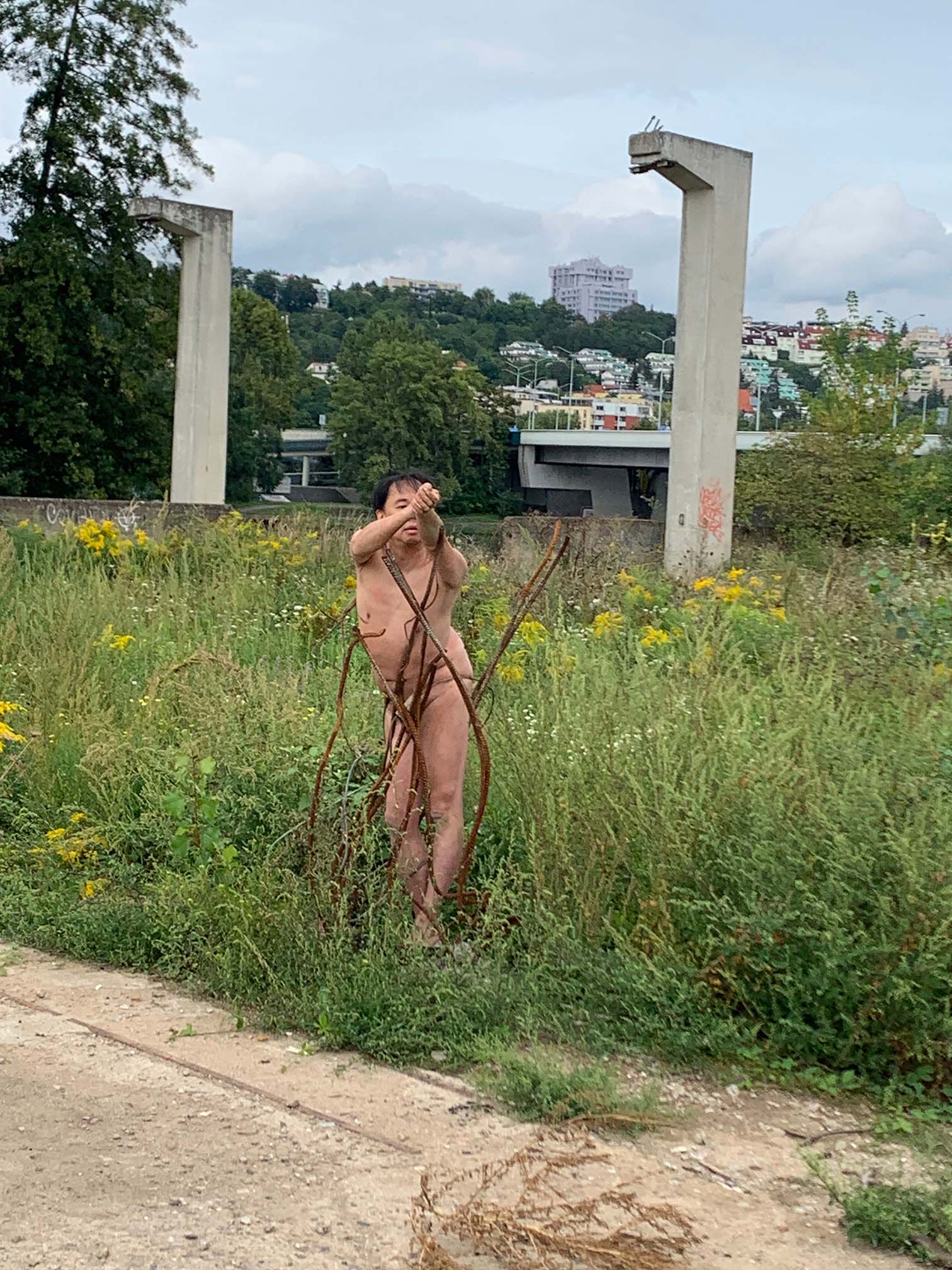
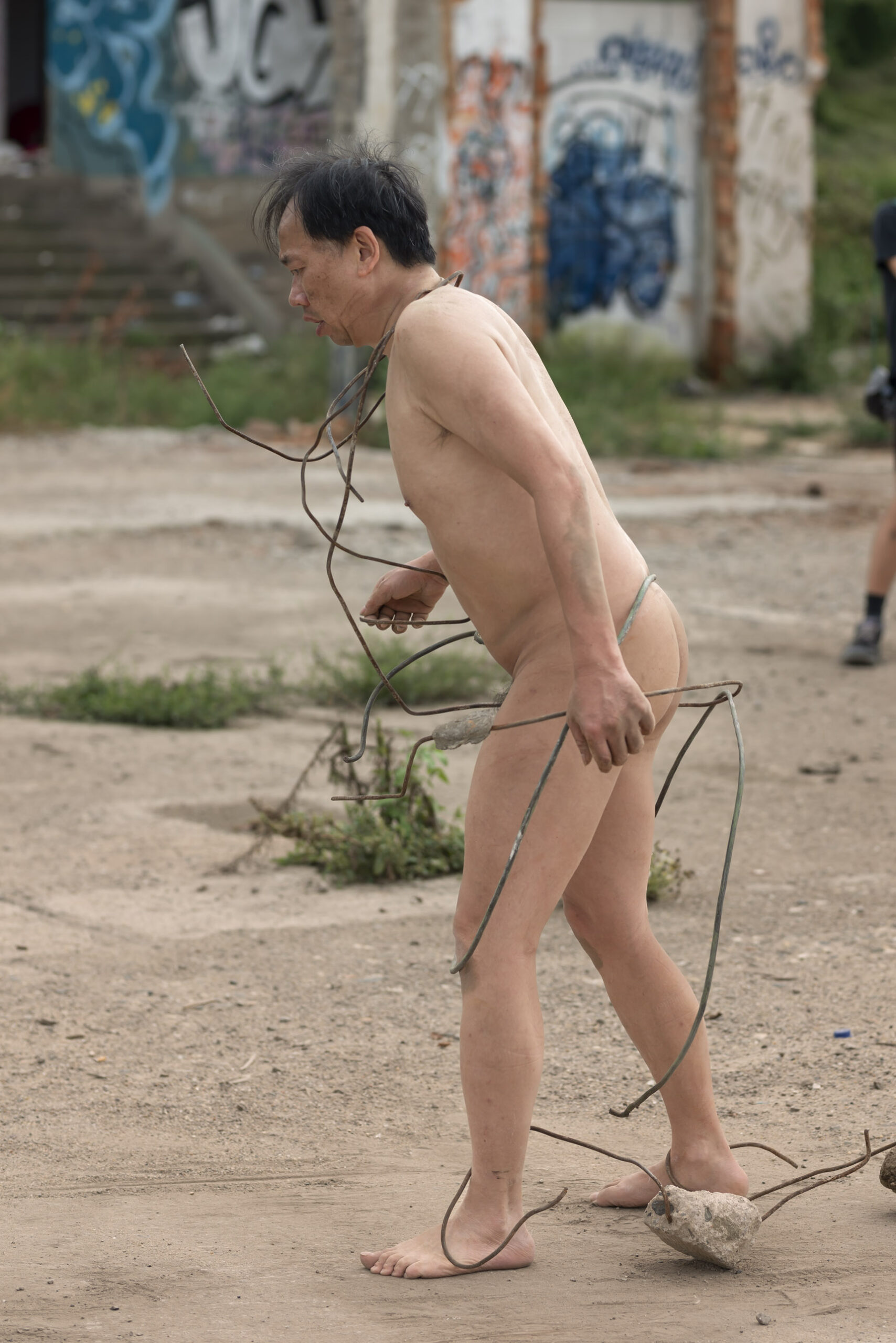
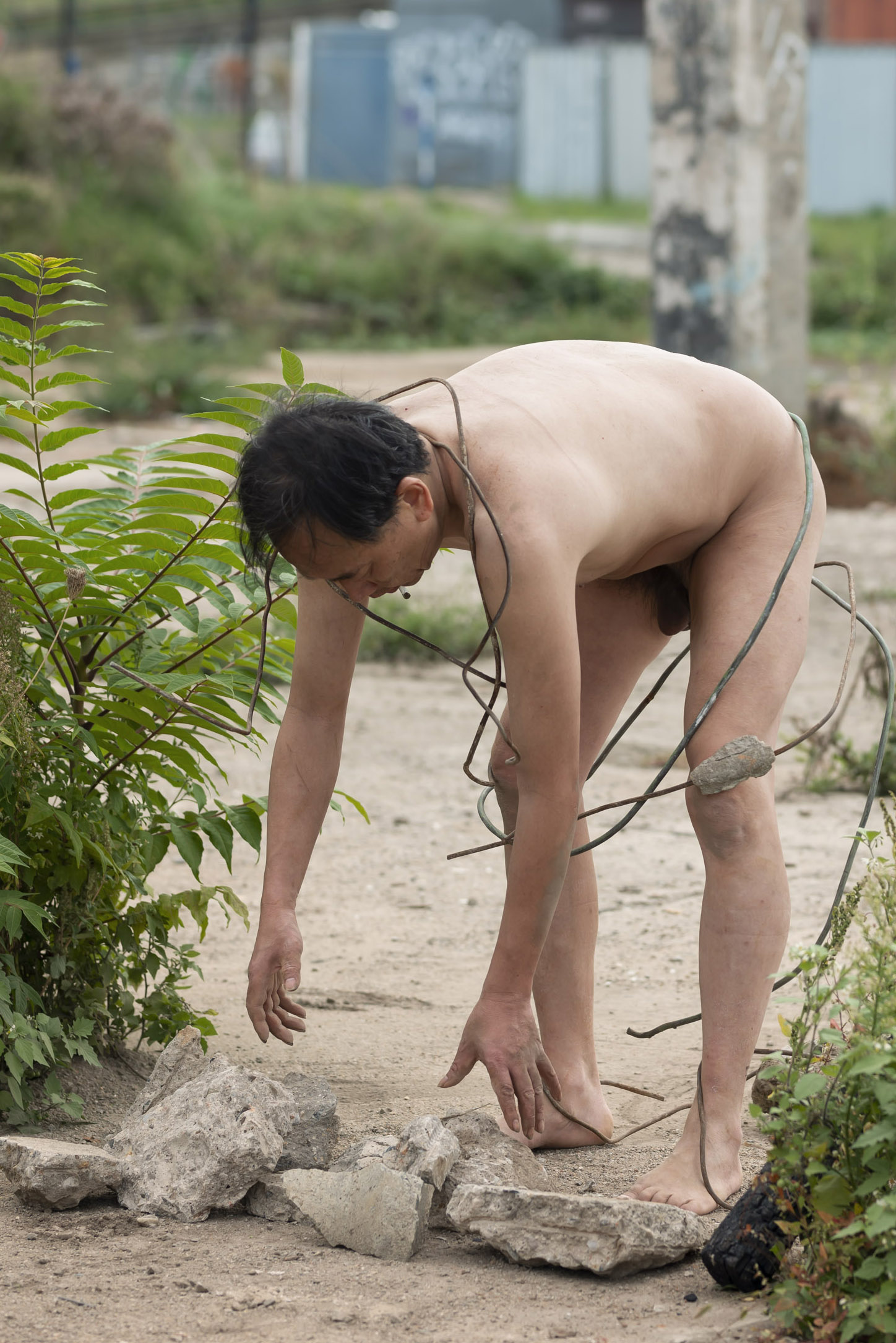
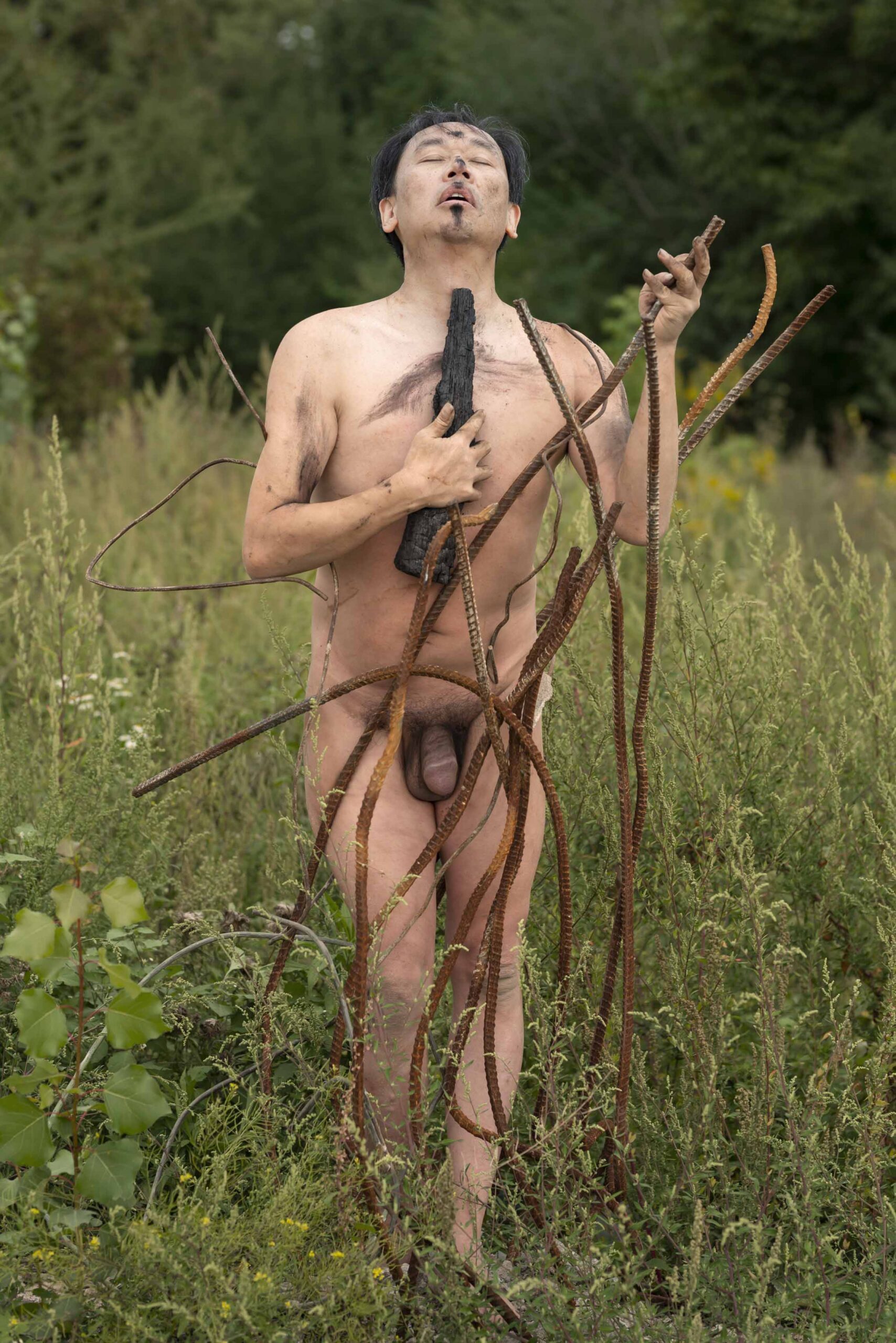
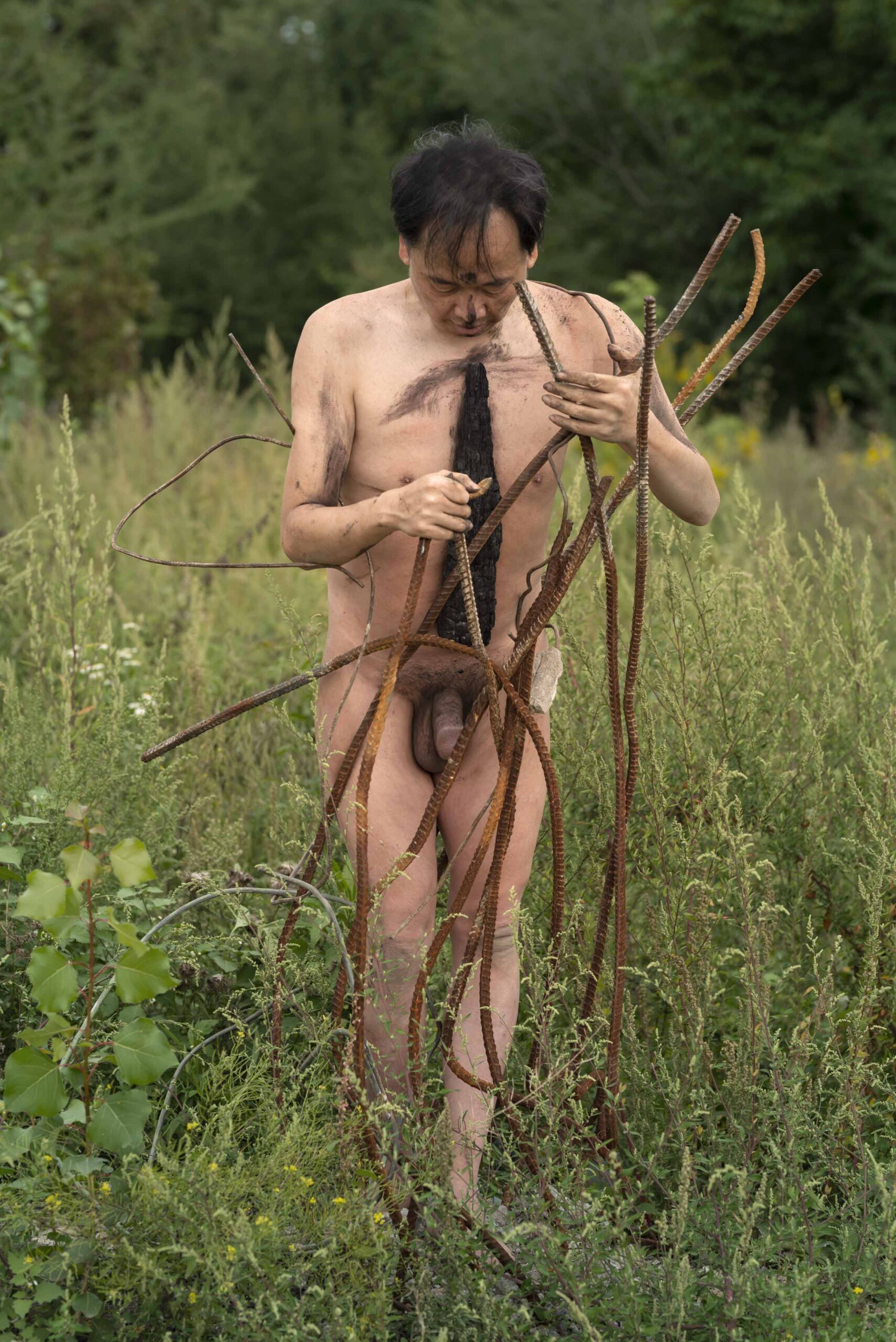
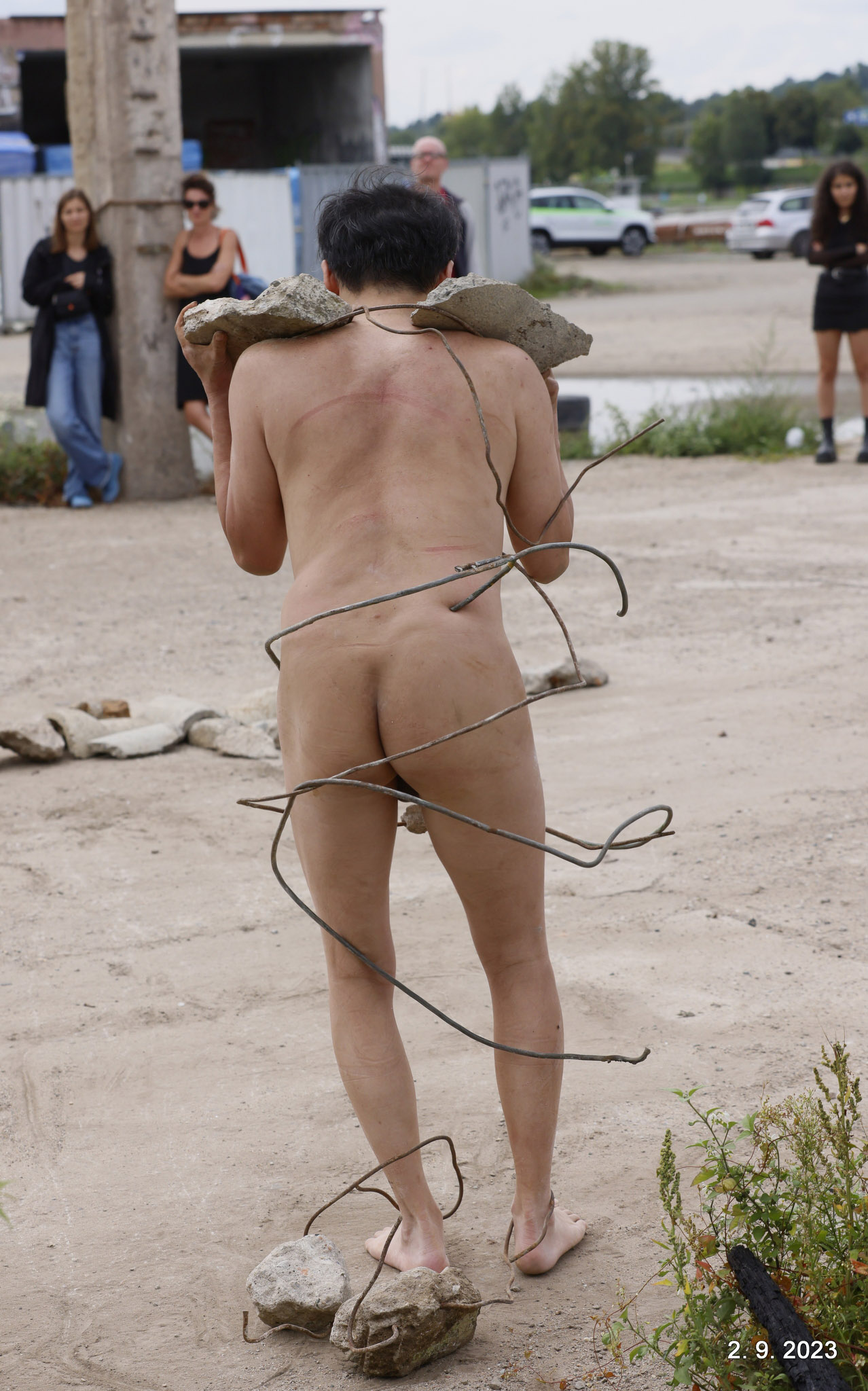
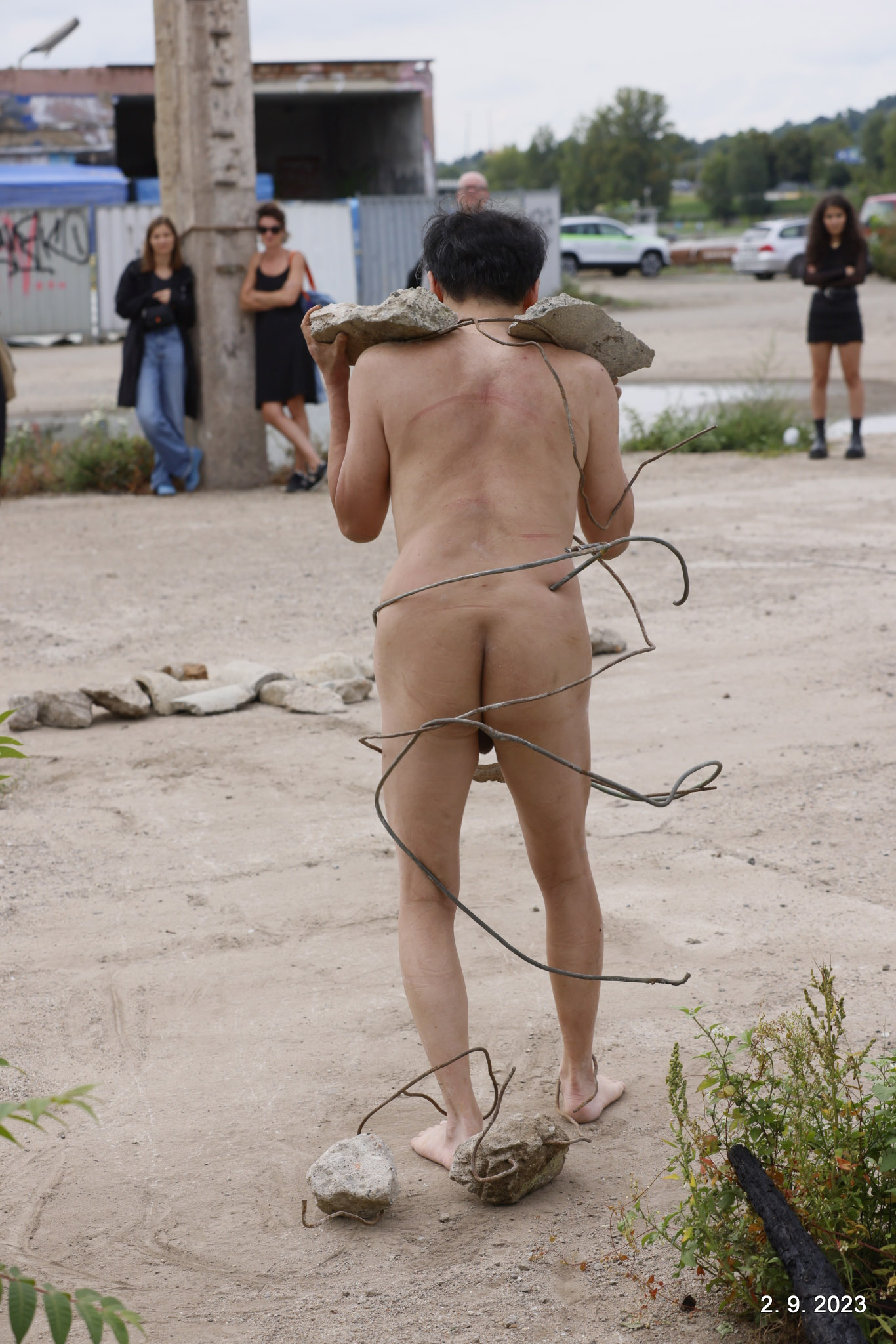
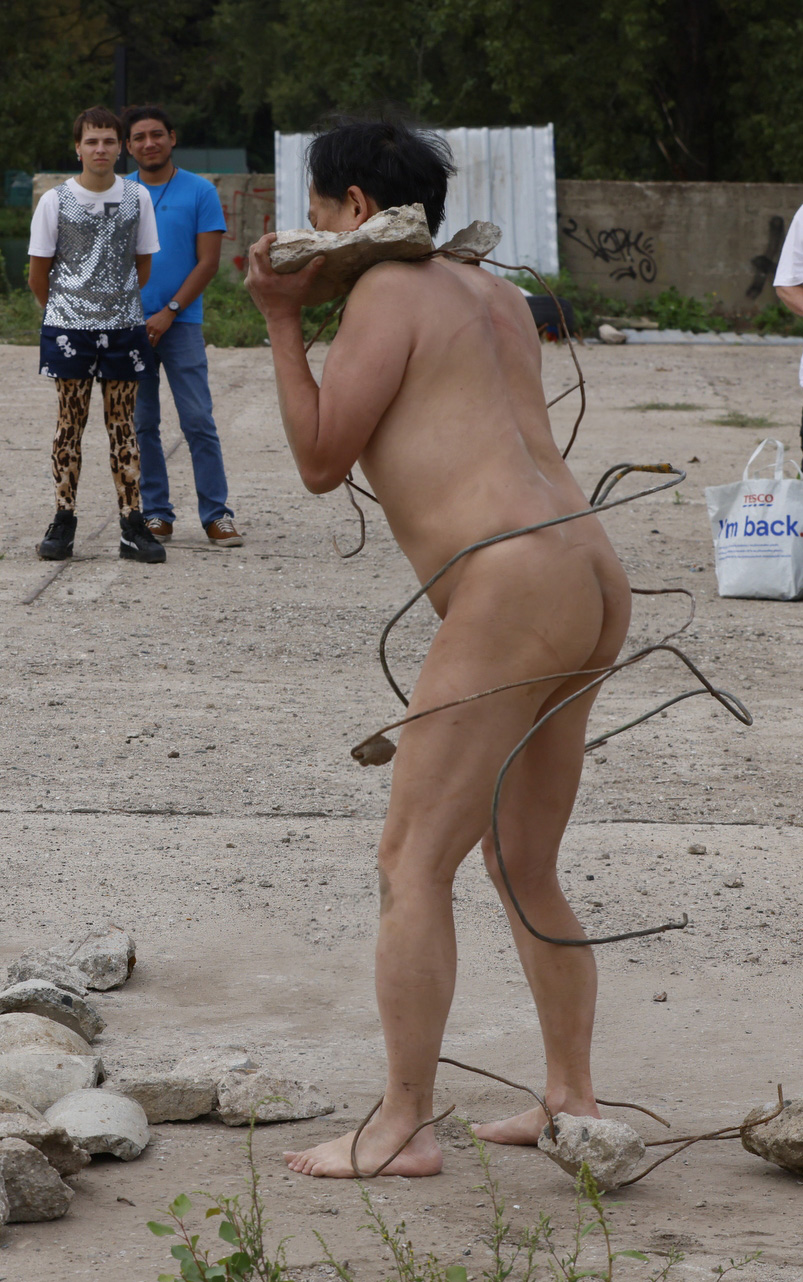
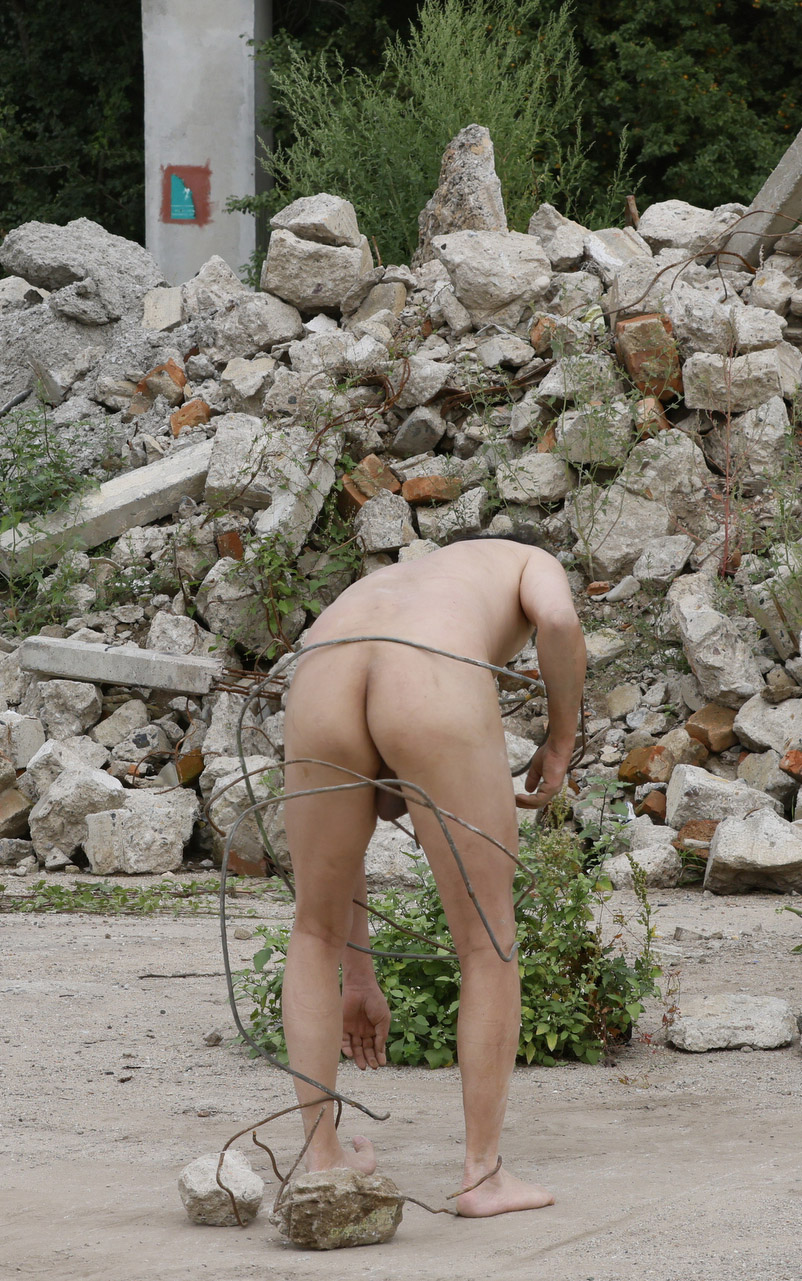
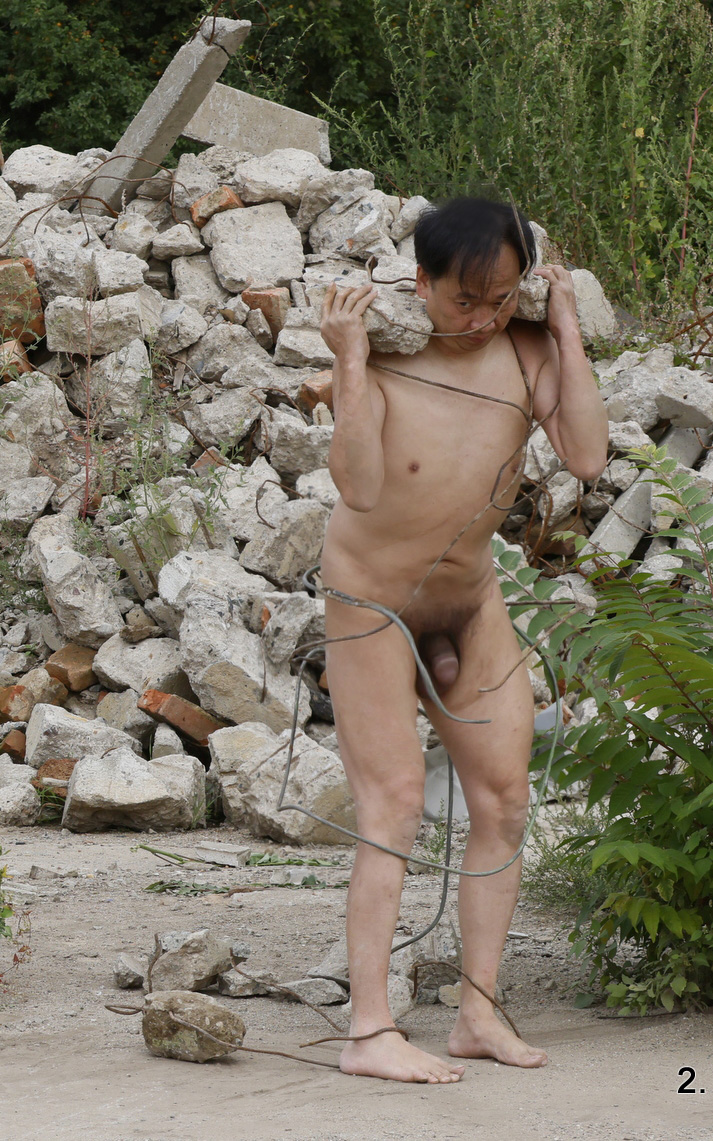
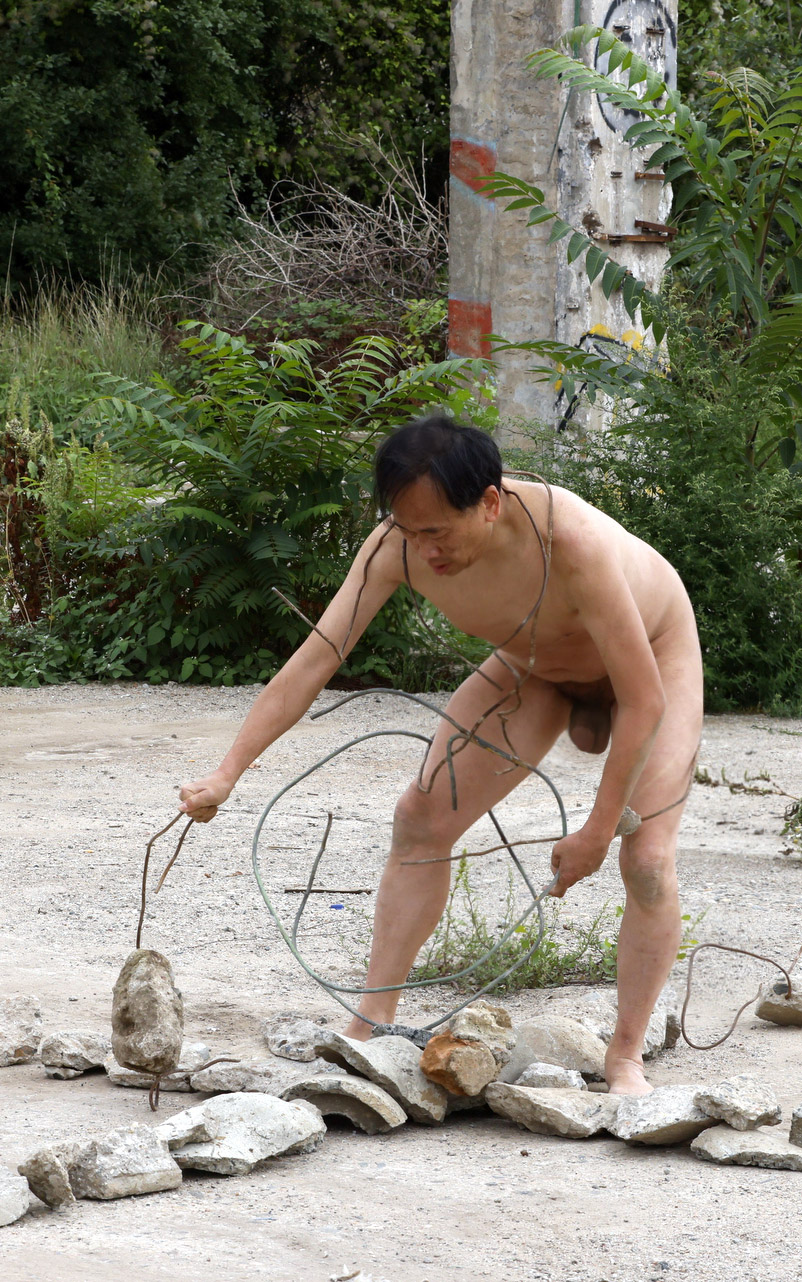
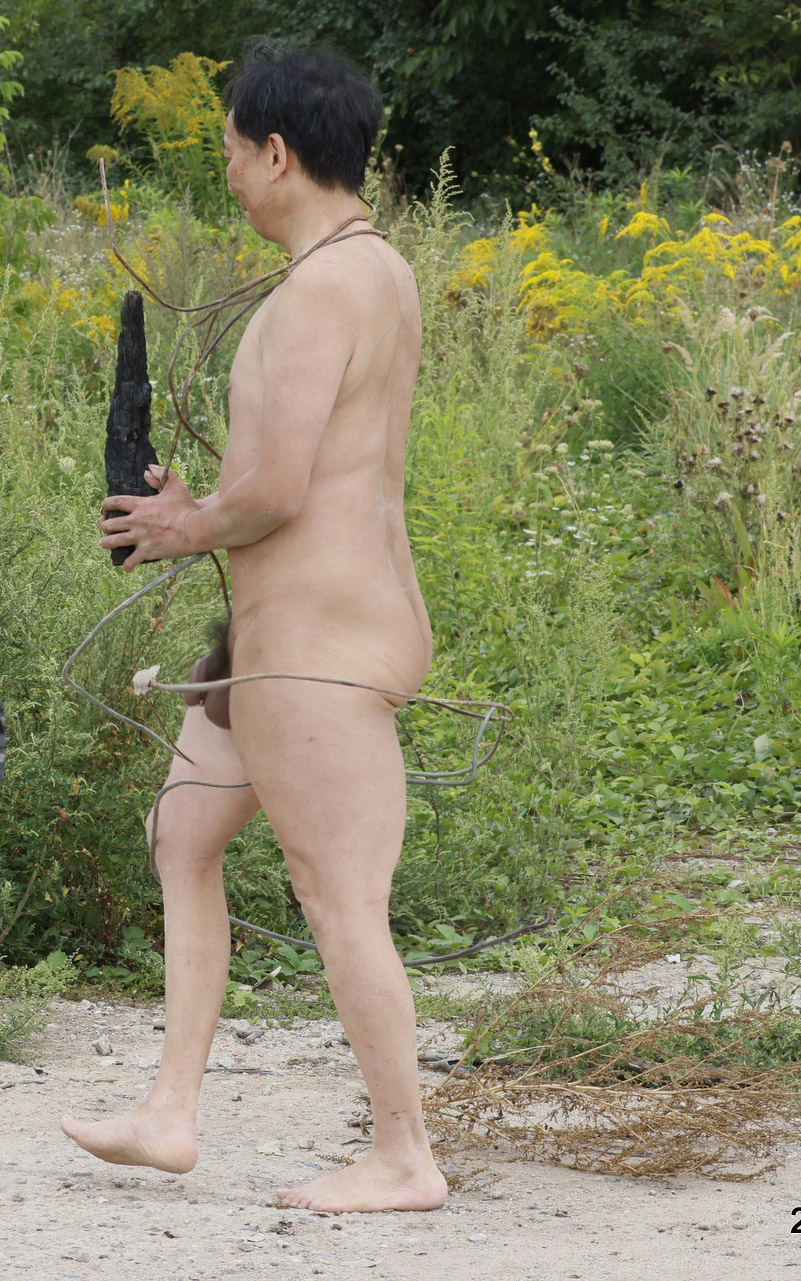
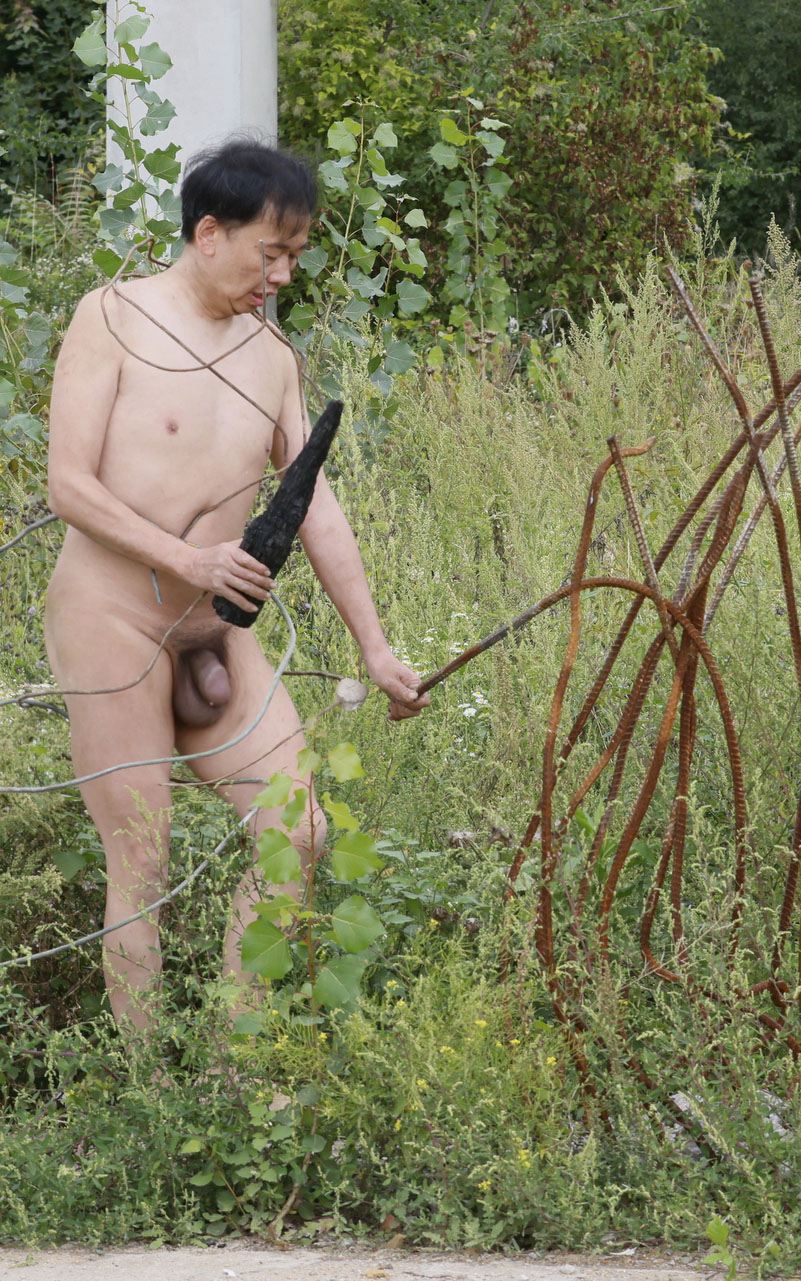
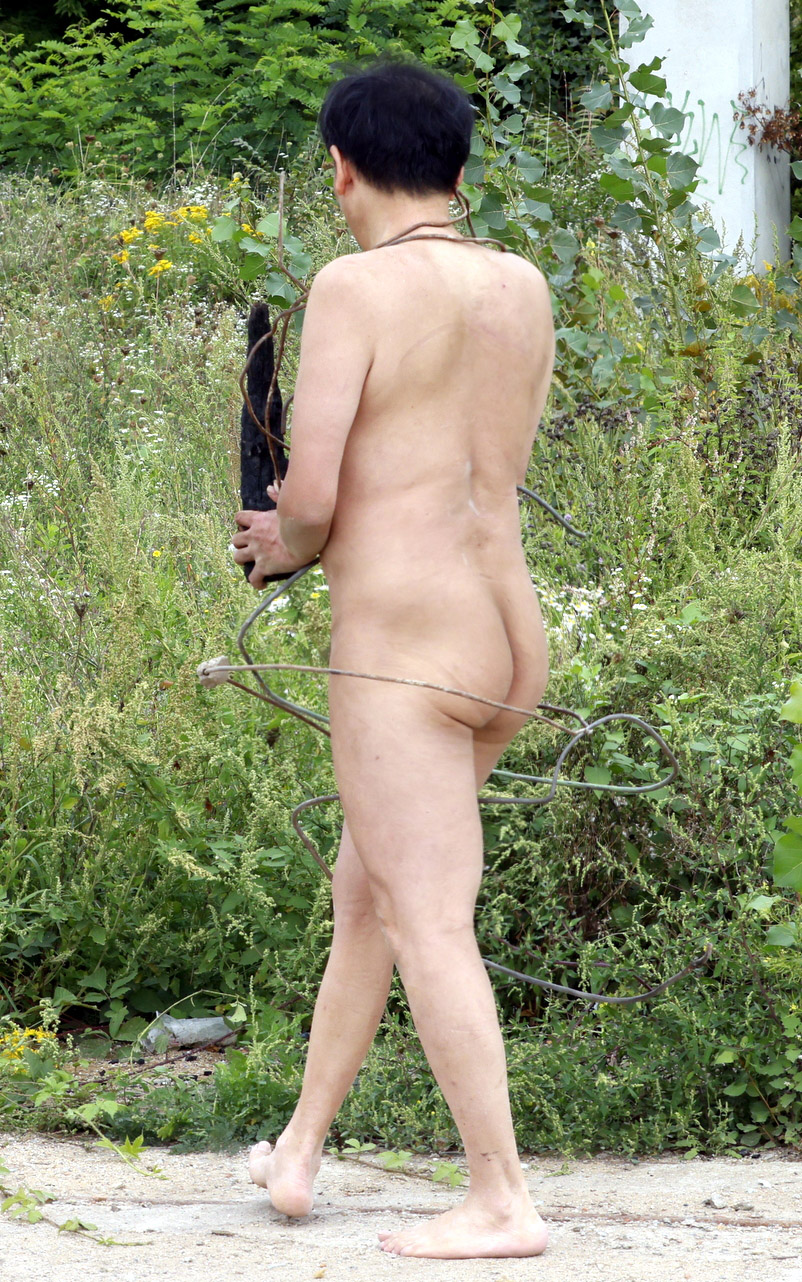
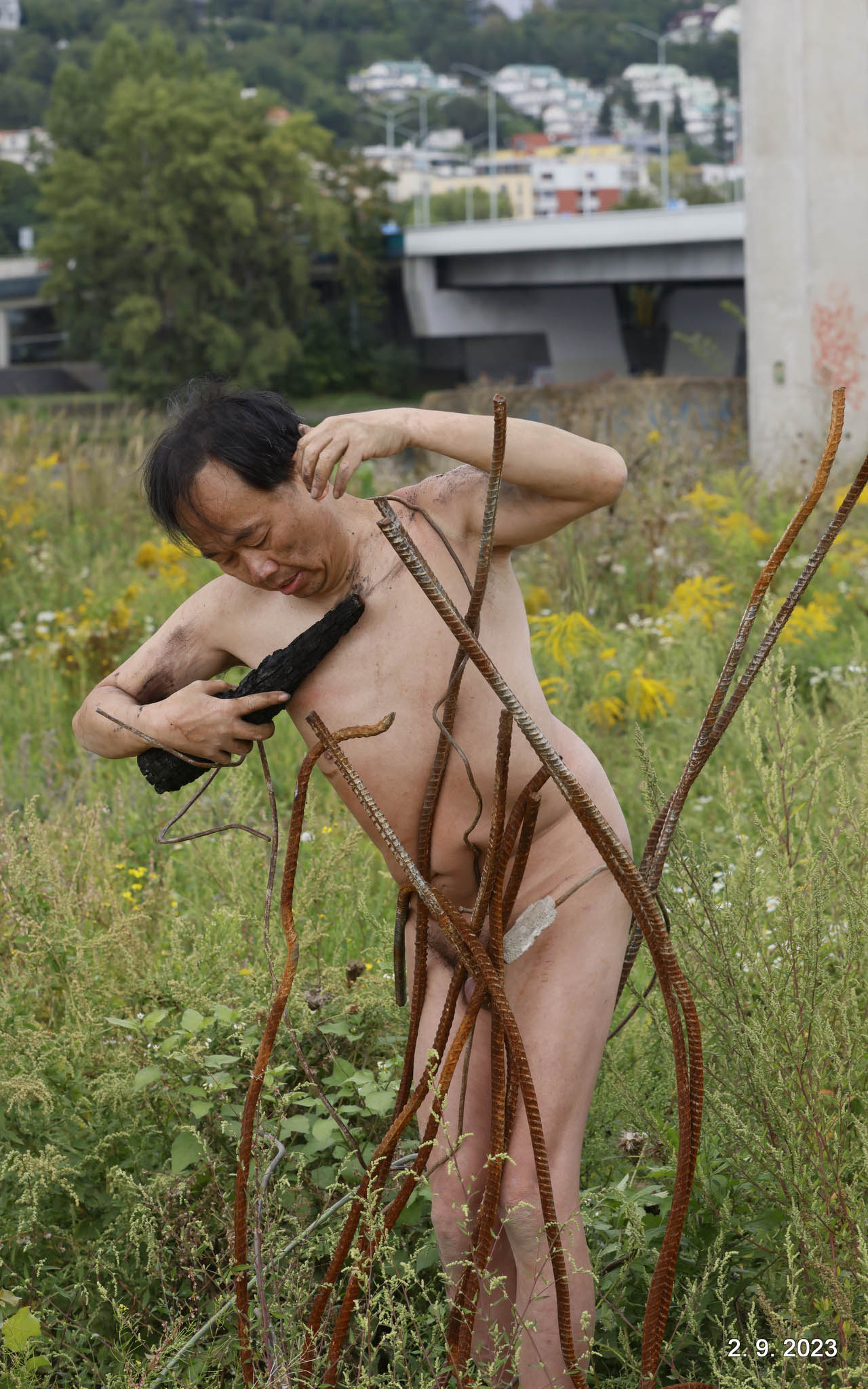
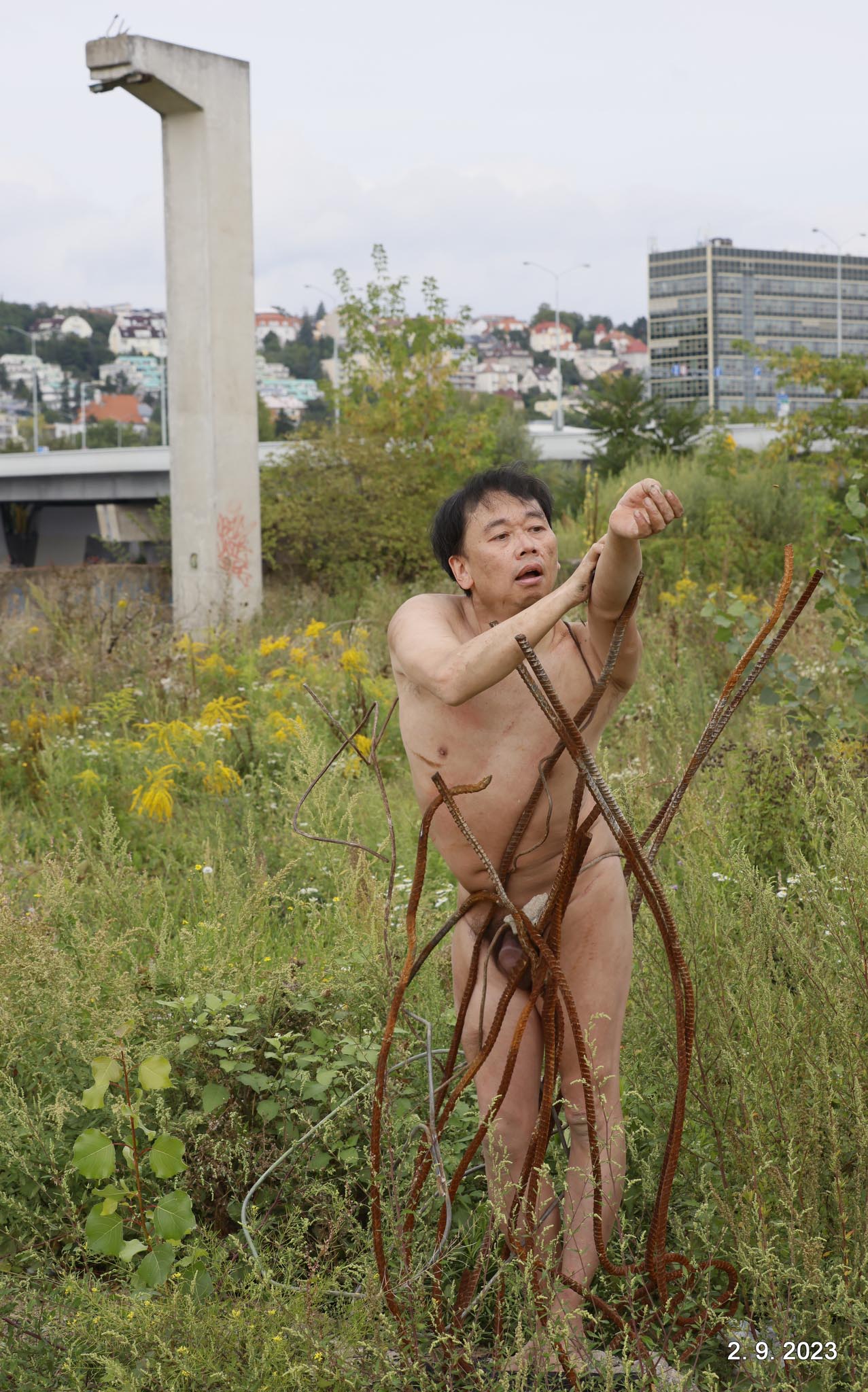
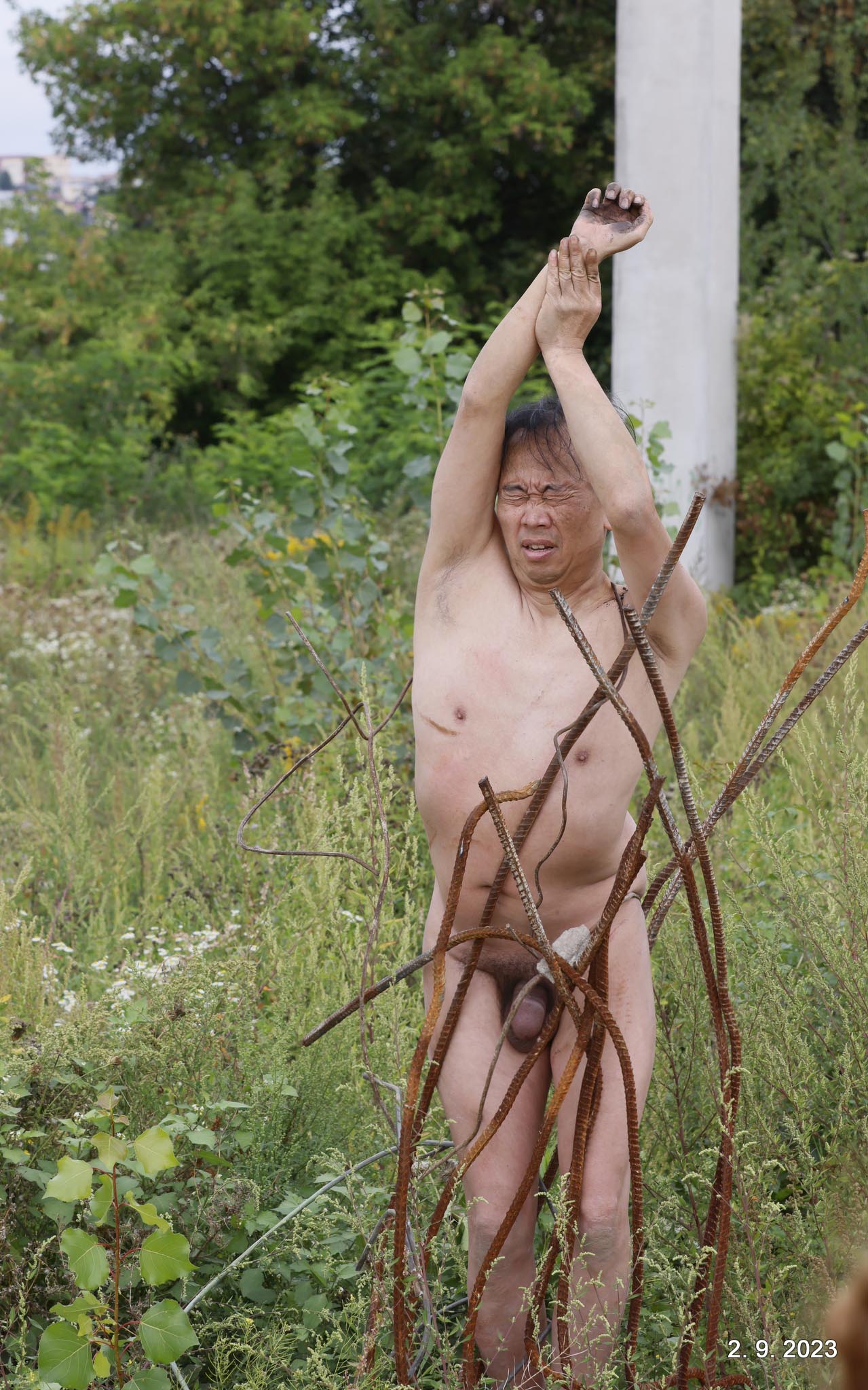
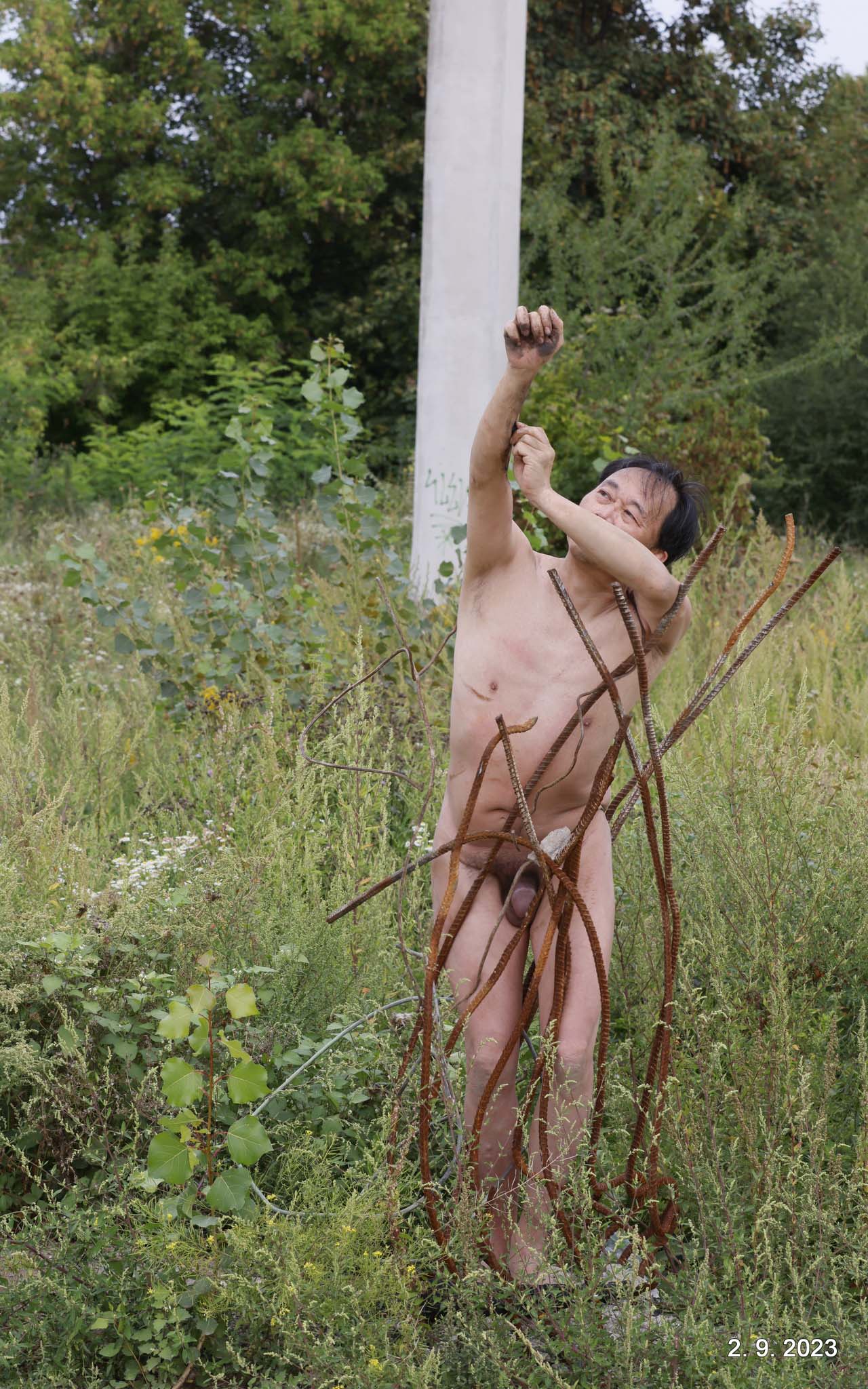
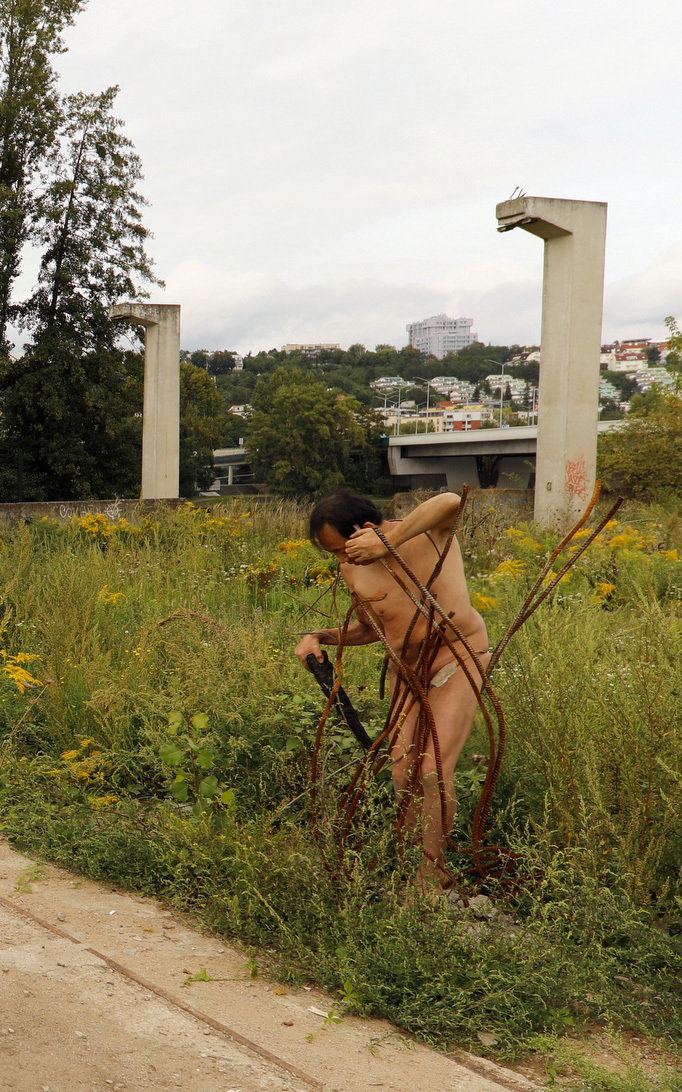
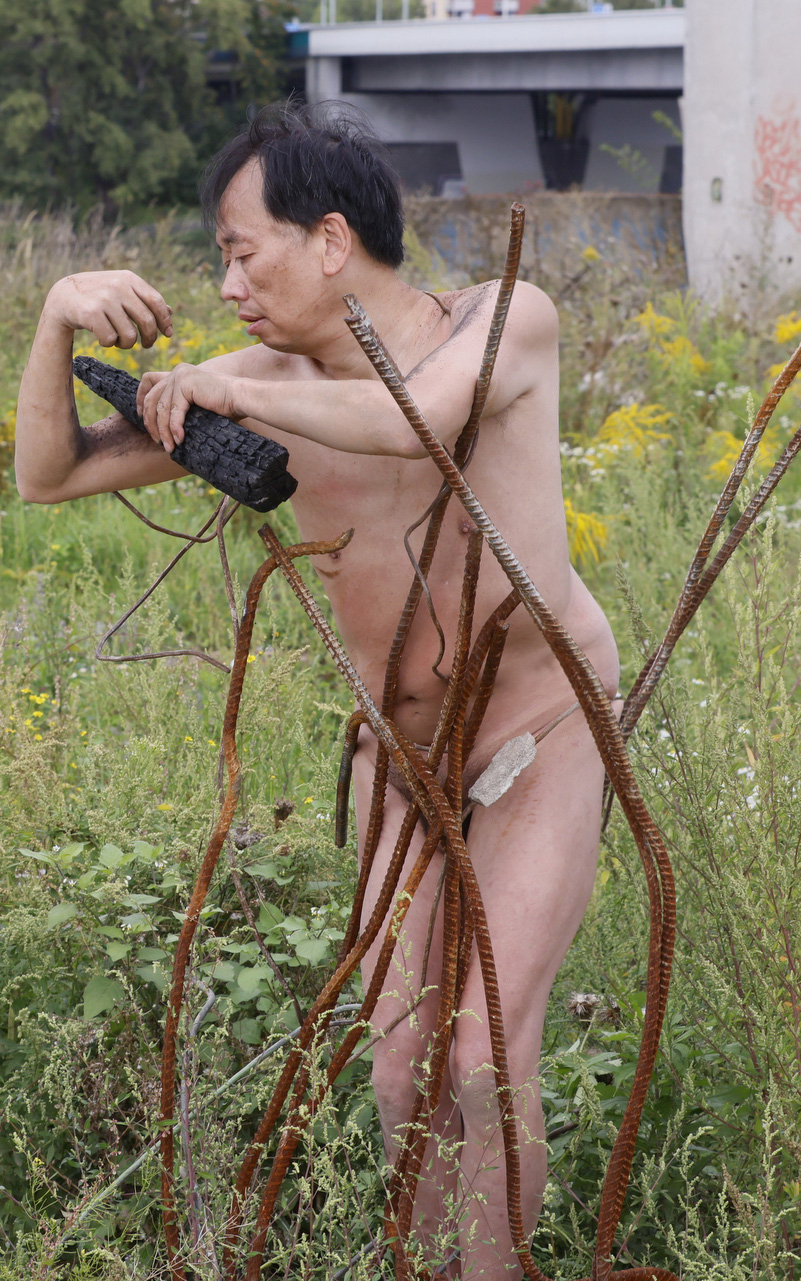
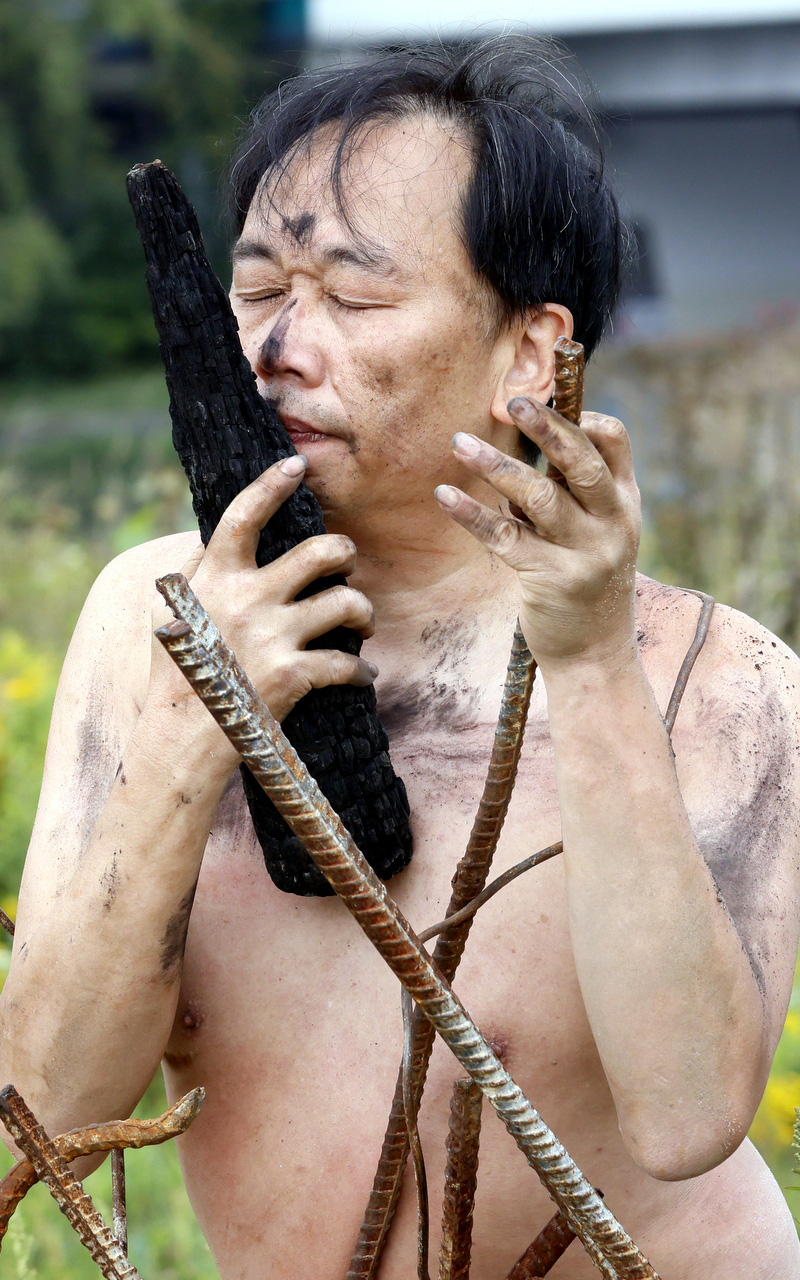
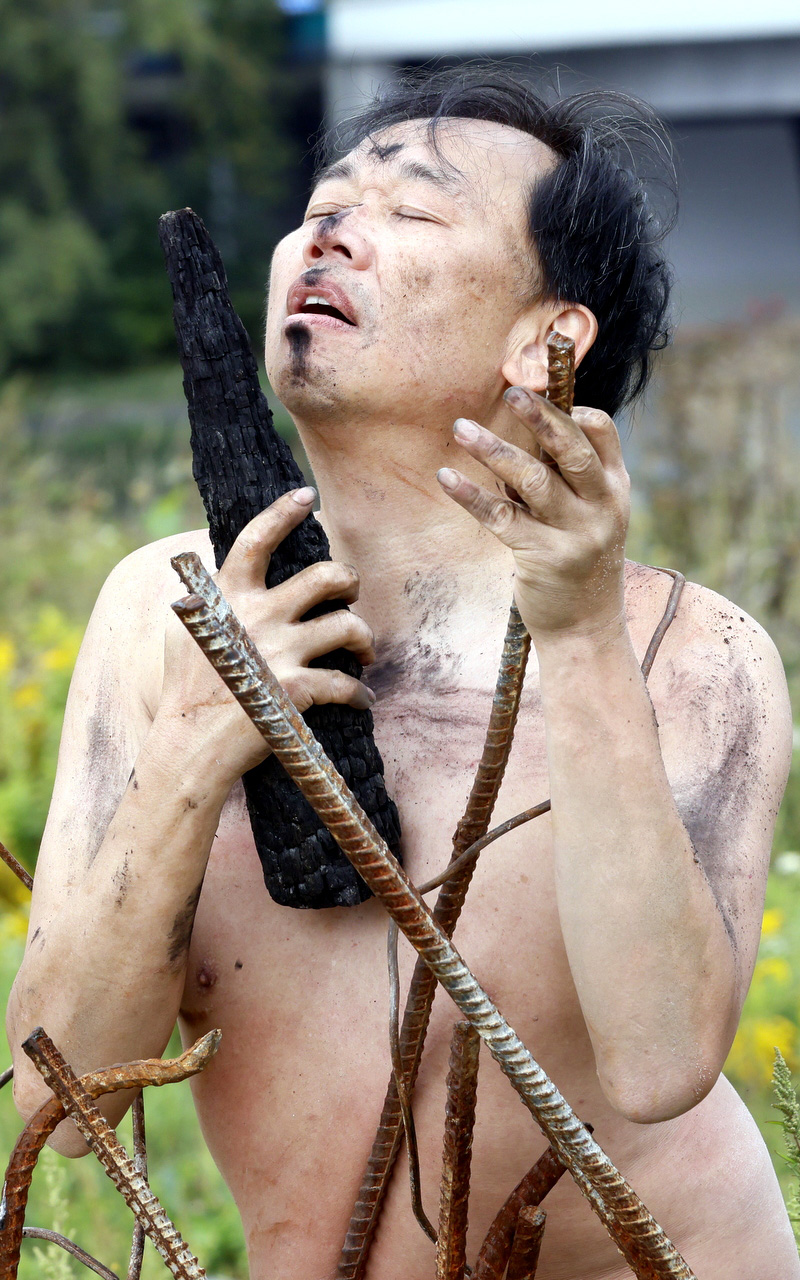
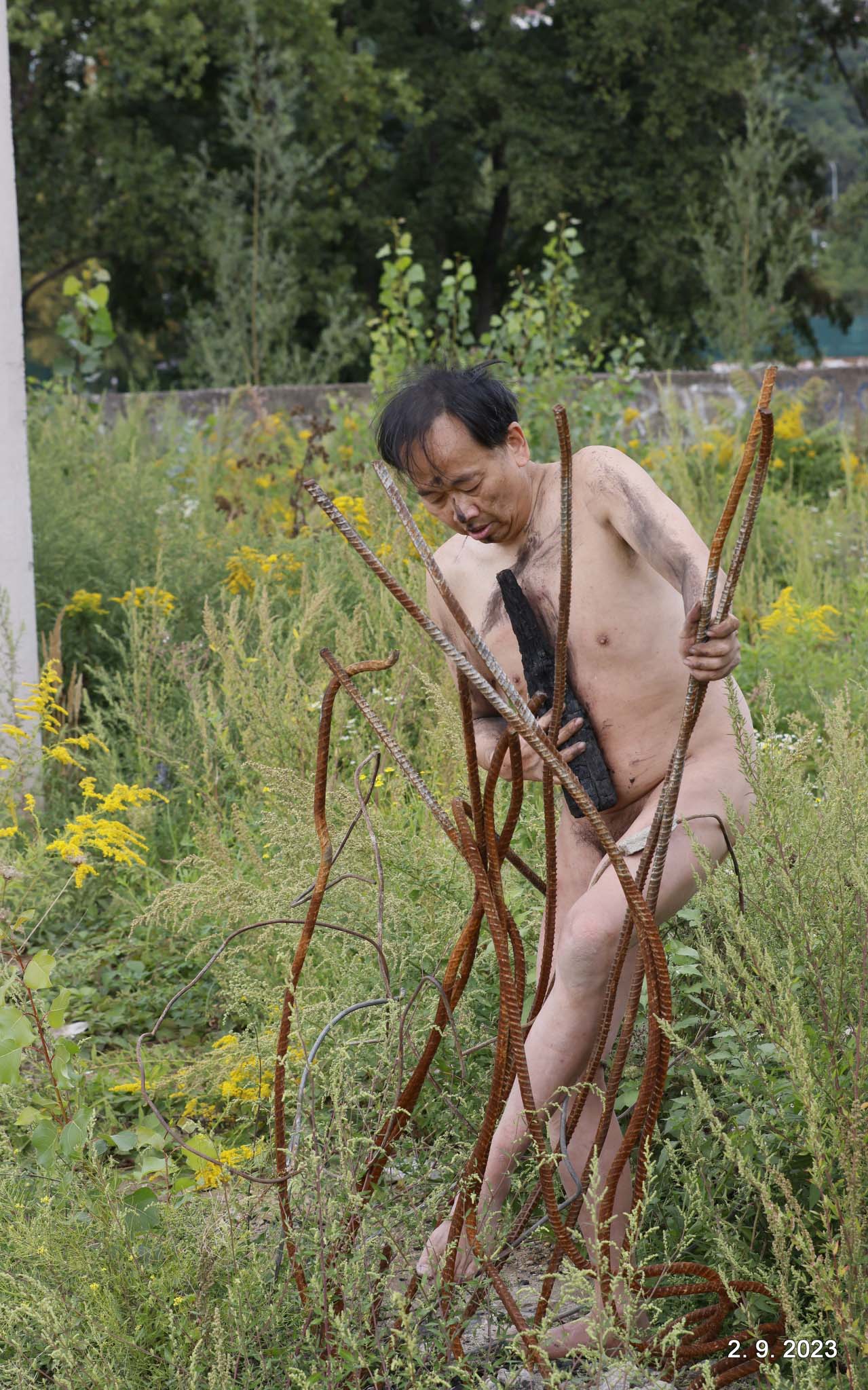
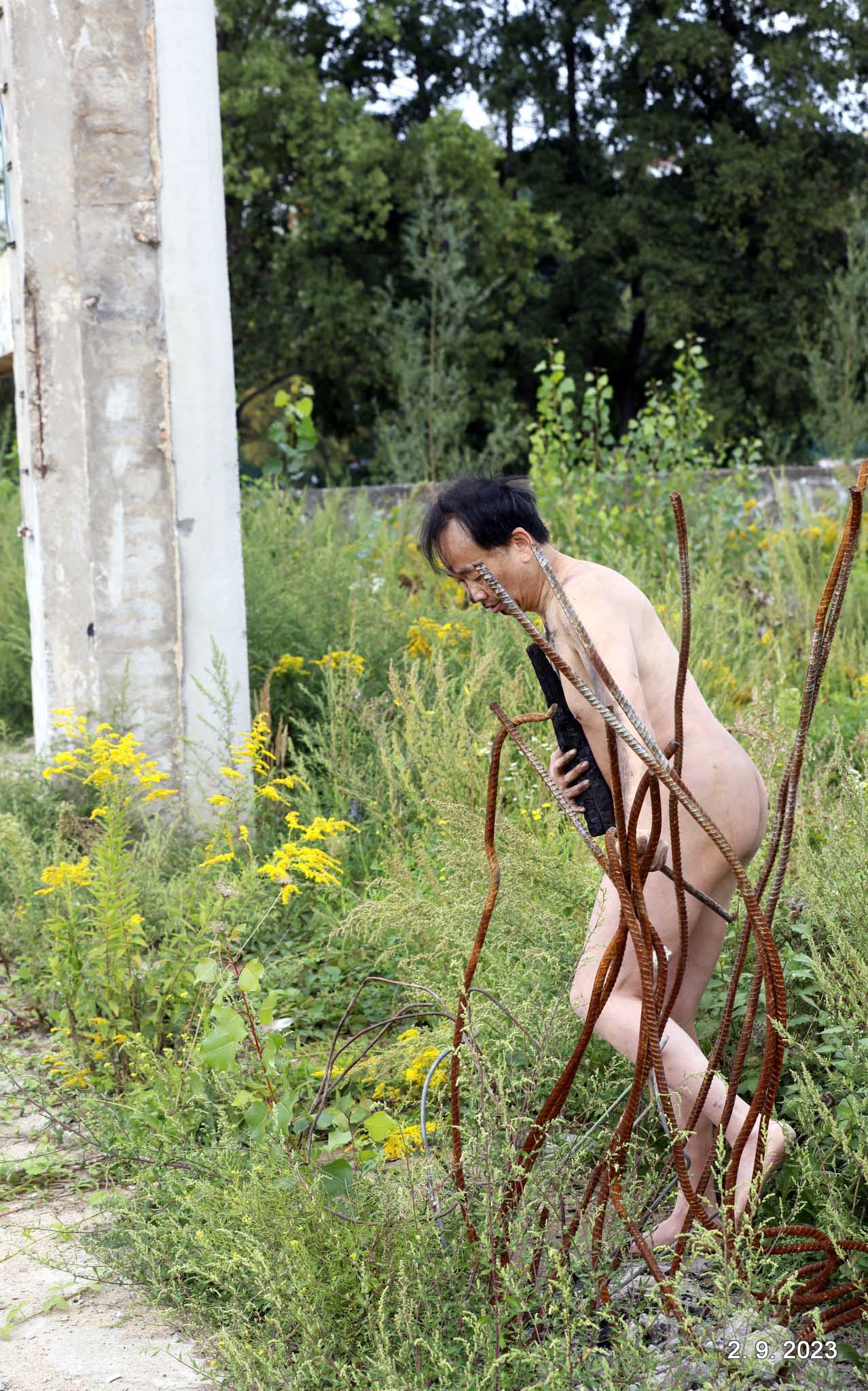
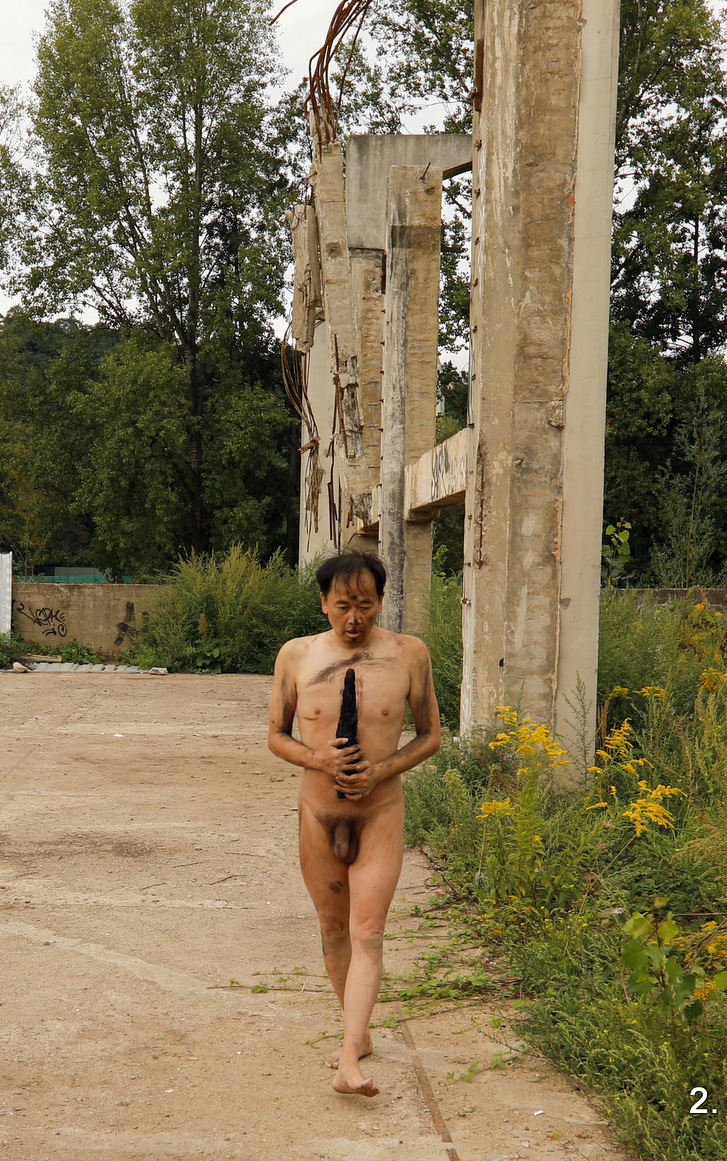
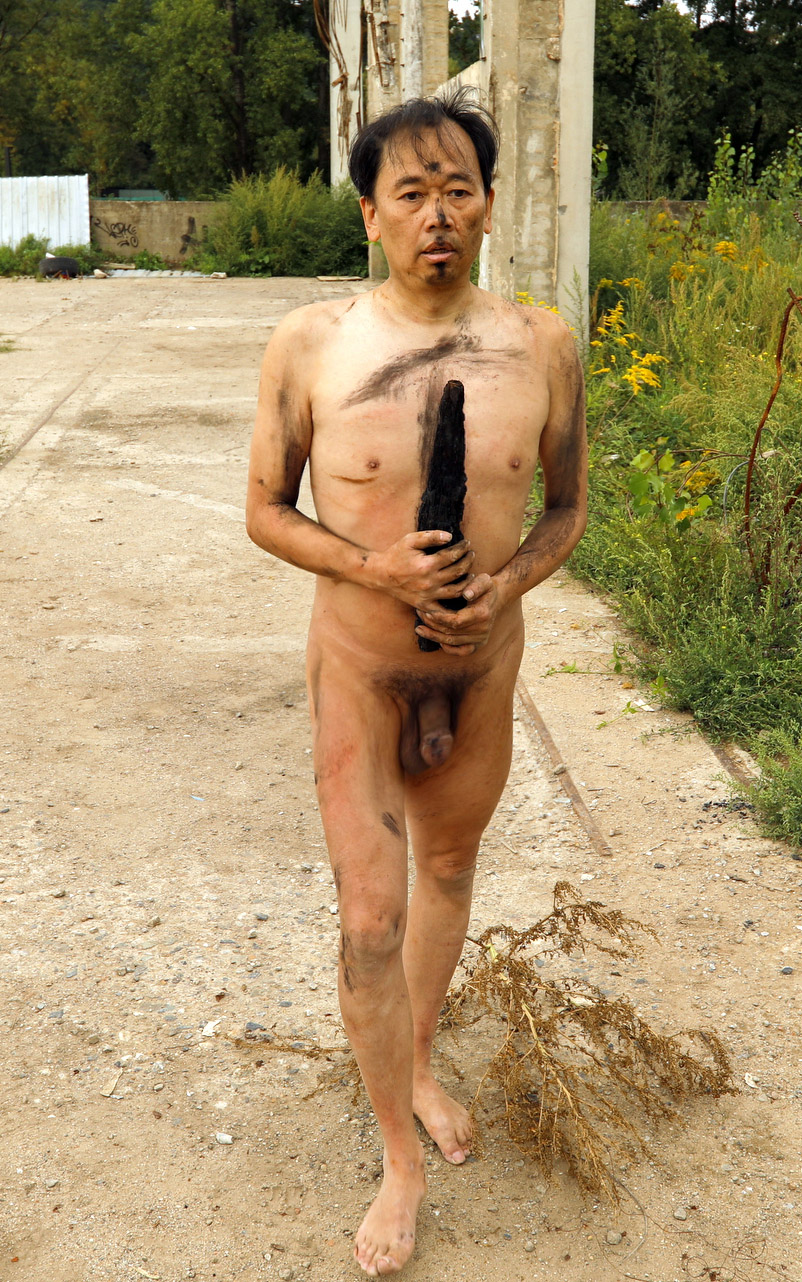
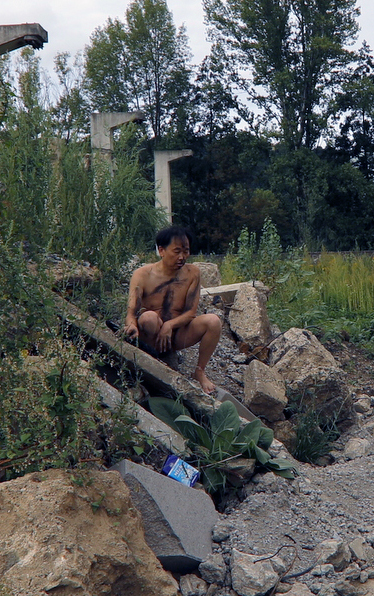
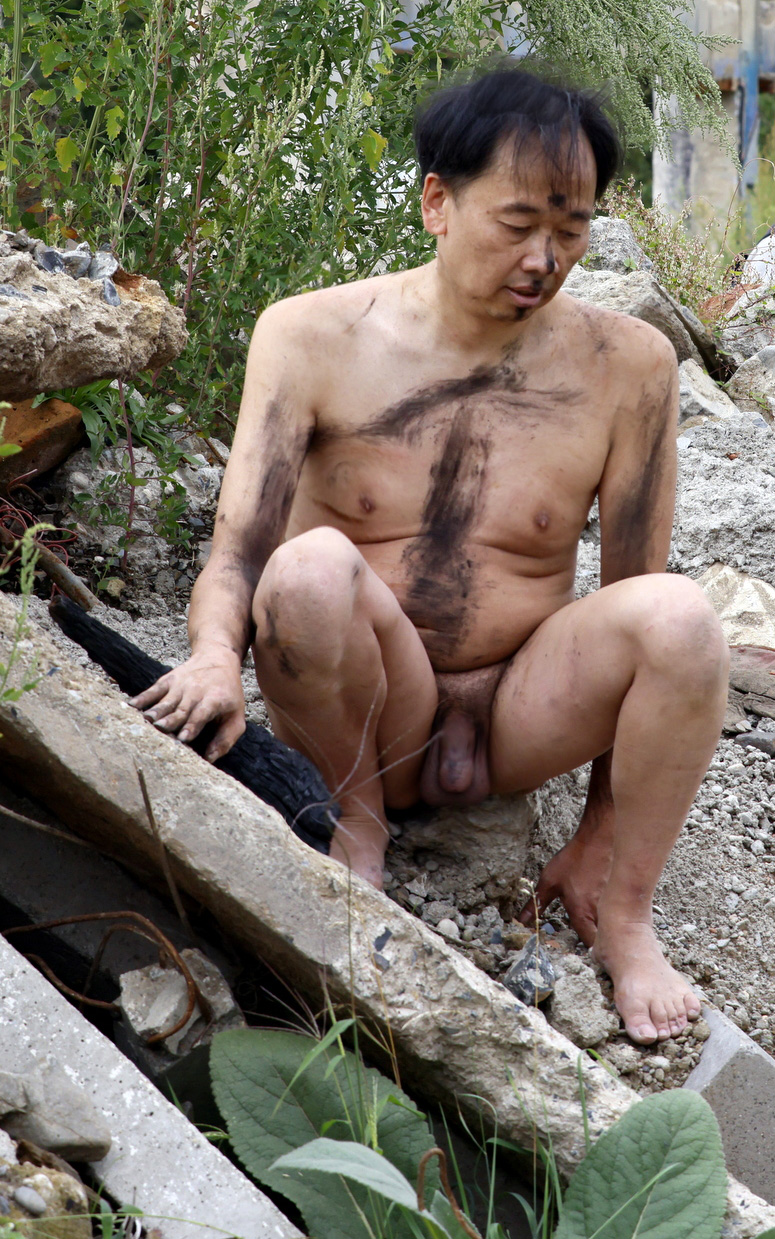
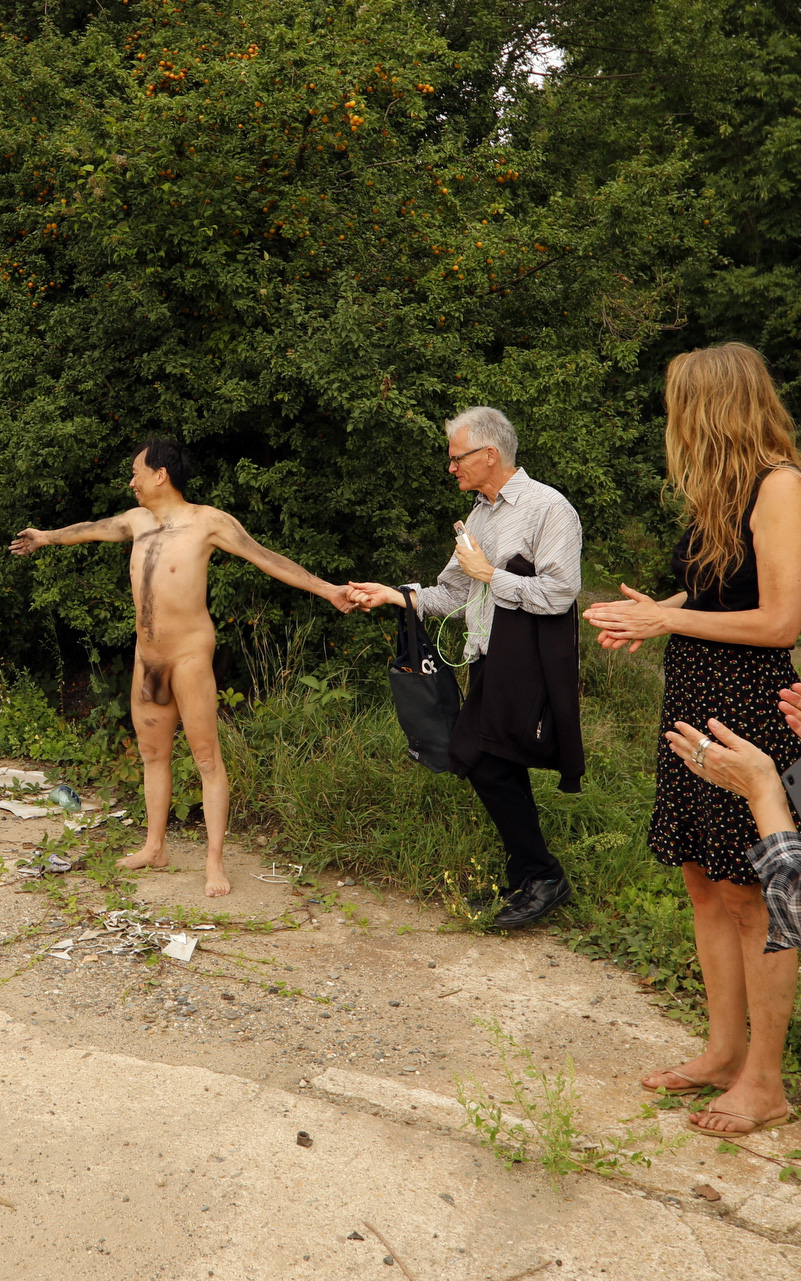
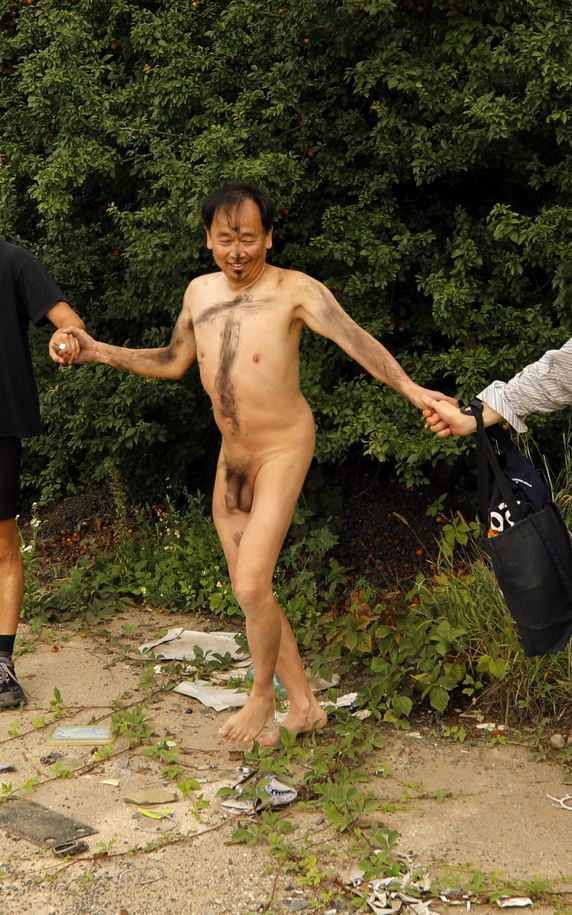
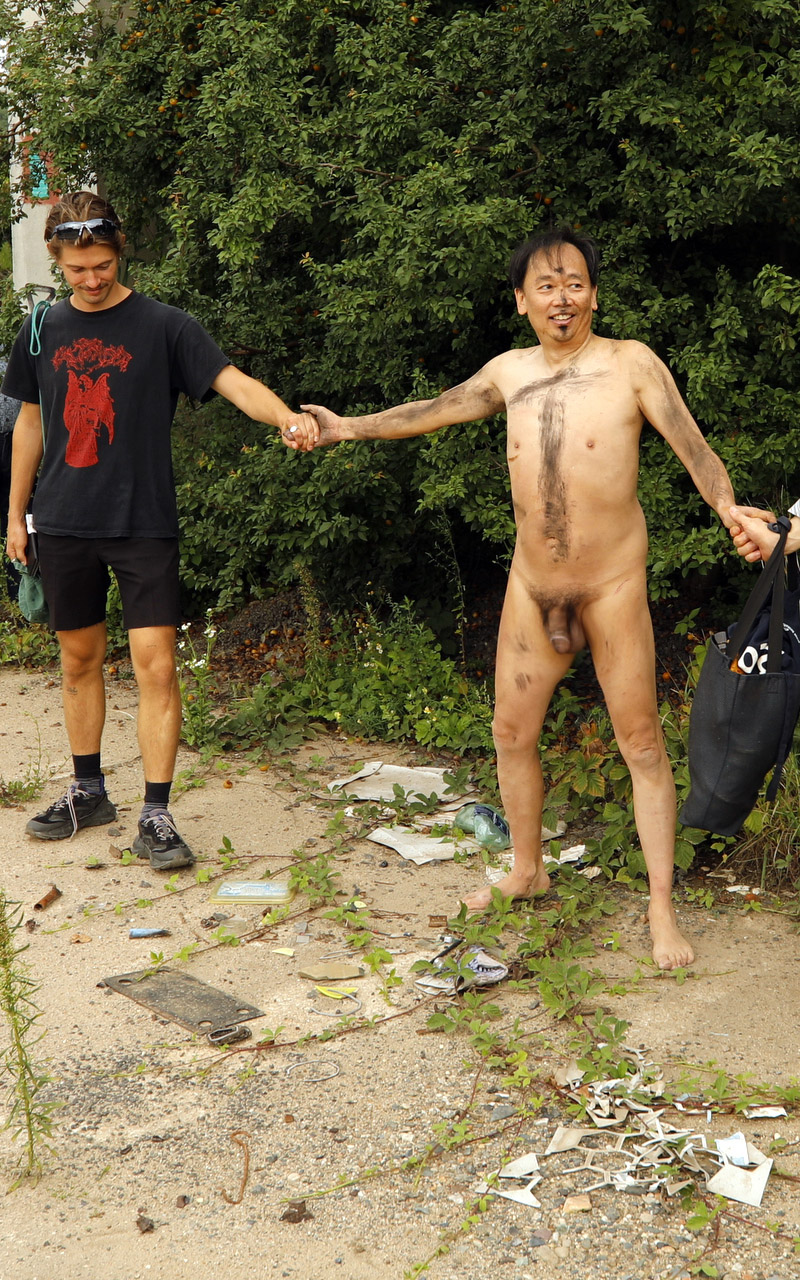
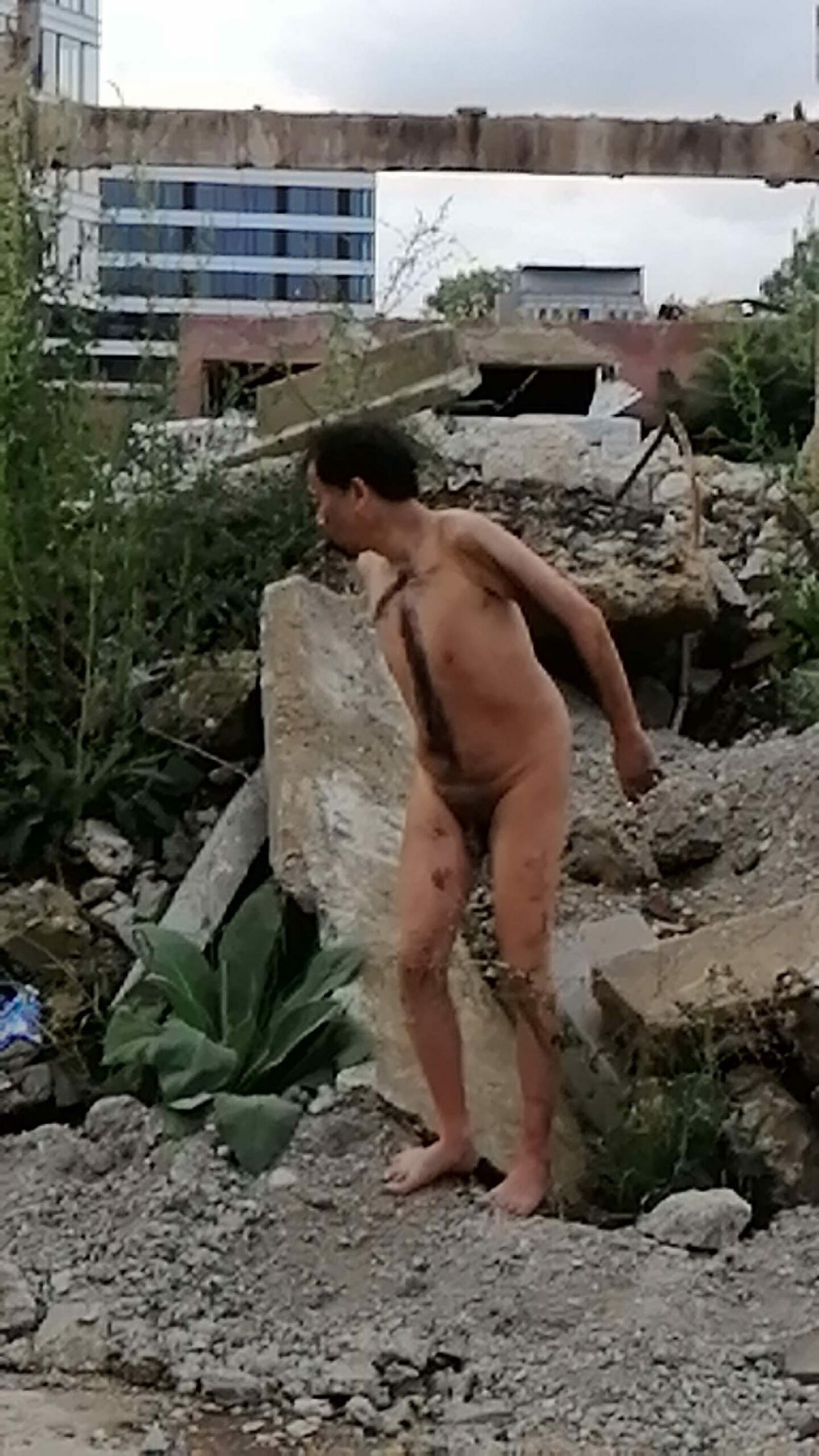
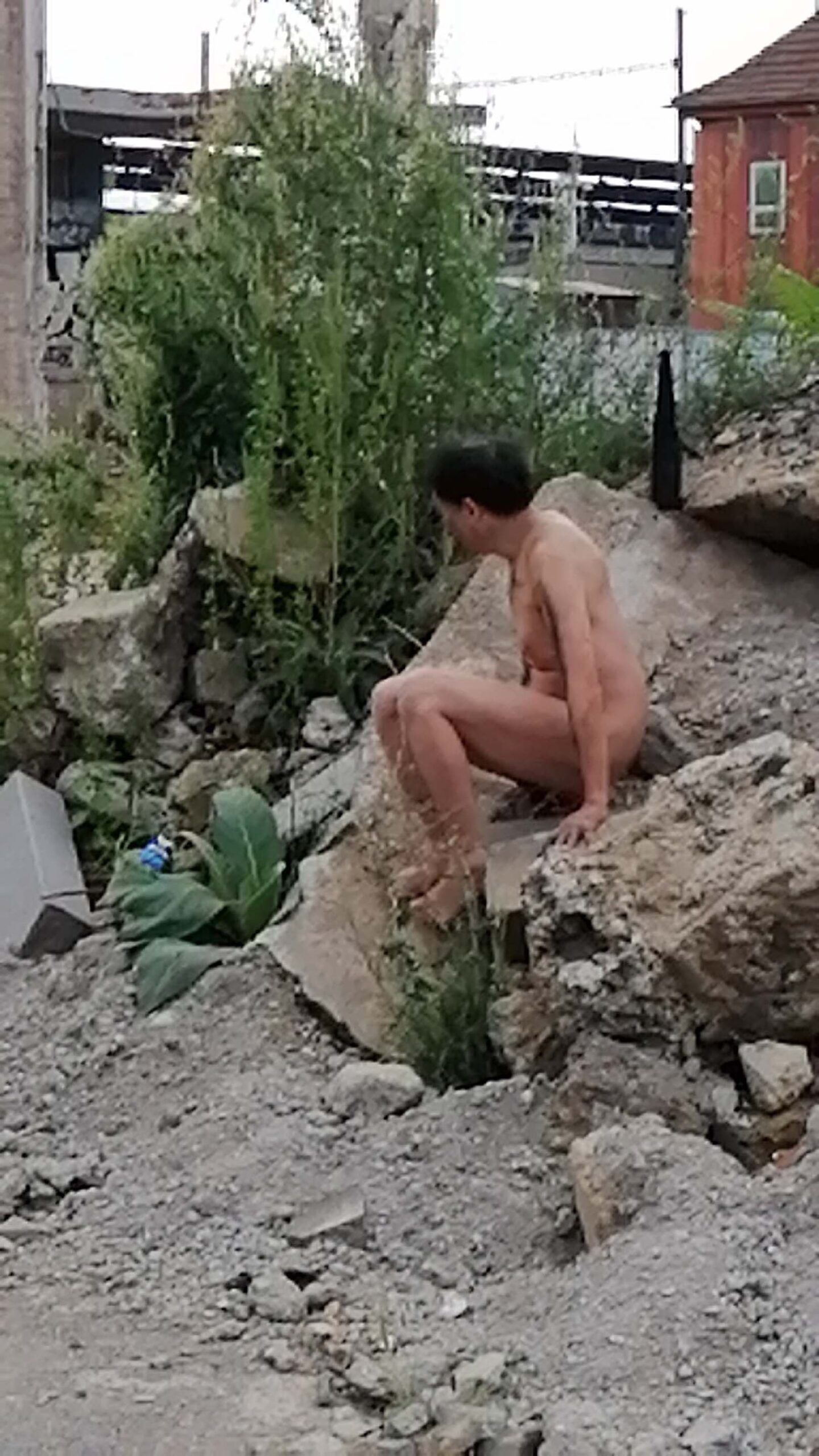
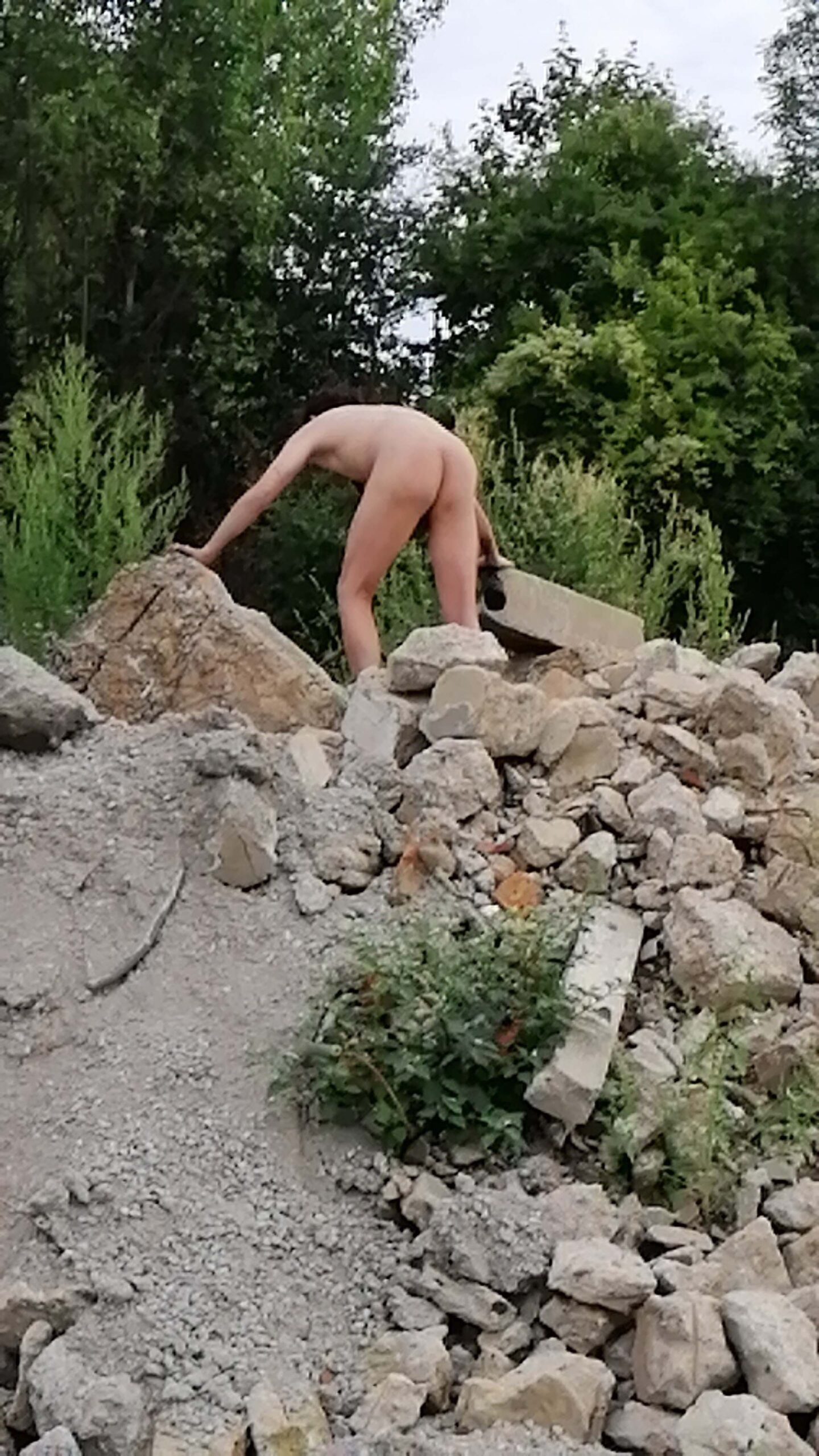
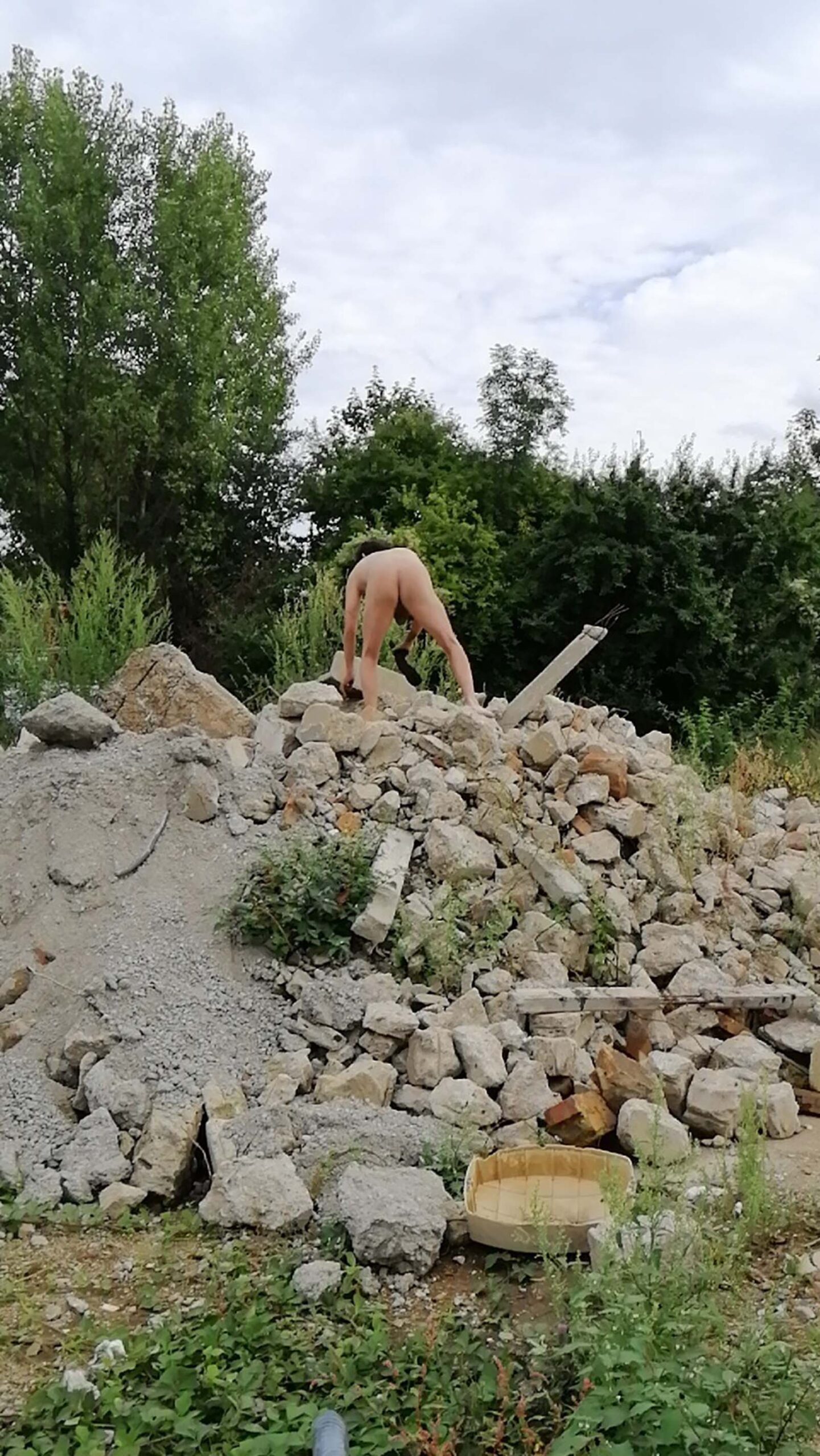
Mukarno’s performance ‘Nudity as trans’ was one of the most striking and memorable performances of the festival. He used his naked body as a tool to create a powerful live art and symbolic expression of his personal journey and transformation. He collected all the materials for his performance at the location, such as thick iron wires, stones, black soot, and iron rods.
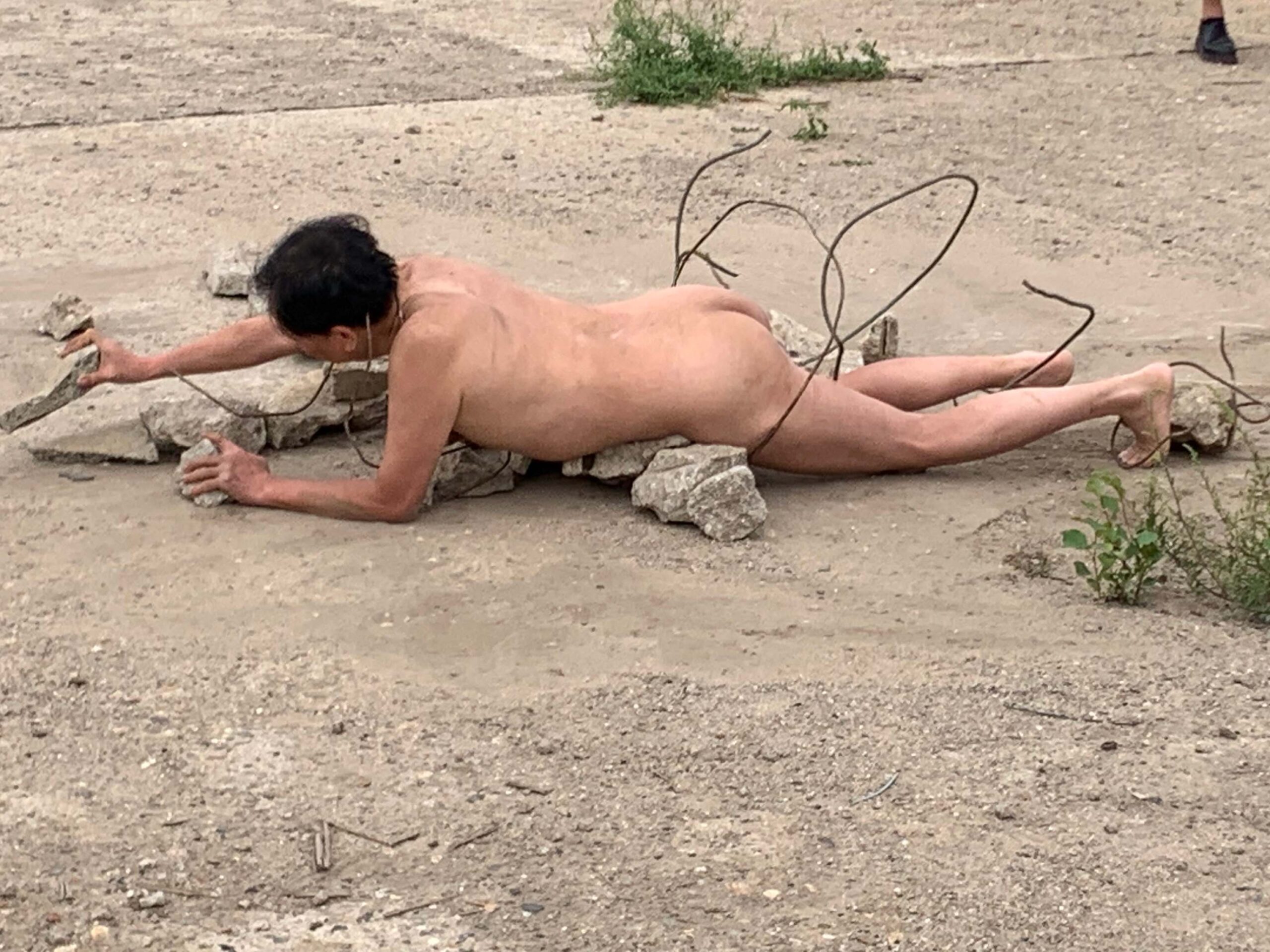
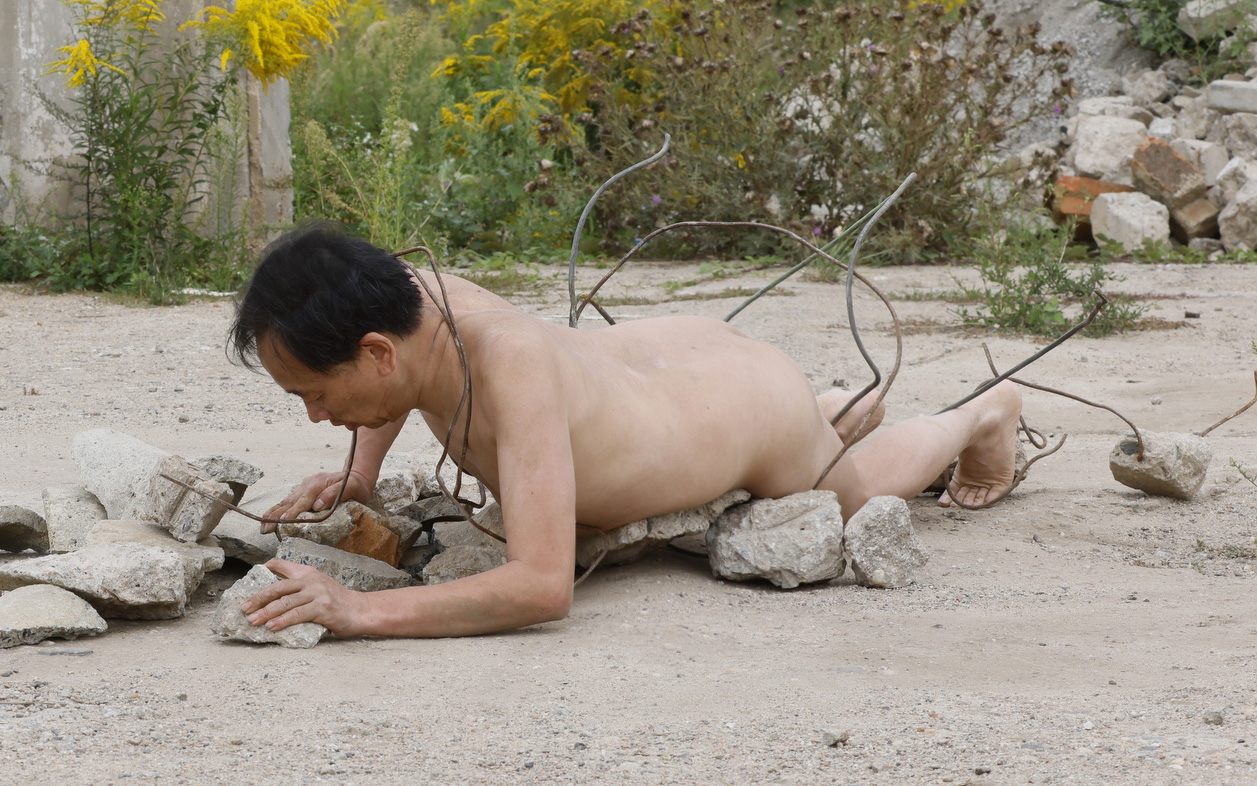
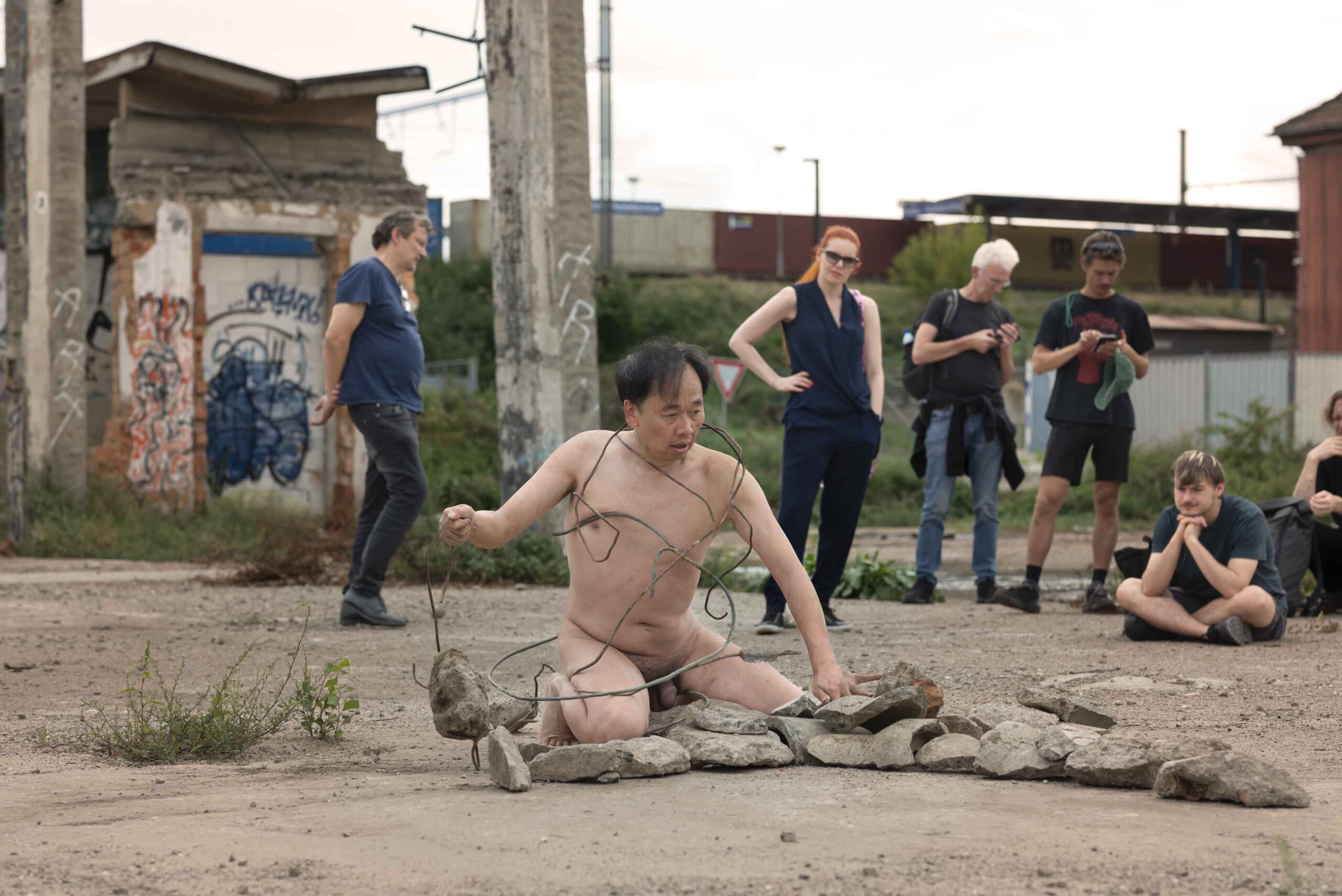
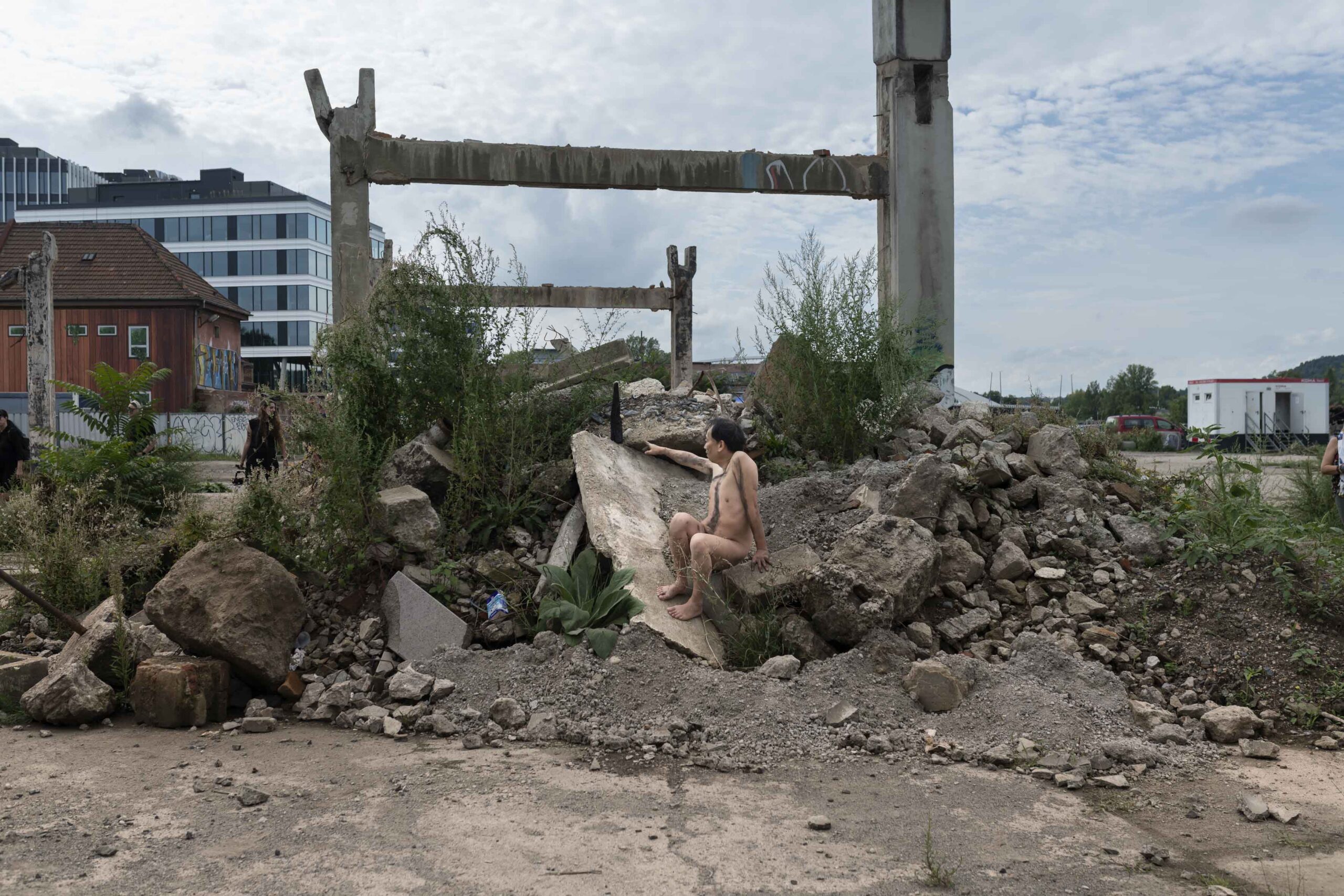
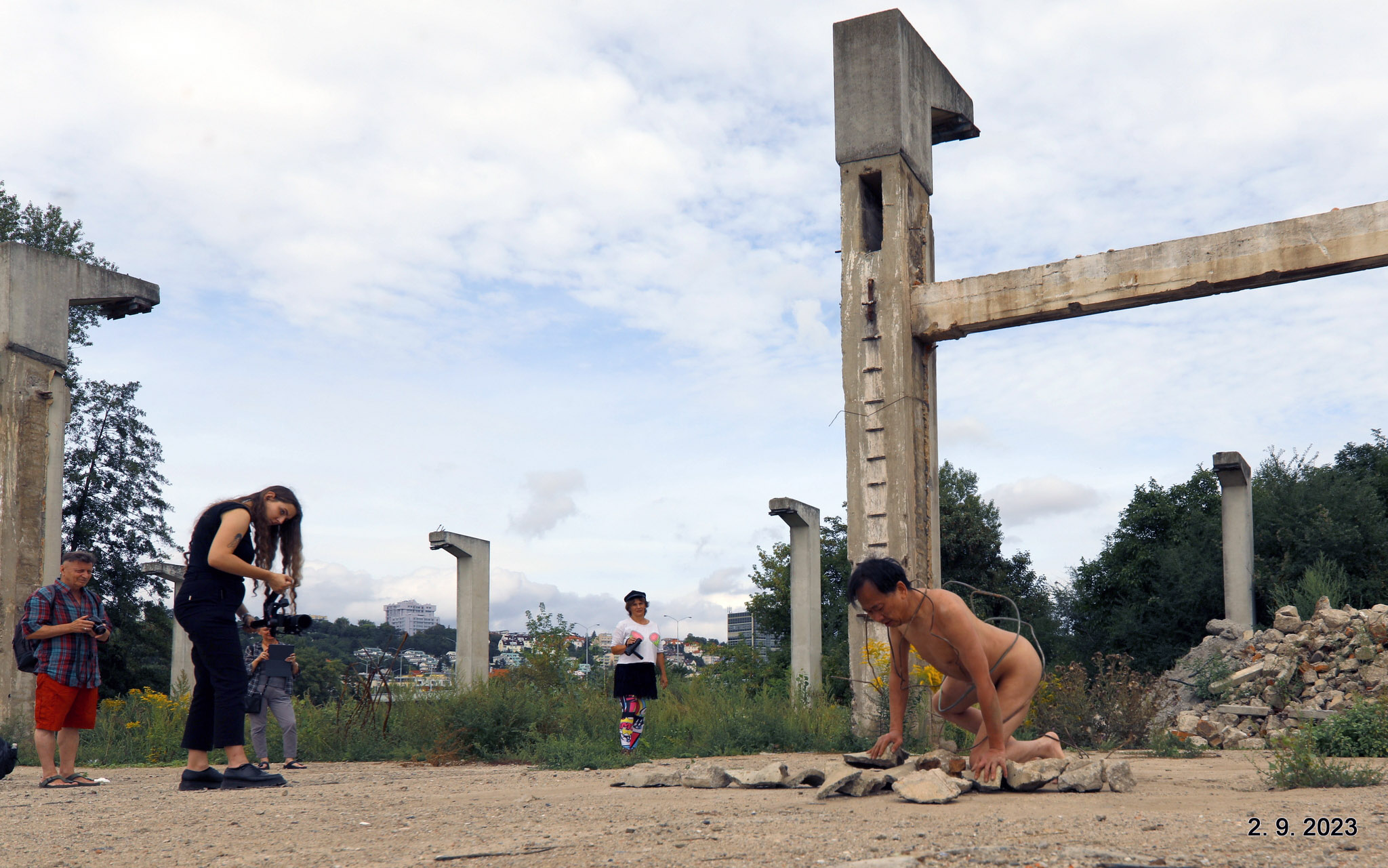
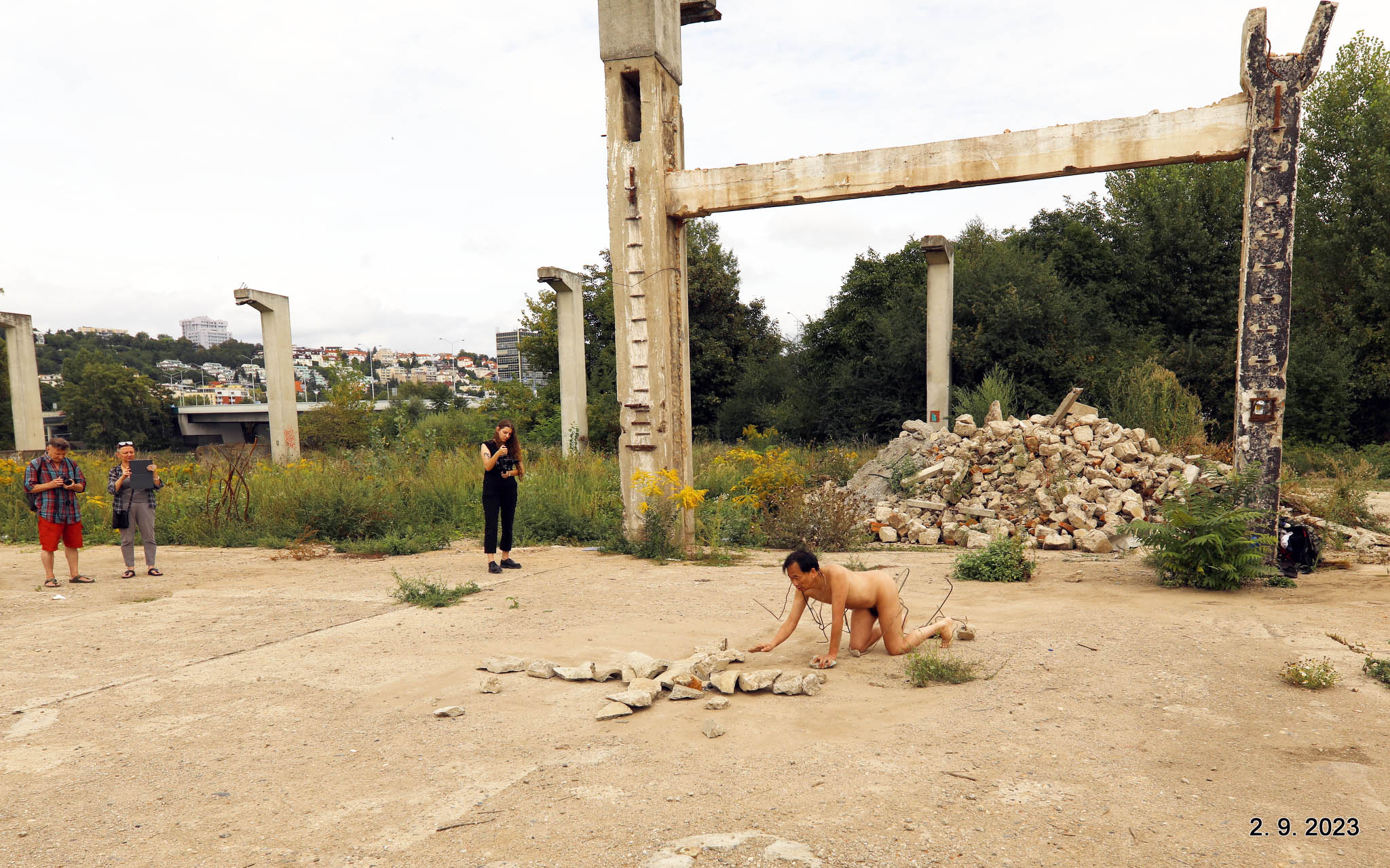
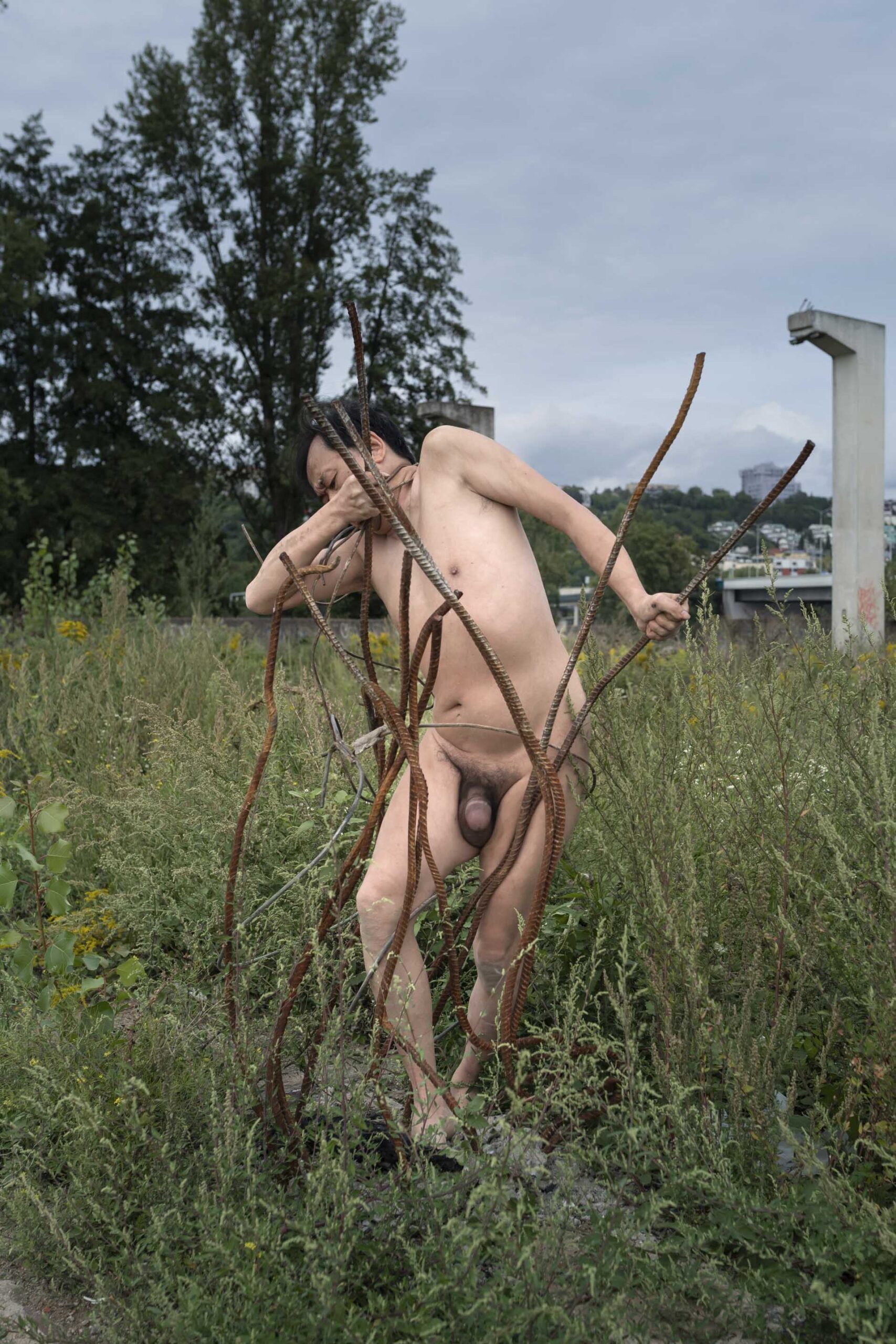
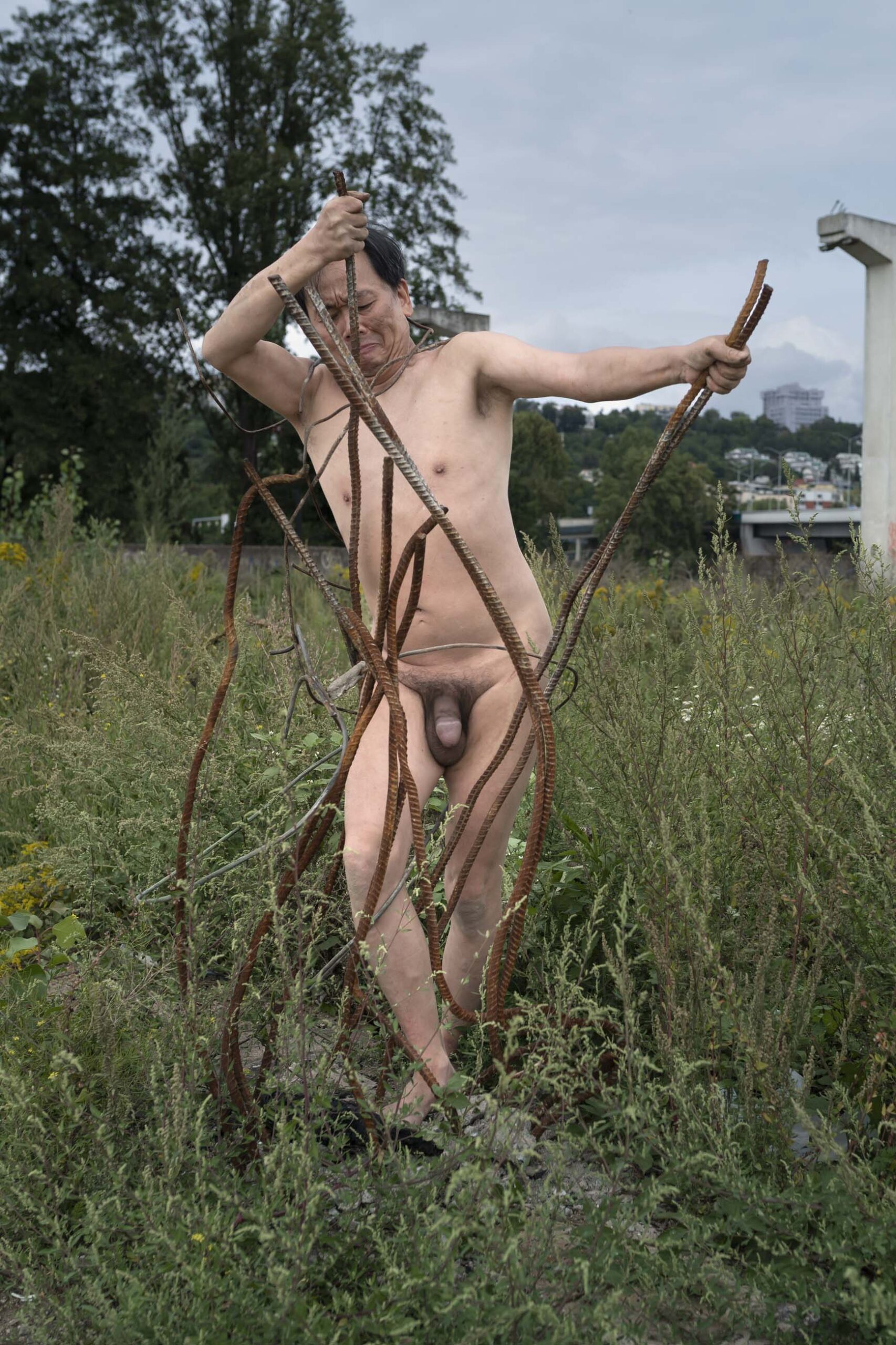
He started his performance by entangling his body with thick iron wires, which felt very oppressive and heavy. Every movement caused pain due to the iron wires. He then tried to make a Christian cross out of the stones that were piled up there and then lay on the cross. This gesture evoked the image of crucifixion and sacrifice, as well as the idea of death and rebirth.
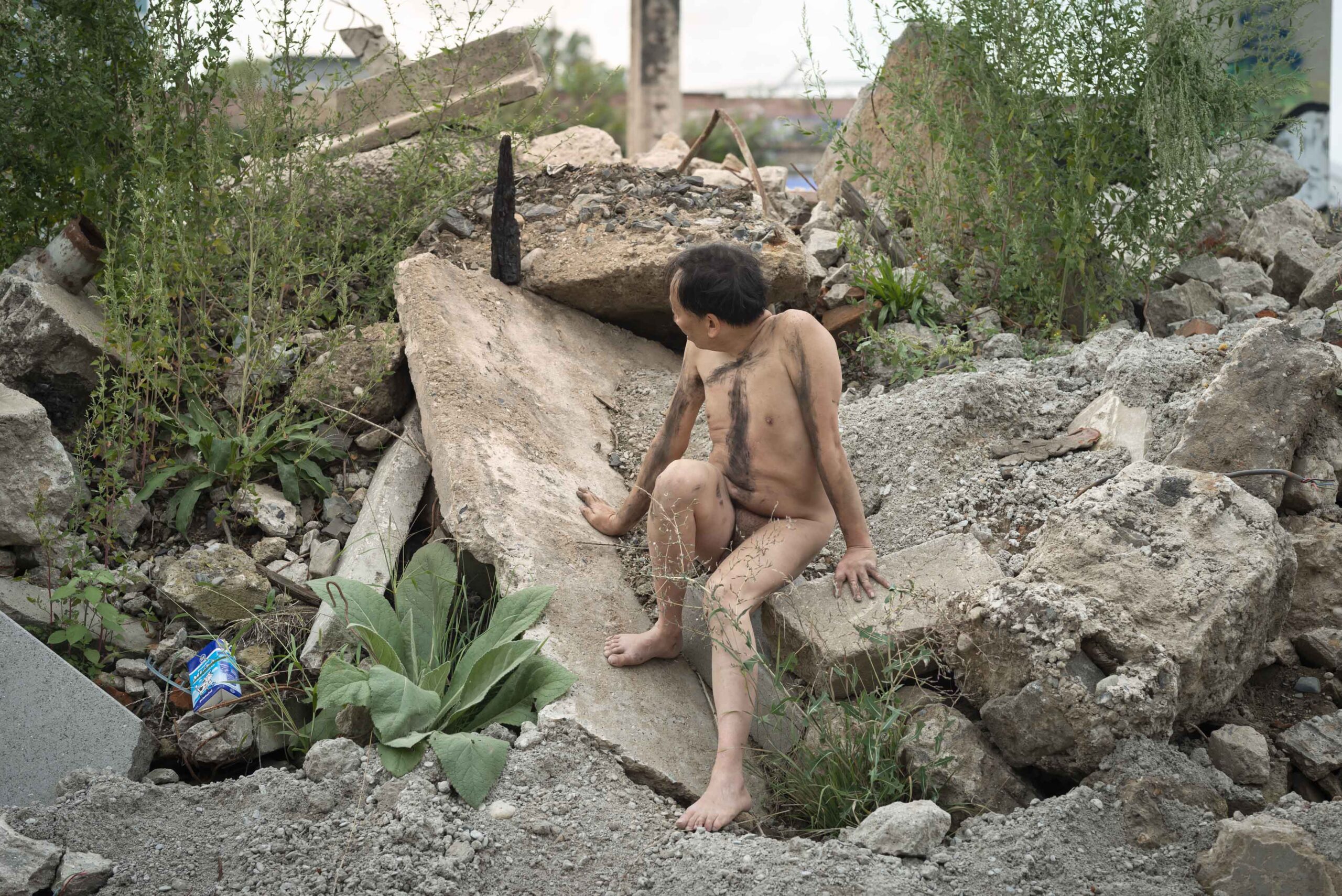
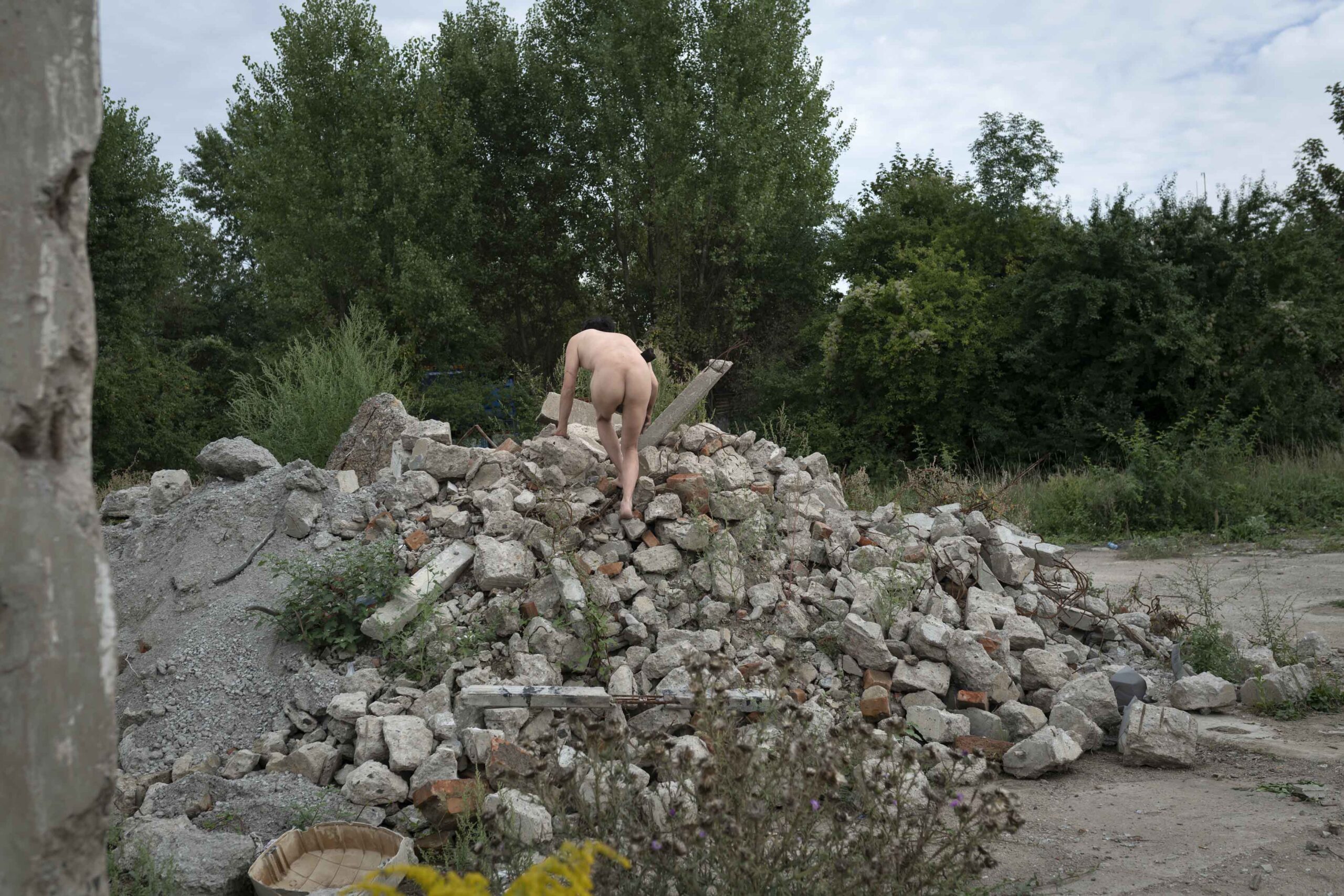
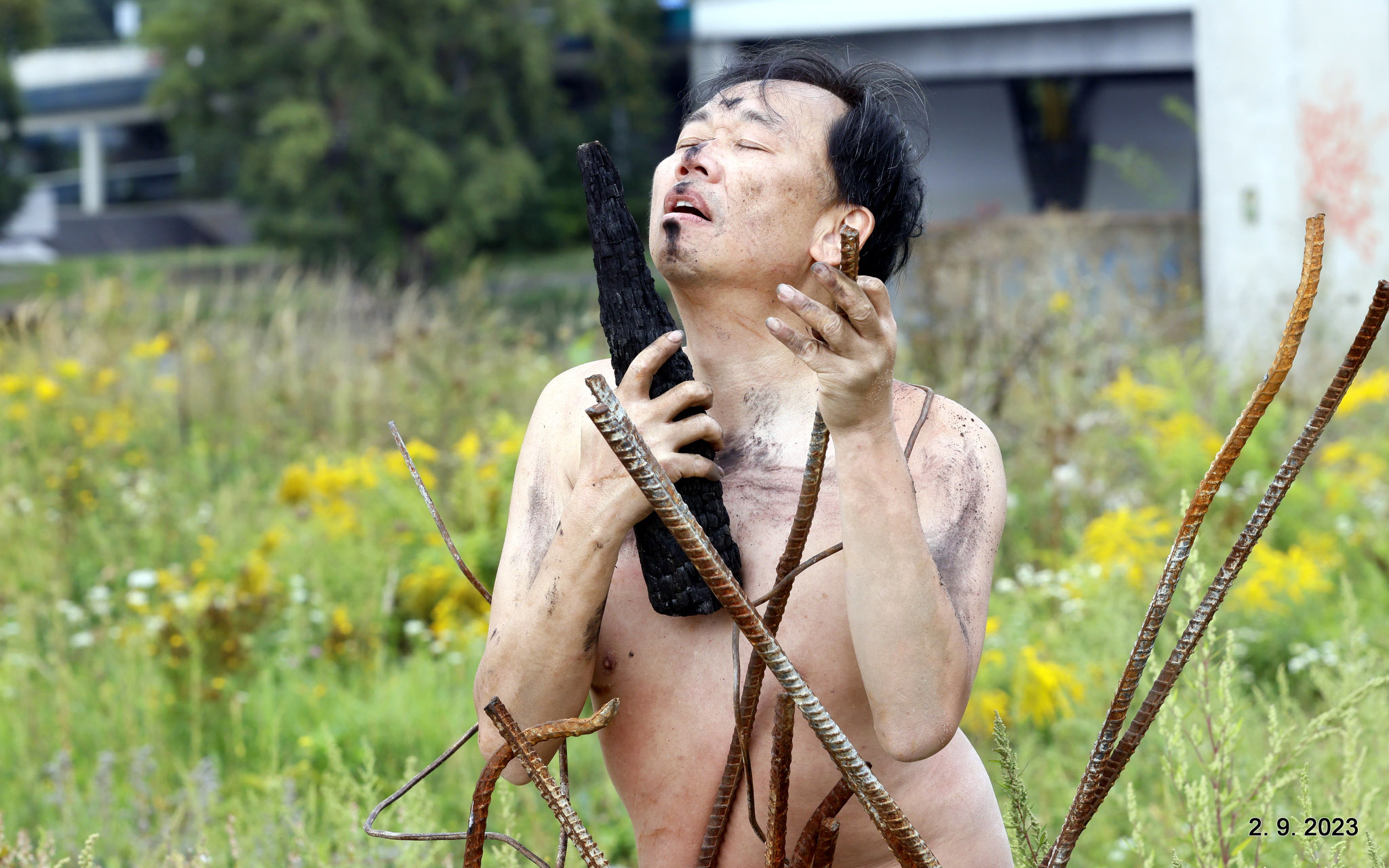
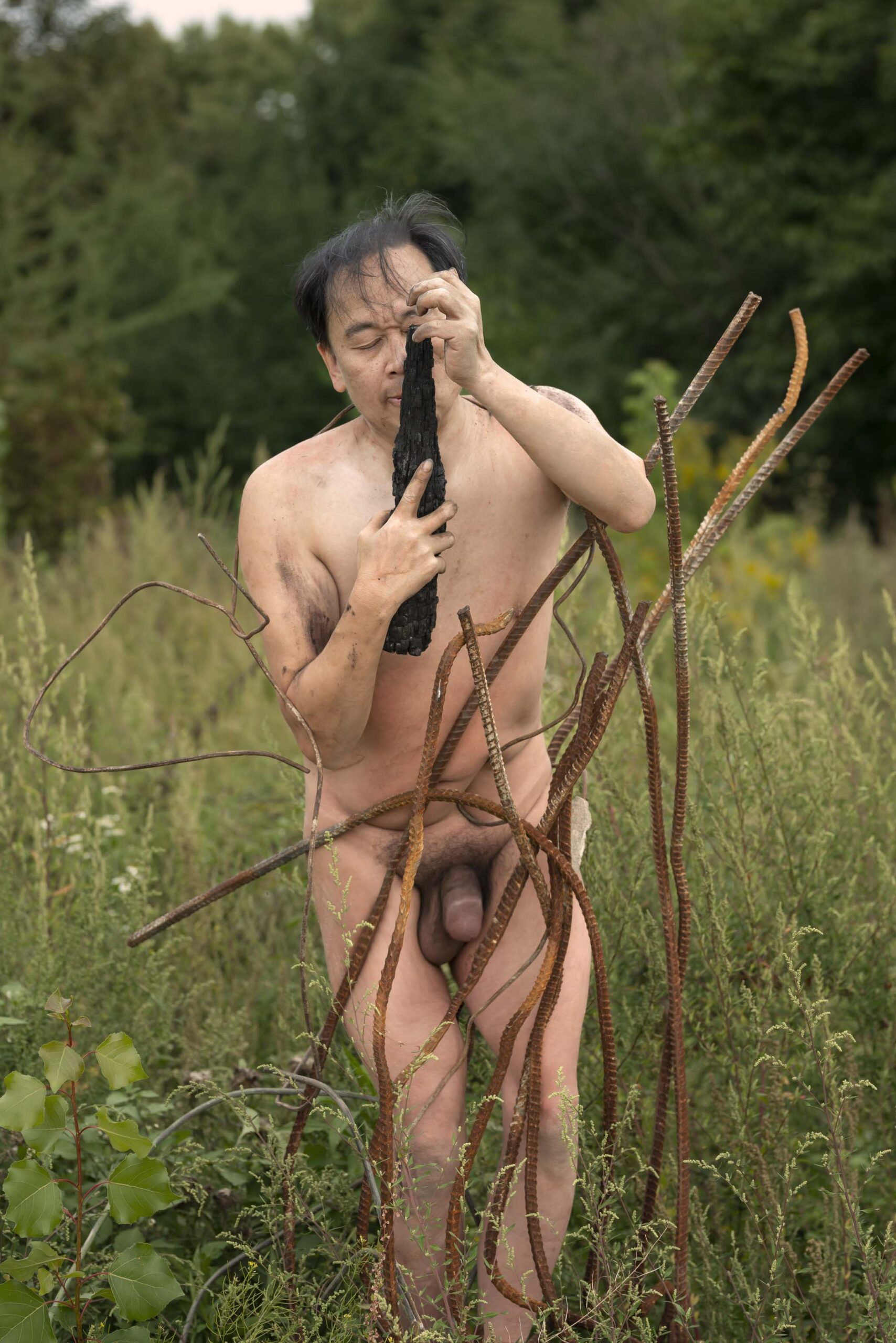
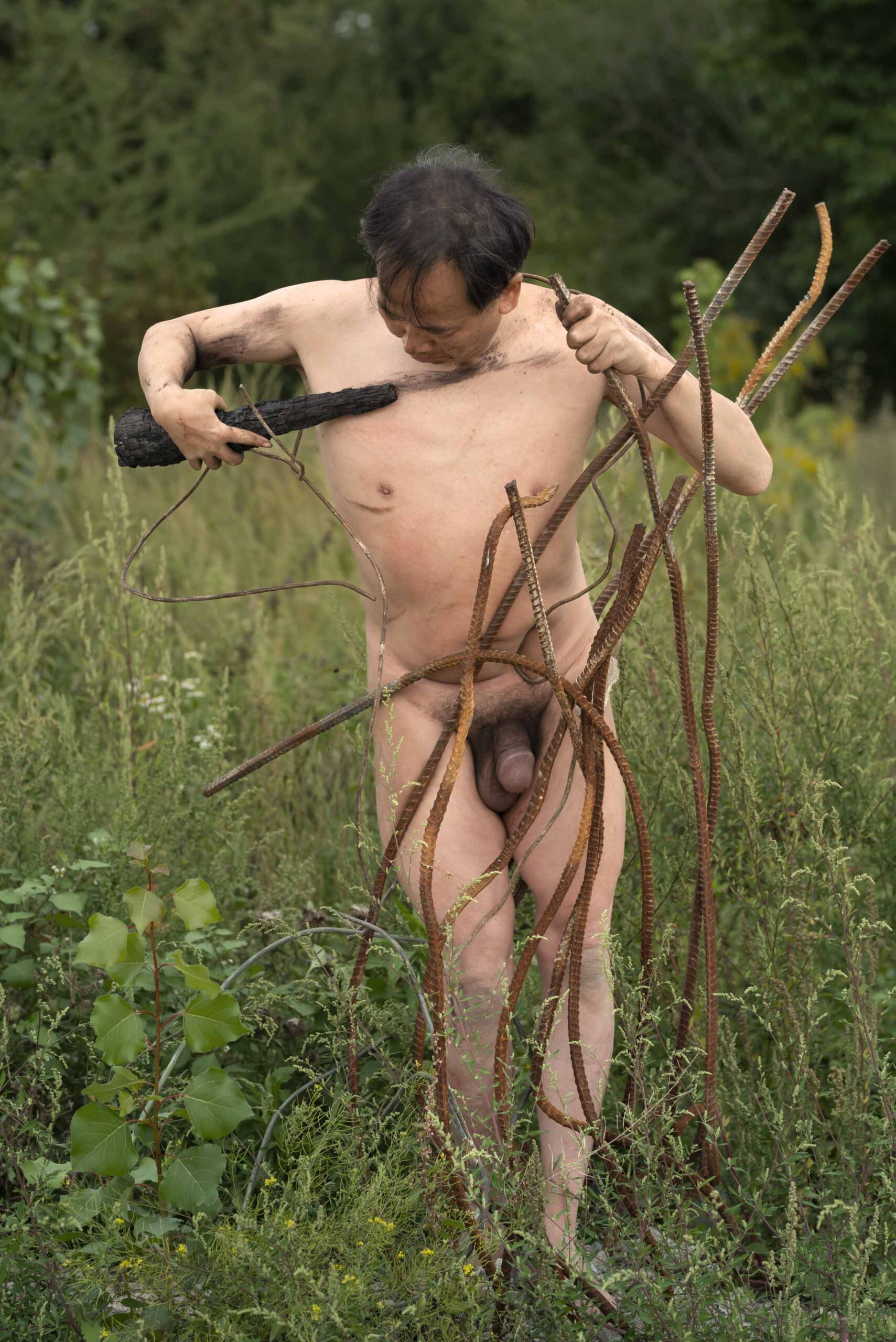
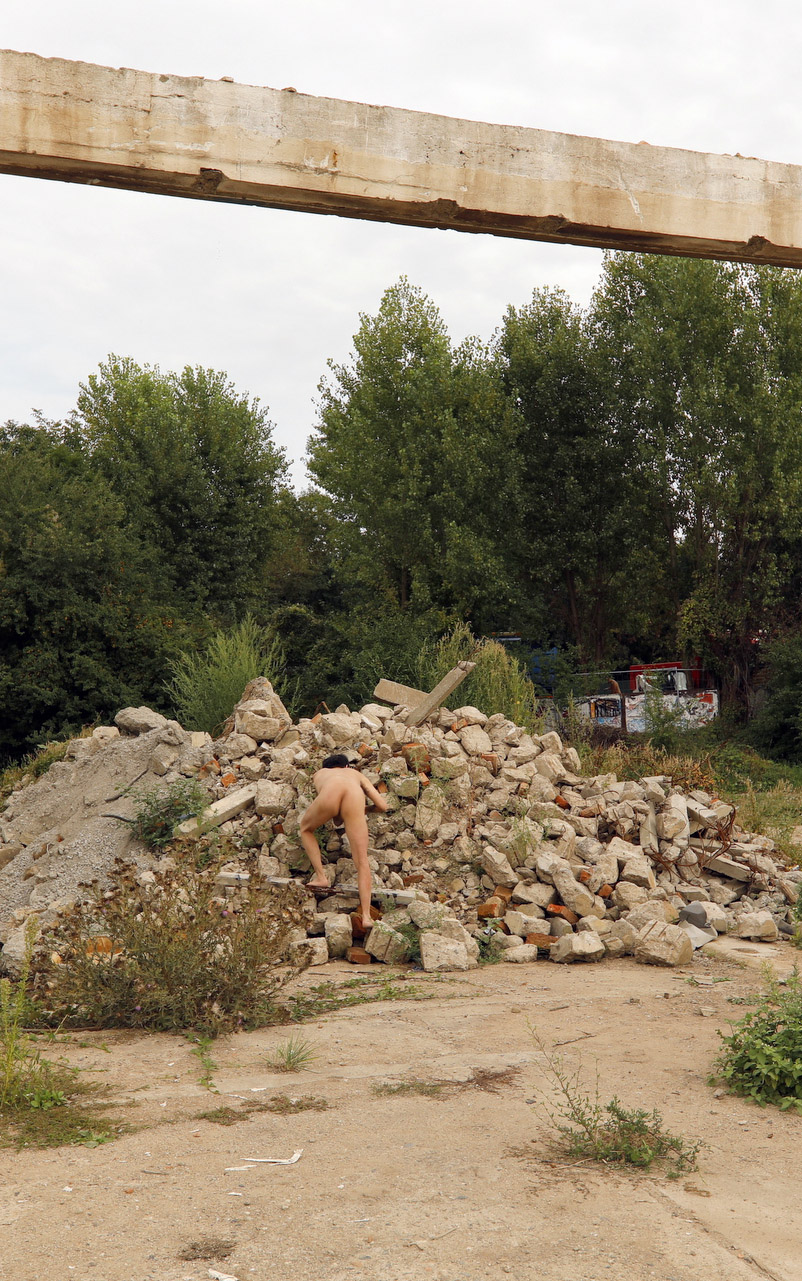
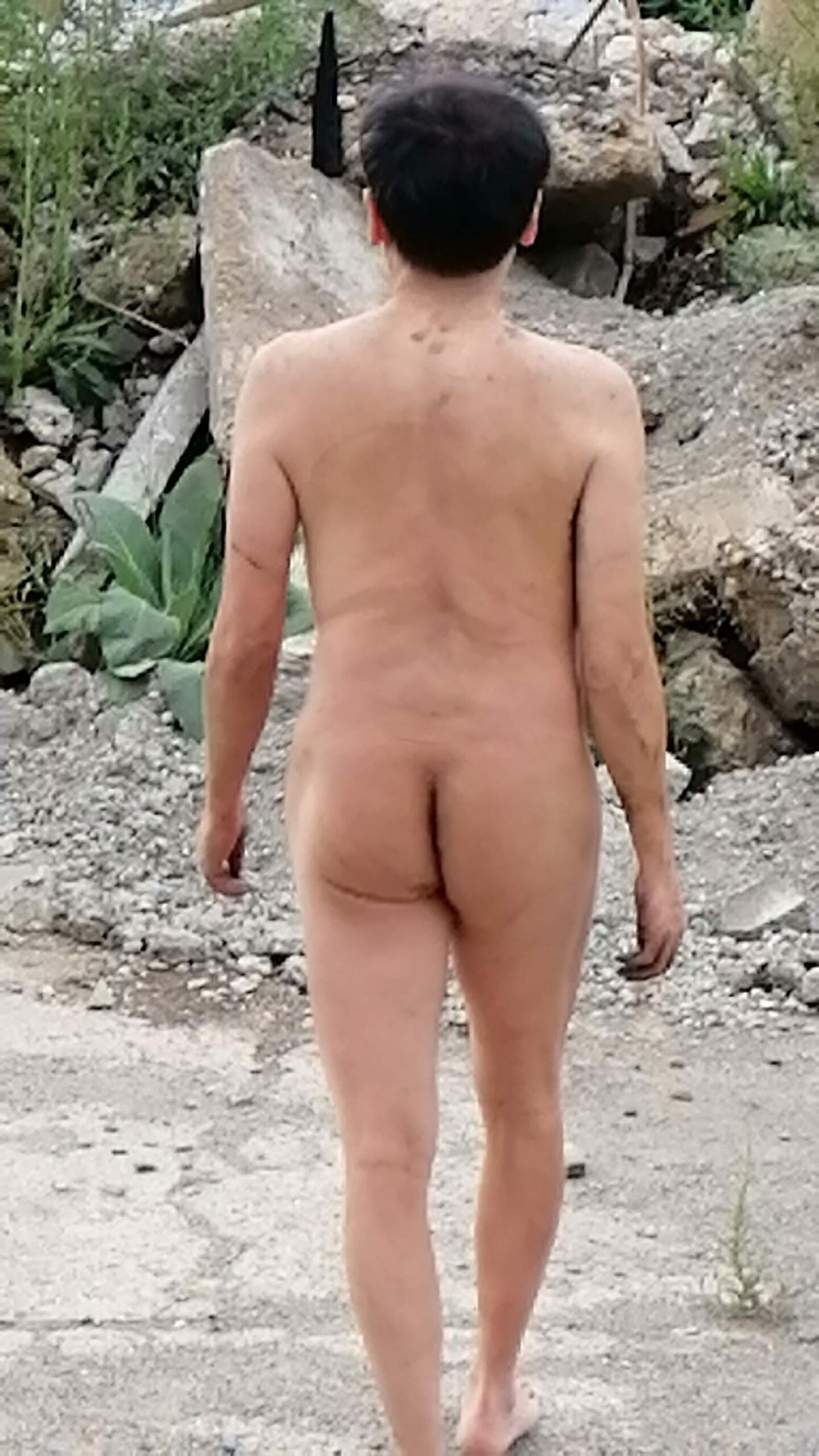
He then moved to an altar made of thick iron rods that protruded upwards. He tried to wriggle into the altar, which looked like a cage or a trap. In the altar, he underwent a transformation by smearing black soot on his body. The black soot covered his skin and gave him a new appearance and identity. He then moved to the holy mountain, which was a mountain of piled stones, and he disappeared into the mountain. This gesture suggested a final ascension and transcendence, as well as a connection with nature and spirituality.
Impact of the performance
The performance Nudity as Trans by Mukarno was a remarkable example of how nudity can be used as a medium and a message in performance art. He showed how nudity can express vulnerability, pain, struggle, courage, change, and liberation. He also showed how nudity can be related to religion, culture, and history. His performance was an emotional and aesthetic experience that touched and inspired many viewers. His performance was also a testament to his artistic vision and skill, as he created a complex and meaningful narrative with minimal resources and maximum creativity.
Nudity
He believes that nudity is a natural and honest state of being that reveals the essence of a person without any masks or pretenses. The performance explores the spiritual significance of nudity in performance art, where vulnerability is used to reveal divinity, challenge separation, and awaken spiritual connections.
The performance ‘Nudity as trans’ is a powerful symbol of transformation and spiritual awakening. The act of going nude on stage holds deep spiritual connotations, purity, truth, and the unification of body, mind, and spirit. By shedding societal constructs and materiality, performers embark on a journey to reveal the divine essence within themselves and others, seeking to access heightened states of consciousness.
Social
The artist has often played a key role in social movements, addressing issues ranging from immigration to sexism to gun violence. Through their expressive talents, artists can challenge cultural narratives, shift imagery, and inspire emotions in a way that traditional political methods alone rarely do. The ability to craft a compelling story that engages and captivates readers is essential. Advanced creative writing techniques can help take your writing to the next level.
The presence of arts is linked to increased neighborhood livability, community identity, and social well-being. Research ties the benefits of arts participation to better health outcomes, including lower rates of depression and anxiety, improved cognitive function, and better overall quality of life. Engagement with the arts can also lead to greater prosocial behaviors within communities, including volunteering and charitable giving, and can enhance social consciousness.
Power
Art can be a powerful tool for addressing oppression and violence in religious communities. Philemon Mukarno’s performance ‘Nudity as trans’ is a thought-provoking exploration of the spiritual significance of nudity in performance art, challenging the audience to embrace their authentic selves and dismantling barriers that separate them from the divine. The act of nudity on stage becomes a conduit for shared spiritual experiences, fostering social change and promoting a more inclusive and accepting society.
Naked as Trans: Philemon Mukarno’s Sacred Performance on Identity, Transition, and Spiritual Transformation
Understanding Naked as Trans as Spiritual Inquiry into Identity
Philemon Mukarno’s “Naked as Trans” (2023) represents a profound embodied exploration of transition, identity, and spiritual transformation through naked performance art. Presented at Prague’s 9th Festival of Naked Forms (FNAF) held September 1-3, 2023 on the cultural boat Altenburg 1964, the work engaged the festival’s central theme celebrating “Nudity as Trans.” The performance took place on an abandoned industrial site near the venue, creating striking contrast between nature and industrial decay. Mukarno’s nakedness combined with ritualistic engagement of raw materials—iron wires, stones, black soot, iron rods—created powerful meditation on the journey from constraint toward liberation and spiritual authenticity.
The concept of “Nudity as Trans” underlying the festival emphasized that transition represents moment of pure nakedness requiring absolute honesty with oneself. As festival curator Lenka Klodová explained, nakedness throughout human history signifies transition—from biblical narrative’s recognition of one’s own nudity marking departure from heavenly state toward human destiny. Eastern spiritual traditions including Jurodivis and Czech Hussite Adamites recognized nakedness as reference to extraordinary personal relationship with God. The festival celebrated how nudity functions as both literal and metaphorical state of consciousness transformation central to performance art itself.
The Sacred Architecture of Iron and Stone: Metaphors for Constraint and Transformation
Iron Wires as Binding Oppression and Spiritual Struggle
Mukarno’s performance began with entangling his naked body in thick iron wires, creating immediate physical and psychological impact. The heavy wires bound his flesh, preventing free movement and causing pain with every gesture. The choice of iron rather than rope or softer material carries profound significance—iron represents industrial hardness, permanence, and oppressive weight. The wires themselves suggest networks of constraint—multiple strands binding together, creating seemingly inescapable entanglement. This opening gesture communicates the fundamental human condition of existing within systems of constraint and limitation.
The iron wires also specifically reference the industrial context of the performance site. The abandoned industrial landscape surrounding Altenburg 1964 provides crucial backdrop suggesting how modernity and industrialization have created systems of oppression and alienation. The wires become symbol of how contemporary society constrains human identity and authentic expression. The performer’s body tangled within industrial materials visualizes how modern existence binds and restricts authentic being. The pain caused by the wires represents genuine suffering resulting from constraint systems.
Yet the wires also reference earlier performance traditions where artists have used pain and physical difficulty as spiritual practice. The entanglement becomes deliberate choice undertaken for specific artistic and spiritual purpose. Mukarno doesn’t merely suffer passively but engages the wires consciously, suggesting that consciousness and intention can transform the meaning of constraint. The performance suggests that acknowledging oppressive systems directly becomes necessary precursor toward liberation from them.
The contrast between soft vulnerable flesh and hard unyielding iron carries profound symbolic weight. The flesh represents sensitivity, capacity for feeling, and embodied consciousness. The iron represents rigid systems apparently impervious to individual negotiation or transformation. Yet the performance suggests that tender flesh can survive entanglement with hard systems. The body’s persistence despite constraint becomes testimony to human resilience and spiritual strength.
The Stone Cross as Sacrifice and Sacred Geometry
Following the iron wire entanglement, Mukarno collected stones from the industrial site and attempted to arrange them into Christian cross. He then lay upon the cross, evoking immediate associations with crucifixion and religious sacrifice. The choice of stone—both from the earth yet shaped deliberately by human intention—carries multiple meanings. Stone represents geological deep time and Earth’s consciousness. Yet stones also represent human construction and deliberate creation.
The cross itself carries powerful Christian symbolism of sacrifice, suffering, and redemption. The performance engages this deeply with the artist’s body becoming literal living christ figure. The nakedness intensifies the religious dimension—recalling Christian imagery of crucified Christ stripped of all worldly possession and protection. The performance asks audiences to confront how religious systems sometimes celebrate suffering and sacrifice while simultaneously condemning the human body and sexuality.
The deliberate construction of the cross from collected materials suggests that sacred meaning emerges through human action and intention rather than being divinely imposed externally. The performance doesn’t passively receive religious authority but actively creates sacred meaning through embodied practice. The artist becomes both crucified victim and active creator, maintaining agency even while enacting sacrifice. This inverts typical Christian narrative where individuals remain passive recipients of divine grace.
The gesture also visualizes the spiritual crisis many individuals face when religious systems demand sacrifice of authentic identity and embodied expression. The cross becomes metaphor for how religion sometimes requires individuals to sacrifice their true selves—their queerness, their sexuality, their authentic identity—in service to doctrinal conformity. Yet by consciously choosing to lie upon the cross, Mukarno suggests possibility of voluntary sacrifice undertaken for spiritual growth rather than forced conformity. The willing sacrifice differs fundamentally from imposed oppression.
The Altar of Iron and Soot: Transformation Through Sacred Ritual
The Iron Cage as Liminal Sacred Space
Moving from the stone cross, Mukarno approached an altar constructed from thick iron rods protruding upward. The structure resembled simultaneously a cage and a trap—constraining yet potentially containing sacred presence. The iron altar carries multiple associations: in Christian tradition, altars function as spaces where material and divine dimensions meet; simultaneously, the cage-like structure suggests imprisonment and constraint. The performance deliberately holds these contradictory meanings in tension.
The artist’s attempt to wriggle into the iron altar structure represents entering into sacred space despite physical difficulty and psychological trepidation. The confined space of the altar requires the body to contract and assume awkward positions. This physical challenge parallels the psychological and spiritual difficulty of approaching genuine transformative spiritual experience. The performance suggests that encountering the sacred requires courage and vulnerability—entering spaces potentially dangerous and constraining.
Within the iron altar, Mukarno underwent profound physical and symbolic transformation by smearing black soot across his entire naked body. The black substance completely alters his appearance and visual presence. What was white flesh becomes blackened—covered in industrial residue collected from the abandoned site. The blackening simultaneously represents spiritual cleansing through contact with natural and industrial elements, and corruption through exposure to industrial contamination. The ambiguity remains intentional—suggesting that transformation involves both purification and contamination.
The soot covering represents multiple layers of spiritual meaning. In various traditions, ashes signify repentance, purification, and return to elemental origins. The black color traditionally associates with darkness, death, and the unknown. Yet black also represents fertility, potential, and the unmanifested. The soot transformation becomes liminal threshold where the performer neither remains in previous state nor fully enters transformed state. The partial coverage—through deliberate smearing rather than complete immersion—suggests incomplete transformation always in progress rather than final achieved state.
Black Soot as Symbol of Spiritual Death and Renewal
The deliberate coating of the naked body with black soot marks visible transformation that audiences can perceive directly. The change in appearance communicates inner spiritual shift through external visible alteration. What remains invisible—consciousness transformation, spiritual awakening, identity liberation—becomes perceptible through the darkened flesh. The body becomes text through which internal spiritual processes become readable.
The soot also connects the performance to industrial heritage and contemporary environmental reality. The black powder represents contamination resulting from human industrial expansion. Yet rather than fleeing from industrial pollution, the performer deliberately incorporates it into his body. This suggests complex relationship toward modernity and technology—neither wholly rejecting nor wholly embracing but rather integrating industrial elements as part of contemporary spiritual practice. The performance acknowledges that modern spiritual practice must engage with industrial and technological reality.
The blackening also invokes shamanic initiation traditions where individuals undergo symbolic death and rebirth. The black coating represents the death of previous identity and consciousness. Emerging from the blackness represents rebirth into new understanding and identity. The performance suggests that genuine transformation requires symbolic death of previous self. The old identity must cease existing before new authentic identity can emerge.
The gradual process of soot application permits audiences to witness the transformation occurring in real time. Rather than presenting finished transformation, the performance reveals transformation as gradual process requiring effort and intention. The viewer’s witness to this unfolding change creates sense of participation in spiritual process. The audience becomes co-creator of the performance’s meaning through their presence and attention.
The Holy Mountain: Ascension and Dissolution
The Piled Stones as Path Toward Transcendence
The performance’s final movement involved Mukarno approaching a mountain constructed from accumulated stones piled at the site. The natural accumulation of stones transformed through performance imagination into “holy mountain”—sacred landscape permitting spiritual ascension. The mountain of stones represents both obstacle to overcome and destination to reach. The artist’s movement toward and into the mountain visualizes spiritual journey culminating in transcendence and union with nature.
The mountain also carries symbolic significance in numerous spiritual traditions. Mountains represent axis mundi connecting material earth with transcendent heavens. Climbing mountains signifies spiritual ascent and transformation. The holy mountain becomes pilgrimage destination where individuals approach the divine through physical movement and spiritual intention. Mukarno’s naked journey toward and into the mountain recapitulates this universal spiritual archetype.
The specific gesture of disappearing into the mountain suggests final dissolution of individual ego boundary and merger with larger natural and spiritual forces. The performer ceases to appear as separate individual and becomes indistinguishable from the landscape. This final transcendence represents culmination of the journey—the complete liberation from oppressive systems and full integration with nature and cosmos. The disappearance suggests that ultimate spiritual realization involves dissolution of individual separateness.
The mountain also represents return to Earth and elemental origins. After the journey through industrial materials and sacred transformations, the performer finally returns to the natural landscape. The soot-covered body merges with the dark stones. The distinction between performer and environment becomes unclear. This suggests that authentic spirituality emerges through recognizing fundamental unity with natural world rather than maintaining separation from nature through civilization and culture.
The Final Transcendence as Spiritual Completion
The climactic disappearance into the mountain represents the apex of the performance’s spiritual arc. The journey from iron constraint through sacred sacrifice and transformative ritual culminates in complete release from separate identity. The performance suggests that liberation requires not merely escaping oppressive systems but ultimately transcending individual ego boundaries altogether. Spiritual awakening involves recognizing that individual separateness remains illusion masking fundamental unity.
Yet the disappearance also preserves mystery. Audiences cannot perceive what occurs as the performer enters the mountain. The disappearance remains incomplete and ambiguous rather than providing clear resolution. This mirrors genuine spiritual experience which remains mysterious and beyond rational comprehension. The performance refuses providing comfortable closure—instead suggesting that transformation extends beyond the performance itself into realms audiences cannot access or understand.
The final image of the performer integrated into the mountainous landscape also honors the site-specific nature of the performance. The abandoned industrial location contains actual history of extraction, production, and waste. By completing the performance integrated into this specific place, Mukarno acknowledges how spiritual transformation emerges through direct engagement with particular locations and their histories. The spirituality remains grounded in specific place rather than transcending materiality.
The movement into the mountain also represents possible continuation of the performance beyond what audiences can witness. The performer may continue existing within the mountain, may emerge transformed in unexpected ways, or may remain dissolved into the landscape. The performance’s refusal to provide final resolution suggests that transformation remains ongoing rather than achieving completion.
Transition as Core Concept: Movement Between States
Understanding Transition as Fundamental Spiritual Process
The central concept underlying both the festival and Mukarno’s performance emphasizes transition as essential spiritual dimension. Transition involves movement between states—from constraint toward freedom, from ignorance toward awareness, from fragmentation toward wholeness. Every person undergoes transitions throughout life: from childhood to adulthood, from one identity to another, from one consciousness state to different awareness. The festival celebrating “Nudity as Trans” honored how humans continually transition and transform across lifespans.
Nudity itself becomes metaphor for the transitional state. Nakedness represents the threshold between clothed social identity and authentic embodied being. It visualizes the moment when protective facades dissolve and raw reality becomes visible. The transition into nakedness requires vulnerability and courage—abandoning the protective semiotics of clothing. Similarly, spiritual transformation requires abandoning protective psychological structures and opening toward genuine vulnerability.
The performance traces complete arc of transition—from initial constraint through progressive liberation toward final transcendence. Each gesture and material engagement represents step within larger transitional journey. The iron wires, stone cross, iron altar, black soot, and mountain journey all constitute movements between states. The overall performance becomes lived experience of fundamental transitional process.
Transition also emphasizes that transformation remains ongoing rather than achieving final completion. The performance never presents itself as providing permanent solution or ultimate resolution. Instead, the journey continues beyond the performance itself. The disappearance into the mountain suggests that transformation extends infinitely beyond any single performance or individual action. The concept of transition honors how change remains constant throughout existence.
Nakedness as Absolute Honesty and Spiritual Authenticity
The curator’s statement that transition requires “absolute honesty with oneself” points toward why nakedness becomes chosen medium for spiritual inquiry. Clothing permits numerous forms of deception and protection—hiding what one wishes to conceal, displaying what one wishes to emphasize. The clothed body can misrepresent inner reality through carefully managed presentation. Nakedness strips away these protective possibilities, revealing embodied reality unmediated by cultural representation.
Absolute honesty with oneself means acknowledging oppressive systems operating invisibly, recognizing internalized shame and constraint, facing authentic desires and impulses regardless of cultural condemnation. The naked body cannot hide these inner truths—they become visible in embodied vulnerability and authentic expression. The performance invites audiences and performer toward such absolute honesty, suggesting that genuine spirituality requires unflinching recognition of truth however uncomfortable or challenging.
The honesty also extends toward acknowledging the pain and difficulty of authentic transformation. The performance doesn’t present liberation as easy or comfortable achievement. The pain from iron wires, the difficulty of arranging stones and lying upon the cross, the discomfort of wriggling into the iron cage, the physical challenge of the journey toward the mountain—all communicate that authentic transformation demands sacrifice and effort. The performance refuses softening the truth of what genuine change requires.
Honesty also involves acknowledging the beauty and possibility of transformation alongside the difficulty and pain. The gradual movements of the performance reveal increasing freedom and authentic expression even as physical challenge continues. The final transcendence suggests that difficulty and pain ultimately permit access to profound spiritual dimensions unavailable through comfortable complacency. The honesty permits holding contradiction in tension—acknowledging both the struggle and the beauty simultaneously.
Religious Symbolism and Spiritual Resistance
Engaging Christian Imagery for Spiritual Reclamation
Mukarno’s deliberate engagement with Christian symbolism—particularly the cross and the altar—reflects the artist’s complex relationship toward religion. The performance demonstrates both critique of oppressive religious systems and recognition of religious imagery’s profound spiritual power. The cross becomes vehicle for addressing how religion sometimes demands sacrifice of authentic identity while simultaneously offering pathway toward spiritual transformation. The ambiguity remains intentional—neither wholly rejecting Christian tradition nor accepting it uncritically.
The performance particularly addresses how religious traditions have treated nakedness and embodied sexuality. Many Christian contexts teach that bodies require control, concealment, and shame. The naked performance body becomes direct challenge to such teachings. By presenting naked vulnerability within religious symbolic framework, Mukarno reclaims the body as legitimate spiritual instrument. The performance suggests that authentic Christianity would celebrate embodied existence rather than condemning it.
The iron altar carries additional religious resonance—it becomes both sacred space where divine presence dwells and cage where individuals become imprisoned by religious constraint. The performance acknowledges how religious institutions simultaneously offer spiritual nourishment and spiritual oppression. The iron altar holds this contradiction without resolving it—suggesting that real religious experience involves wrestling with ambiguity rather than accepting simple answers.
The black soot transformation occurring within the altar space suggests spiritual death and renewal emerging through religious engagement. The performer doesn’t merely reject religion but undergoes transformation through wrestling with religious symbols and traditions. The soot-blackened emergence from the altar suggests altered consciousness resulting from such struggle. The performance models how engagement with religious traditions can facilitate spiritual transformation even when critiquing oppressive dimensions.
Spiritual Authority Through Vulnerable Embodiment
The performance establishes Mukarno as spiritual teacher and guide through demonstrating courageous vulnerable embodiment. The artist’s willingness to present nakedness, experience pain, and undergo transformation before assembled audience establishes authority not through institutional credentials but through lived embodied practice. The naked vulnerable body becomes most credible spiritual voice precisely because it refuses hiding behind authority claims or doctrinal positions.
The performance suggests that authentic spirituality emerges not from institutional religion but from individuals willing to engage genuine transformation regardless of personal cost. The artist’s courage to present raw vulnerable reality without protective barriers becomes spiritual testimony more powerful than sermon or theological argument. The audience witnesses genuine spiritual practice occurring in real time—not merely hearing about spirituality conceptually but perceiving it through vulnerable embodied presence.
The performer’s intentional choice to undergo pain and difficulty also establishes authority. The audience recognizes that the artist chooses this challenging spiritual practice voluntarily rather than having it imposed externally. This voluntary commitment demonstrates genuine spiritual devotion distinguishing authentic practice from mere exhibition or spectacle. The willingness to suffer for spiritual insight aligns with countless spiritual traditions valuing sacrifice as pathway toward awakening.
The final transcendence and disappearance also establishes spiritual authority through suggesting that the performer accesses dimensions beyond ordinary consciousness. The movement into the mountain and dissolution into landscape suggest achieving heightened spiritual states accessible through the ritualized practice. The audience recognizes they are witnessing individual who has traveled far into spiritual territory and returns transformed.
Conclusion: Naked as Trans as Ceremony of Collective Transformation
Philemon Mukarno’s “Naked as Trans” stands as courageous artistic statement about identity, transition, and spiritual awakening through naked embodied performance art. The 2023 presentation at Prague’s Festival of Naked Forms engaged festival’s central concept that nudity represents absolute honesty permitting authentic transformation. The performance traced complete arc from oppressive iron constraint through sacred ritual toward final transcendence. The journey through iron wires, stone cross, iron altar, and holy mountain became lived experience of spiritual awakening and identity liberation.
The performance’s power emerges through its commitment to raw honesty and authentic vulnerability. The artist’s naked body becomes vehicle for communicating truths beyond intellectual discourse. The visible pain, the evident struggle, the genuine transformation—all become palpable through direct embodied perception. Audiences cannot dismiss or distance themselves from what they witness directly. The performance demands authentic response from viewers through its own unwavering authenticity.
The deliberate engagement with Christian symbolism and industrial materials grounds the work in specific cultural and historical context while addressing universal themes. The performance acknowledges contemporary reality—the industrial legacy, the religious constraint, the spiritual hunger—while suggesting possibility of transformation transcending these oppressive systems. The work speaks particularly to those struggling with identity questions and religious oppression while addressing broader human concerns about authenticity and spiritual awakening.
The site-specific nature of the performance—using materials found at the abandoned location, engaging with the landscape directly—honors how genuine transformation emerges through engagement with particular places and circumstances rather than remaining abstract. The industrial wasteland becomes sacred space through the artist’s intentional spiritual practice. The performance suggests that spirituality remains accessible anywhere when individuals approach experiences with genuine intention and authentic vulnerability.
Through “Naked as Trans” and his broader artistic practice, Mukarno affirms the power of naked embodied performance for facilitating spiritual consciousness transformation. The vulnerable naked body becomes sacred instrument for accessing truth beyond ordinary consciousness. The transition from constraint toward freedom becomes lived spiritual practice rather than mere conceptual understanding. The collective witness becomes temporary sacred community recognizing shared capacity for transformation and spiritual awakening. The performance leaves indelible impact—on individual consciousness, on cultural conversation about identity and spirituality, on collective understanding of how authentic transformation occurs through courageous vulnerable embodiment.
SEO Optimization Notes
Primary Keyword: Naked as Trans Philemon Mukarno performance
Secondary Keywords: Identity transition naked performance art, spiritual transformation embodied practice, FNAF Prague 2023 performance
Meta Description: Discover Philemon Mukarno’s transformative “Naked as Trans” performance—exploring identity, spiritual transition, and awakening through sacred naked embodied art.
Title: Naked as Trans: Philemon Mukarno’s Sacred Performance on Identity, Transition, and Spiritual Awakening




























FNAF 9 – TRANS
Praha – Holešovice, culture boat Altenburg 1964, boulevards on the Vltava river, September 1-3, 2023
Lenka Klodová, curator and inventor of FNAF, organizes the festival every year under a leading slogan. But that’s not what’s original about her concept, because many festivals have more or less metaphorical titles, but the fact that she takes the topic seriously. The festival is usually accompanied by discussion panels and conferences. Thus, she gives this artistic project a scholarly character. The FNAF Festival, in Klodová’s assumption, is a research and artistic project, so it has been included in a relatively new, contemporary area of research, which, however, has already developed its own methodology and is a well-established way of creating in art, both in terms of the content of the works and their visual forms. FNAF 9 in 2023 also has a FNAF EDU component related to the issue of nudity in the art teaching process. Nudity, as a nude study, has been the basis of academic teaching since the beginning of the history of the Academy. In turn, actionism is a relatively new field in artistic education, seeking its place at art academies. The combination of these two factors, tradition, and modernity, creates the ground on which a contemporary Academy can be built.
Klodová, via FNAF, placed performance in a new artistic field. At the same time, she gave performance art itself a new character, adapting this type of artistic practice to the lines of development of contemporary art. So far, in the history of art, performance art has been present as one, homogeneous trend, distinguished from other artistic practices, or art media. Performance art, when it was created in the 1970s, was new compared to traditional media such as painting or sculpture. Today, it has lost its novelty status and has become one of the equal media of art. And this is how it works in the Academies. Therefore, in the unified field of performance art, distinguishing subcategories is a task that specifies performance practices by indicating a specific workshop and contextual practice, socially located in art discourses. In this way, subtrends are created within performance, with their own theoretical background. Just like in the history of science, distinguishing new fields leads to specifications that prove the development of science, its vitality, and its openness to new things (unlike religion based on dogmas).
Distinguishing works of art based on the naked body in the field of performance is such a classifying and pro-development measure, ensuring a place for performance in the art created today. In this way, FNAF provides performance art with vitality and the possibility of creating new forms of art. There are probably other performance subcategories that can be distinguished today. However, the category of nudity is basic and essential, i.e. it encompasses the essential character of works of performance art, thanks to the fact that they are based on the somatic and mental condition of a person. It is also historically grounded in works of body art. Therefore, it has artistic continuity, which ensures that the works being created today are grounded in the field of art. The FNAF festival is therefore of great importance for the construction of contemporary art. It is a continuation of its development lines and at the same time a new position ensuring the place of performance within its contemporary trends.


















So FNAF is not one of the festivals with a traditional formula, where artists present various forms of this art – the more individual the solutions, the better. During this type of festivals, the most important thing was not to repeat a form already invented by someone, in order to be original. This means that the presented art was governed by the main principle of the avant-garde – originality. Referring to the text by Rosalind Krauss – the basis, i.e. the equivalent of the grid, was the individual psychophysical condition. This approach, practiced for decades, allowed performance to crystallize as a separate art discipline. Performance artists could circulate in a network of festivals taking place around the world. However, this was the situation in the 1990s and the first decade of the 2000s. Then the movement of performance festivals as a distinguished field of art fades out and festivals are organized less frequently, which is due to the generational change in the performance art scene, but also to changes in the art itself. Today, we see it clearly, the generation of pioneers is leaving the stage and is not being replaced by young people who no longer see themselves as performers, but just as artists. It is the result of the success of performance art, which has gained an equal position with other artistic disciplines with a much longer history. But at the same time it ceased to be the avant-garde of art. This also forced it to be placed in post-avant-garde and post-modern art discourses.
FNAF is a young festival and Klodová is an artist belonging to the generation for which performance is one of the possibilities. As an artist, she uses all techniques and creates videos, paintings, installations, and photographs (see my text from her cross-sectional solo exhibition in Ostrava at https://www.midart.eu/body-fiesta-or-we-all-are-animals/.
Art for her is postmodern ‘anything goes’, not avant-garde militancy in favor of any new form of art. She is therefore perfectly prepared to give a new role to performance art and she does it by dealing with nudity in performance, or as she calls it – body design.
Within FNAF, there are various attitudes towards nudity. Sometimes it happens that artists ignore the festival’s theme, although Klodová emphasizes its monothematic nature. The curator is tolerant here and does not apply dogmatic rules – this is one of the post-avant-garde and post-modernist features that contrasts with the modernist avant-gardes which very sharply set the boundaries of their concepts and fought against any deviations. But at the same time, this attitude of the curator means that the responsibility for tackling the topic falls on the artists themselves. Everyone needs to consider the topic of nudity. Take it – or not. And most importantly – how to do it. Klodová experiments with the possibilities of artists, inviting to FNAF also those who have never done nude performances before or dealt with the body. Here they can open up to new possibilities – or not. This is a certain problem for older artists who are used to the unifying definition of performance, which ensures that any form could be included in the festival.
Video Naked as Trans short version
After purchase you receive an access code by email.
That access code does not open this video. Please try again.
Video: Natalia Sara Skorupa
As a teacher at Brno University of Technology, Faculty of Fine Arts, Klodová runs the Body Design studio, which deals with the subject of the body in various aspects, located in various contexts, both historical and in contemporary mass culture. The naked body is an accessible and handy artistic material. Its direct live presence in art eliminates the distance between the work and reality, unlike in the case of pictures made in traditional media which always create such a distance. At the same time, nudity has a critical power, it makes art radical and groundbreaking. This is an unusual program for art education. Klodová’s studio is probably the only place in the world where the artists are trained, paying no attention to compromises with the market or institutions.
FNAF in 2023 was the ninth edition. This is a long enough period of time to consolidate its position on the performance art scene, as well as to consolidate its topic as an important part of the performance art discourse. Below I present briefly examples of works of performance art by artists who took up the topic of nude action and created new formal and artistic solutions.
Below is the curator’s statement:
“FNAF is a monothematic and multi-genre festival. As you can see from the title, the festival focuses on how human nakedness is perceived. The festival consists of two days of art performances, lectures, workshops, and spatial events.
The topic of the 9th issue of FNAF is Nudity as trans:
The meaning that we would like to bring to the fore is support for all beings who have gone through any transition. The moment of transition is a moment of pure nudity in the sense of the requirement of absolute honesty with himself/herself. At the same time, trance means a state where the state of our consciousness changes, no matter what we support it with. It has to do with subjective transformations of time, space, and perception. And this is already close to the definition of performance art.”
Performance Art trans-forms
Let’s list some possible ways of understanding the key term trans in many senses, such as transition, change, transformation, gender change, personality change, identity change, psychic trance, change of state of consciousness, translation, technology transfer and between various old and new technologies.
NUDE FORMS IN THE PRESENTED PERFORMANCES (categorised)
Creation of a living sculpture (during or as the finale of a performance). Trance here consisted in persistence, for a longer or shorter period of time, or in slight movement.
Lenka Klodová, as always, opened the festival with her performance. FNAF is political, so its performance also refers to current politics. She appeared naked, with yellow flowers on her breasts, blue on her crotch, and red on her ass. In this way, she welcomed especially artists from Ukraine on the Vltava boulevard, next to the culture boat Altenburg 1964.
Olha Skliarska performed next to the boulevard. Initially, she appears static to the audience – she stands with permanent sculptural elements made of plaster, placed on her head, hands, and feet in such a way as to prevent movement. Apart from these, she is naked. When these elements are removed, it covers the body, including the face, with green paint, as if with camouflage, and “disappears” in the grass. Then she takes another action to prevent movement – she wraps a bandage around her hips and breasts. Finally, she puts the sculptural elements back on, creating a unified form out of herself.
Vlodko Kaufman performed next to the boulevard. The final sequence was breaking the glass windows suspended in the space of the ruined structures of the demolished building with a throw of a stone. He then lay naked on the glass in a fetal position and stayed that way.
Philemon Mukarno incorporated his naked body into iron rods – the remains of the building’s structure, in the same place.
Anastasia Prozora, performing naked on the bank of Vltava, used water from the river to mix with sand and build towers, presenting as if a memory of her childhood and fun on vacation, then she lay down on the sand and stayed like that.
Alexandra Holownia, on the boulevard, starts dressed in props, doing a fashion show from a sex shop (performance of too many gadgets). She ended up doing a striptease.
Fausto Grossi, performed in the hold of the ship Altenburg 1964. In his individual performance, he first shaved his body hair and then covered it with gold, metallic pigment, presenting himself as a visual form – a living sculpture.
Darina Alster promenaded along the Vltava boulevard. Her naked body was covered with a tight-fitting pinkish mesh that did not cover her nakedness, but turned the surface of her body into sculptural matter, like a living statue. Her face was covered with an ornament of “precious stones.”During the performance, she read a text of a poetic nature, the ambiguity of which belongs to the style and privilege of the goddesses’ expression.
Dariusz Fodczuk invited his student, Natalia Sara Skorupa, to participate in his performance, and she outshone his performance because her performance was so individual and visually strong. The artist, at first as a model, stood naked on a platform on wheels and was moved by Fodczuk along the path on the boulevard. However, at some point, she started hitting her nose with her fist, causing it to bleed heavily. In the final, she entered Vltava and lay motionless on her back – she looked like a victim of a brutal crime. This nose trick was already used by her, but here it gained power. The blood is real, but the artist knows how to tune her body to make it flow spectacularly. Nudity and blood create a very suggestive combination because they suspend us between extremes such as life and death, eros, and Thanatos.
Martin Zet also created a suggestive image in his performance. He swam at night, in the dark Vltava, in a silver, shiny suit illuminated from the shore by onlookers with flashlights, looking like a ghost against the water.
A type of performance using a form of interpersonal transfers
Kaca Olivova performed with her husband on the boulevard, they were both naked and created a performance about their mutual relationship. First, she paints him and turns him into a woman – this is a phase of mutual tenderness, and then they throw paper plates with whipped cream at each other like in a slapstick comedy – this is a phase of conflict.
Fausto Grossi and Jolanda Jansen (on the boulevard) in a collaborative performance depicted relationships by swapping clothes – a trans vest fashion show – which looked comical. But in the next part, it turns into a wrestling match that ends with a long-lasting hug gesture.
Jolanda Jansen’s solo performance was also about building relationships. She appears naked, and as props, she has two naked men tied with a rope. But at the end, she frees them and runs naked somewhere ahead along Vltava Boulevard.
Vladimir Havlik, in the hold of Altenburg 1964, adopted in his performance the form of a parascientific experiment, involving the body understood as an organism and not as an appearance. A group of half-naked people stood together and measured the impact of each other using heart rate measuring devices. The mutual influence caused the participants’ heart rates to even out.
Video Naked as Trans long version
That access code does not open this video. Please try again.
The form of performance that forced us to shift our attention to world problems was explicitly political in nature
Barbara Le Beguec, in her performance in the ship’s hold, referred to the rape victims of Russian soldiers on Ukrainian women. It was a kind of tribute to these women, and it did not allow us to forget that at the time of the FNAF festival, a brutal war was taking place in Ukraine and Ukraine was repelling the Russian attack. Everyone now understands that this is also an attack on Europe and this would also be the fate of women in other countries. The artist knows this problem because she participated as a volunteer helping women in Ukraine. In the beginning, the artist told us a story about elephants that undergo an evolution that reduces their tusks, which allows them to avoid being killed to obtain them. It reminded her of images of the Ukrainian women she helped – almost all of them lost their teeth as a result of violence. Her action was a simple gesture – she stood naked in front of the audience, ground her baby teeth in a mortar, collected as a souvenir of her childhood, and immersed her mouth in it. Trance here had the meaning of identification.
Pascale Ciapp, started her performance in the hold of the ship Altenburg 1964. She based the structure of her performance on the story of an albino gorilla from Italo Calvino’s book Mr. Palomar. First, she read the passage, but backward. Then she put prints on her face, like a gorilla mask, and continued the performance in it. She undressed and dyed the hair on her head and chest gray. She continued to perform with props such as tires, which are supposed to bring to mind associations with an animal cage and to enhance this effect, she asks the audience to look at her actions through a sheet of paper with stripes cut out – as if through bars. She gilded her face – mask and ran until exhaustion, repeating “I can’t explain to you what…” Trance was achieved here by physical action.
One performance that particularly moved the audience
Emilie Franceschin, performing in the hold of the ship Altenburg 1964, started by throwing her clothes into a bucket and continued her actions naked. She tied a towel around her head, large enough to use its end to wipe the floor in the hold like a mop. It required effort and took a long time. When the task was finished, she tied a towel around her head and stepped outside, as if from a bath. However, this was not the end, but the beginning of the most important part of the action. Suddenly, the lids of the hold opened above the heads of the spectators, but at the same time, the exit from the ship’s hold was closed, making everyone feel trapped. The artist reappeared above the heads of the gathered audience and started singing Édith Piaf’s song Non, je ne regrette rien. We were transported for a moment to another reality.



Video Opening FNAF with Lenka Klodová
That access code does not open this video. Please try again.
Lenka Klodová, as always, opened the festival with her performance. FNAF is political, so its performance also refers to current politics. She appeared naked, with yellow flowers on her breasts, blue on her crotch, and red on her ass. In this way, she welcomed especially artists from Ukraine on the Vltava boulevard, next to the culture boat Altenburg 1964.
Jolanda Jansen’s solo performance was also about building relationships. She appears naked, and as props, she has two naked men tied with a rope. But in the end, she frees them and runs naked somewhere ahead along Vltava Boulevard.
Video Jolanda Jansen at FNAF
That access code does not open this video. Please try again.
Dariusz Fodczuk invited his student, Natalia Sara Skorupa, to participate in his performance, and she outshone his performance because her performance was so individual and visually strong. The artist, at first as a model, stood naked on a platform on wheels and was moved by Fodczuk along the path on the boulevard. However, at some point, she started hitting her nose with her fist, causing it to bleed heavily. In the final, she entered Vltava and lay motionless on her back – she looked like a victim of a brutal crime. This nose trick was already used by her, but here it gained power. The blood is real, but the artist knows how to tune her body to make it flow spectacularly. Nudity and blood create a very suggestive combination because they suspend us between extremes such as life and death, eros, and Thanatos.
Video Dariusz Fodczuk & Natalia Sara Skorupa at FNAF
That access code does not open this video. Please try again.
Video Barbara Le Béguec Friedman at FNAF
That access code does not open this video. Please try again.
Barbara Le Béguec Friedman
In her performance in the ship’s hold, referred to the rape victims of Russian soldiers on Ukrainian women. It was a kind of tribute to these women, and it did not allow us to forget that at the time of the FNAF festival, a brutal war was taking place in Ukraine and Ukraine was repelling the Russian attack. Everyone now understands that this is also an attack on Europe and this would also be the fate of women in other countries. The artist knows this problem because she participated as a volunteer helping women in Ukraine. In the beginning, the artist told us a story about elephants that undergo an evolution that reduces their tusks, which allows them to avoid being killed to obtain them. It reminded her of images of the Ukrainian women she helped – almost all of them lost their teeth as a result of violence. Her action was a simple gesture – she stood naked in front of the audience, ground her baby teeth in a mortar, collected as a souvenir of her childhood, and immersed her mouth in it. Trance here had the meaning of identification.
Share this:
- Share on Facebook (Opens in new window) Facebook
- Share on X (Opens in new window) X
- Share on LinkedIn (Opens in new window) LinkedIn
- Share on Tumblr (Opens in new window) Tumblr
- Share on Reddit (Opens in new window) Reddit
- Share on Mastodon (Opens in new window) Mastodon
- Share on Threads (Opens in new window) Threads