
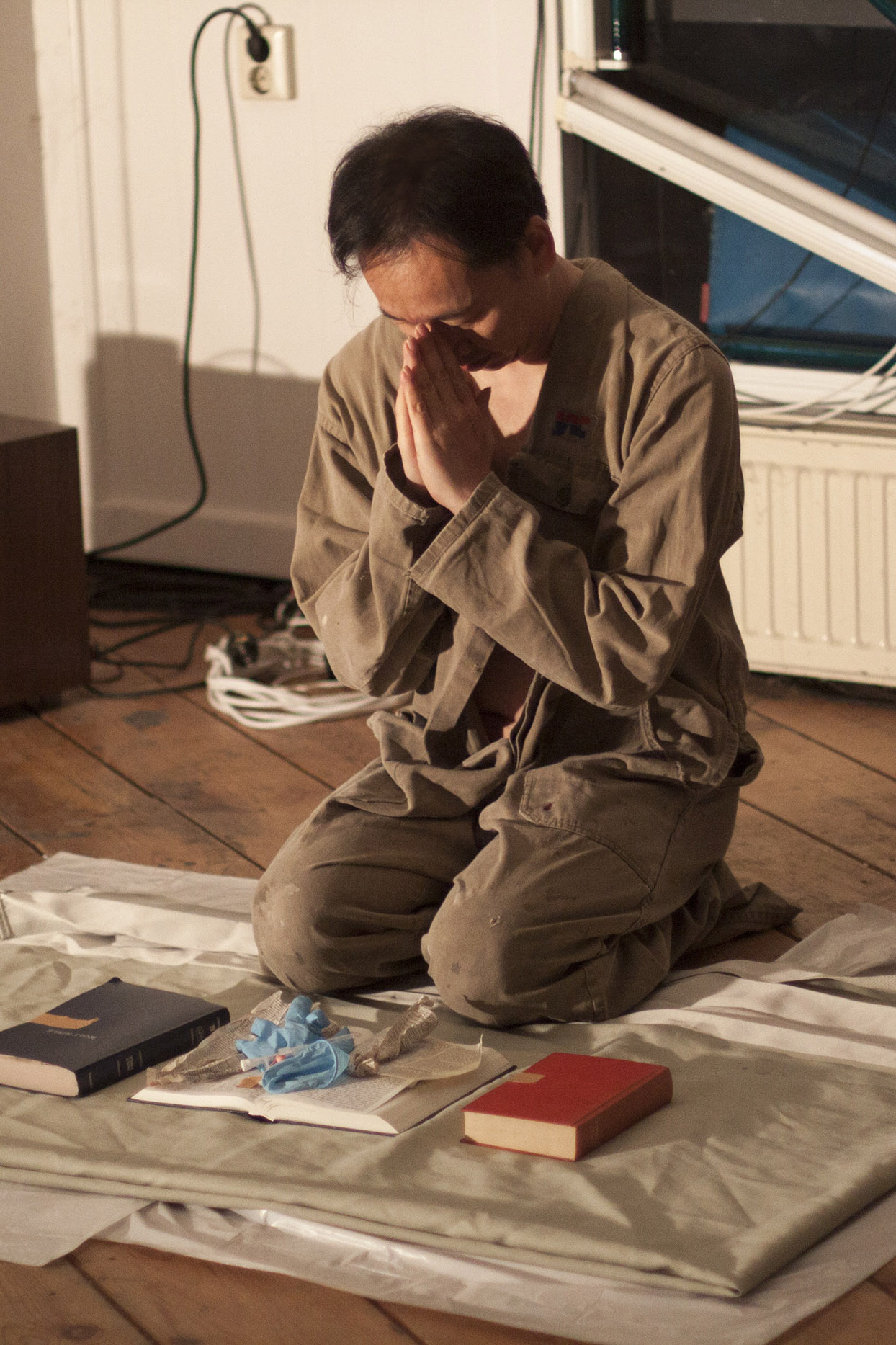
Easter Christmas (2017)'20 Philemon Mukarno

The Body as Sacred Architecture: Decoding Philemon Mukarno’s ‘Easter Christmas’ Nude Performance in the Breda Underground (2017)
Philemon Mukarno, a visionary artist based in Rotterdam, occupies a singular space within the Dutch avant-garde, bridging rigorous academic training in electronic music composition with the intense physicality and spiritual depth of Japanese Butoh dance. His performance work is characterized by an uncompromising aesthetic and a focus on deep spiritual inquiry. At the core of this artistic path lies the utilization of the naked body, presented not as mere spectacle, but as a powerful, raw medium for radical honesty. This report analyzes Mukarno’s 2018 performance, ‘Easter Christmas’, presented within the challenging and boundary-pushing context of the 1m2 Podium bij JAPEN! in Breda, examining how the dual spiritual symbolism of the title and the radical vulnerability of the nude form converge to create a transformative meditation on the self and the cosmos.
Setting the Stage: The Breda Underground and the Aesthetics of Laceration
The 2018 staging of Mukarno’s ‘Easter Christmas’ took place within the context of the ‘JAPEN!’ exhibition, organized by Nick J. Swarth/IDFX and hosted by the Kunst Drift Collectief 2.0 at Galerie Drift, Liniestraat 121, Breda. This setting is crucial, as the performance was situated far outside traditional institutional parameters, embracing the ethos of underground, unconventional art forms.
The Nexus of Critique: Kunst Drift Collectief 2.0 and Galerie Drift
Galerie Drift, managed by the Kunst Drift Collectief 2.0, functions as a critical platform where diverse makers, art institutions, collectors, and the public intersect. The collective is dedicated to advocating for contemporary visual art and everything that borders and touches it. Its mission is not simply to display finished works but to serve as a meeting point where “autonomous expressions and the collective meet and not only clash but also create new possibilities”. This environment, known for hosting alternative initiatives like the BUT Film & BEER Pairing festival initiated by the Idee-fixe (IDFX) foundation, established Breda’s Liniestraat 121 as a space inherently receptive to challenging, boundary-pushing artistic endeavors.
The collective’s emphasis on bringing different expertises together to bring about “an artistic expression” suggests that Mukarno’s involvement was not an isolated event but a targeted collaborative act. His highly structured yet deeply visceral style was perfectly suited to the Collectief’s artistic mandate, which required uncompromising integrity in execution and thematic depth. The venue’s location and philosophical openness provided the essential conditions for a performance that intentionally defies comfortable classification and embraces controversy as a means to higher understanding.
JAPEN! Art as a Spiritual Incision
The overarching curatorial concept for the winter programming was encapsulated in the exhibition title, JAPEN! Kunst als een kerf in je geest, een jaap in je ziel—meaning, Art as a laceration in your spirit, a gash in your soul. This philosophy frames the entire ancillary program, including Mukarno’s performance. The exhibition curator, Nick J. Swarth, explicitly sought artists whose work possessed a necessary “intensity and directness” that compelled viewers “to look beyond the surface”.
The necessity of spiritual laceration—a powerful metaphor for trauma, exposure, and radical self-confrontation—created a causal link to the selection of an artist like Mukarno. His philosophy centers on using the naked body as a site of “spiritual repair and radical honesty”. In this context, the body itself becomes the physical manifestation of the curatorial theme: the required ‘laceration’ necessary for spiritual insight is enacted upon the performer’s own flesh, moving the aesthetic experience from mere observation to an act of internal penetration.
The Logistical Footnote: The 1m2 Podium Ambiguity
The original user inquiry specified Sunday, December 2, 2018, at 3:00 PM. However, the official program for the JAPEN! ancillary events listed the December 2nd time slot as the 1m2 PODIUM dichterspodium, featuring poets like X-Burger Swarth. Mukarno’s performance was officially listed as part of the Presentation ‘Anonymous Glossy’ evening, alongside Lorna Buckley and Lars Reen, on Friday, December 7, 2018, at 8:00 PM. Regardless of the specific moment within the week, the critical context remains firmly established: the performance occurred within the challenging atmosphere of the JAPEN! exhibition’s radical schedule.
The physical constraint of the performance space, the 1m2 Podium (one square meter stage) , is profoundly significant. This spatial limitation emphasizes intensity and concentration. Mukarno’s artistic aspiration is to convey a “monolithic aura” through “great simplicity”. The restriction of the 1m2 Podium forces a distillation of movement and intention, relying purely on the performer’s raw, spiritual presence rather than grand theatrical gestures. This environment perfectly complements his Butoh-composition fusion, where structural rigor meets visceral vulnerability.
Philemon Mukarno: The Cartographer of Consciousness
Mukarno’s artistic identity is defined by a rigorous, unyielding approach to creation. He is often cited as one of the most original Dutch artists of his generation, producing work that is characterized by an immediately recognizable, strong sense of aesthetics and individual style. His performance work is not merely theatrical; it functions as a critical exploration of consciousness itself.
The Butoh-Composition Synthesis
The unique strength of Mukarno’s performance lies in the synthesis of two seemingly divergent disciplines: rigorous academic music composition and the philosophy of Japanese Butoh. Butoh, often referred to as the “Dance of Darkness,” embraces decay, vulnerability, and the grotesque as paths to transcendent expression. When paired with Mukarno’s musical foundation, which mandates “a strong economy of Means and a strict control of Form”, a powerful artistic dialectic emerges.
The precision of his electronic compositions, which is his true calling, provides a formal, structural skeleton. Onto this skeleton, the raw, vulnerable, and often emotionally chaotic energy of Butoh is draped. This tension between control and chaos, between the intellectual rigor of composition and the embodied trauma of the dance, allows him to convey a “high level of excitement and a monolithic aura”. The structure stabilizes the spirituality, while the physicality prevents the structure from becoming merely academic, ensuring the work remains visceral and rooted in raw truth.
Spirituality and the Philosophy of Non-Attachment
Mukarno explicitly positions his artistic practice as being led by “Spirituality and belief in God”. This orientation manifests as a philosophy of non-attachment. He views material tools, such as the computer used for electronic composition, as merely “matter that over time wears out and is destroyed”. He maintains that “art in all its forms remains above all in the interior of people”. The objects are transient; the resulting spiritual experience is permanent.
This deep commitment to non-attachment aligns profoundly with core principles.
For Mukarno, the performance itself is transformed into a “rite of passage”. The act of breaking or discarding a tool, as described in his other work, symbolizes the necessary renunciation of the material means to prioritize the spiritual result. Therefore, ‘Easter Christmas’ is understood not as a fleeting spectacle, but as a publicly enacted ritual—a transformative spiritual discipline mirroring the internal effort required for inner rebirth.
Nudity as Theology: The Sacred Architecture of the Flesh
The use of the naked body in Mukarno’s work is the central instrument through which this spiritual inquiry is conducted. It serves as a tool for emotional vulnerability, societal critique, and profound spiritual connection.
The Naked Body as Raw Medium and Spiritual Conduit
The presentation of nudity in Mukarno’s performance art deliberately transcends eroticism or sensationalism. Instead, the naked body is utilized as a “powerful, raw medium” designed to expose vulnerability and simultaneously transform that vulnerability into strength. This exposure is a kinetic process intended to defy societal norms surrounding the body and to invite the audience into an immediate, profound connection with the performer’s internal world.
This philosophical approach finds resonance in ancient and contemporary performance traditions across the globe. Indian spirituality, for instance, often regards the human body not as obscene, but as a sacred “microcosm” and a tool to reach enlightenment. Mukarno, who bridges Asian heritage with European avant-garde, aligns his work with these traditions, presenting the body as a “conduit to enlightenment”. In this framework, the nakedness symbolizes the sacred nature of the physical being, transforming the performer into a “living, breathing spiritual architecture”.
Radical Honesty and Dismantling the Cultural Self-Image
A core tenet of Mukarno’s aesthetic is the achievement of “radical honesty.” By dismantling the social mask, the nude performance critiques the self-image that is “warped by culture”. The body is viewed as a physical “site—marked by experience, memory, and desire”. When stripped of clothing, the superficial layers of identity are removed, leaving the audience to confront the performer’s unvarnished self. This act is intended as a process of “spiritual repair”.
The radical honesty demanded by the exposed state of the physically confined 1m2 Podium intensified the confrontation for both performer and observer. Furthermore, Mukarno often explores the subconscious elements of the self, referring to this darkness as the “Shadowbody”. Nudity in the context of Butoh allows the performer to access and express these repressed or hidden aspects, ensuring that the performance is a complete integration of the conscious self and the subconscious “Shadowbody.” This commitment to uncompromised truth perfectly manifests the ‘JAPEN!’ curatorial requirement for art to be a painful, yet necessary, laceration in the soul.
The Paradox of ‘Easter Christmas’: Temporal and Spiritual Collision
The title of the work, ‘Easter Christmas’, is a conceptual collision that forces the audience to consider two distinct, yet fundamentally connected, pivotal points in the spiritual and seasonal calendar. The title is the engine of the performance’s esoteric meaning.
Deconstructing the Title: Opposing Cycles
The dual holidays represent opposing cyclical movements:
Easter Symbolism: Easter is one of the most significant celebrations in Christianity, marking the resurrection of Jesus Christ and the affirmation of eternal life. It coincides with the Spring Equinox in the Northern Hemisphere, symbolizing the ascendancy of light over shadow and the arrival of renewal, hope, and new beginnings. It is traditionally associated with the external, palpable rebirth of nature and the spirit.
Christmas Symbolism: Christmas is celebrated near the Winter Solstice, the culminating point of the cold season when the night is longest. While marking a birth, it traditionally represents the moment of inner, spiritual rebirth. This inner rebirth is described as requiring difficult spiritual discipline, renunciation, and acceptance during the darkest part of the year.
By juxtaposing these two holidays, Mukarno collapses the entire yearly liturgical and seasonal cycle into a single, intense moment. The performance demands the embodiment of the full spiritual trajectory—the descent into darkness and incubation (Christmas/Winter) followed by the transformative triumph and renewal (Easter/Spring). The title implies a spiritual state that exists outside of linear time, constantly cycling between death, waiting, and resurrection.
The December Timing: Incubation and Anticipation
The staging of ‘Easter Christmas’ in early December 2018 is highly significant. This date falls squarely within the deep winter incubation period, prior to the Solstice and the beginning of the slow return of light. The performance occurred when the external world was submitting to cold, darkness, and decay—the “cold season”.
This temporal context magnifies the central tension of the performance. The performance must manifest the strenuous internal preparation—the renunciation and acceptance associated with winter—while simultaneously holding the promise and energy of external triumph (Easter) within the body. The performance, therefore, becomes a meditation on the grueling spiritual labor required before transformation occurs. The exposed, vulnerable body in the intimate Breda underground space physically represents this ascetic struggle, where the body, the sacred microcosm, is pushed to its limits in preparation for an eventual, internal resurgence.
Analytical Synthesis: The Monolithic Aura and Performance as Transcendence
Mukarno’s work, particularly ‘Easter Christmas’ in the context of the JAPEN! exhibition, represents a powerful convergence of philosophical intent, spatial rigor, and embodied spiritual practice.
The Uncompromising Aesthetic and the Role of Stillness
Mukarno’s reputation rests on his “utterly uncompromising” style, which generates a “monolithic aura”. This effect is amplified, paradoxically, by the simplicity and small scale of the 1m2 Podium. When confined to a single square meter, any unnecessary movement or distraction is eliminated, focusing the audience’s perception entirely on the performer’s internal state.
The monolithic quality arises from the intense spiritual concentration achieved within the body, the sacred microcosm. By treating the physical form as monumental architecture, the performance projects gravity that far exceeds the physical limitations of the space, contrasting sharply with the expectation of massive scale often associated with avant-garde performance art. This uncompromising focus transforms the act of viewing into a shared, highly intimate ritual of exposure and confrontation.
The Influence of Sound and Silence
As a musical composer specializing in electronic composition , Mukarno’s sonic environment is an inseparable element of his work, even when the visual focus is on the body. The soundscape for ‘Easter Christmas’ would not have been merely an accompaniment, but a formal structure for the spiritual rite. His characteristic reliance on “strict control of Form” and “economy of Means” suggests that the electronic elements were utilized to frame the raw, visceral movements of the Butoh body.
The sound would serve as the container of spirituality and technicality , using precise sonic architecture to guide the audience through the emotional stages of death, decay, and spiritual anticipation inherent in the ‘Easter Christmas’ paradox. The intentional use of silence or highly abstract electronic textures would amplify the meditative and vulnerable state of the naked body, transforming the 1m2 Podium into a temple where the performer’s internal journey is made audible.
The Transformative Power of the Unveiled Self
Ultimately, ‘Easter Christmas’ at the 1m2 Podium bij JAPEN! served as a critical embodiment of the exhibition’s mandate. Mukarno used the body to create the necessary “kerf” or laceration in the spiritual perception of the audience. The performance transcended the visual, becoming an act of radical honesty that transformed vulnerability into an undeniable, monolithic strength. By synthesizing Eastern spiritual disciplines with Western compositional rigor, Mukarno successfully positioned the unveiled self as the ultimate site for both societal critique and profound, uncompromised spiritual inquiry.
Legacy and Archival Significance
Philemon Mukarno’s ‘Easter Christmas’ represents a vital point of intersection for contemporary European performance art, Butoh, and electronic composition. The work provides a complex, multilayered analysis of human spirituality articulated through the extreme vulnerability of the naked body.
The endurance of such experimental, ephemeral work, particularly those staged in intimate, underground venues like the 1m2 Podium at the Kunst Drift Collectief 2.0, depends heavily on rigorous archival and documentation efforts. The uncompromising nature of the performance—its focus on the sacred microcosm and its radical honesty—establishes Mukarno as an artist who uses the body as a primary vehicle for achieving transcendent spiritual communication. This dedication ensures that ‘Easter Christmas’ stands as a pivotal example of Dutch avant-garde practice, maintaining the tradition of challenging and essential performance that uses ritual and exposure to achieve profound, lasting spiritual resonance.
The conceptual framework of ‘Easter Christmas’ relies on the paradox inherent in its title:
The ‘Easter Christmas’ Paradox in Mukarno’s Spiritual Framework
Thematic Axis Easter Symbolism (Renewal) Christmas Symbolism (Incubation) Synthesis in Mukarno’s Nude Performance
Spiritual Cycle
Resurrection, Triumph over Death, External Rebirth
Birth, Winter Solstice, Inner Rebirth, Renunciation
The performance enacts the full cyclical discipline, showcasing the transformative cycle necessary for inner freedom.
The Body’s Function
Vulnerability transformed into Strength; Sacrifice for Salvation
Sacred Microcosm; Conduit to Enlightenment; Embracing the Shadow
The naked self is the locus of spiritual repair, manifesting uncompromising honesty and monumental spiritual gravity.
Aesthetic Goal
Exposing Raw Truth; Challenging societal image
Non-attachment to the material; Economy of Means







Share this:
- Share on Facebook (Opens in new window) Facebook
- Share on X (Opens in new window) X
- Share on LinkedIn (Opens in new window) LinkedIn
- Share on Tumblr (Opens in new window) Tumblr
- Share on Reddit (Opens in new window) Reddit
- Share on Mastodon (Opens in new window) Mastodon
- Share on Threads (Opens in new window) Threads